Amazon Manager Salary Breakdown
Wondering if becoming a manager at Amazon is actually worth it — or just a fast track to more meetings and bigger headaches? Let’s talk numbers and unpack what “Amazon manager salary” really means once you factor in base, stock, bonuses, and level.
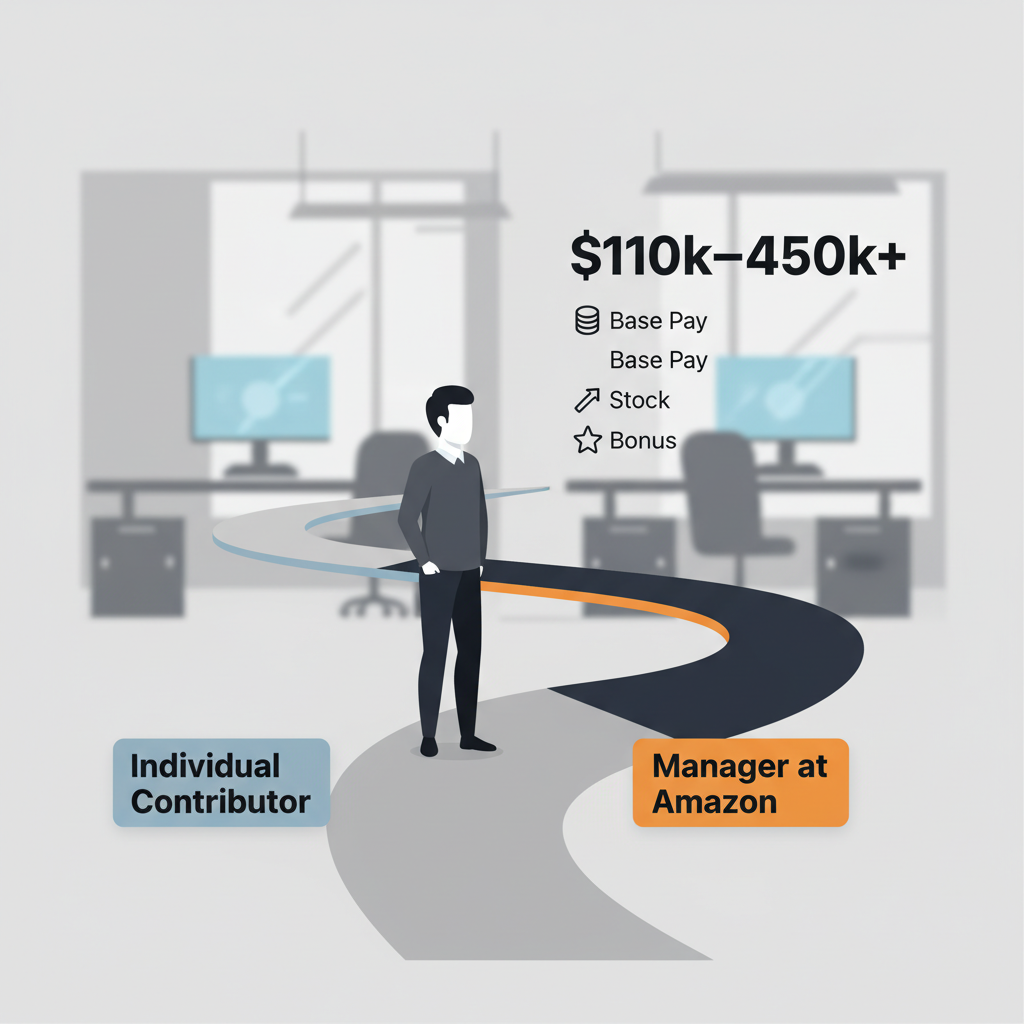
Amazon manager paths: how base pay, stock, and bonuses stack up across levels.
Quick Snapshot: How Much Do Amazon Managers Make?
In the U.S., most Amazon manager roles (think operations managers, area managers, product managers, program managers, etc.) fall into a few broad pay ranges:
- Early-career managers (L5-ish): ~$110,000–$180,000 total compensation
- Mid-level managers (L6): ~$160,000–$260,000+ total compensation
- Senior managers (L7): often $250,000–$450,000+ total compensation
Those ranges include base salary + stock + bonuses. Base pay alone will usually be noticeably lower than the total package.
Now let’s zoom in by role.

Inside the fulfillment center: where many Amazon managers start their careers.
Types of Amazon Manager Roles (And Typical Pay Ranges)
These are broad U.S. market ranges based on typical industry data and public compensation reports as of 2025. Real offers can land higher or lower depending on city, team, performance, and negotiation.
1. Area Manager (Fulfillment / Operations)
This is one of the most common entry management roles in Amazon fulfillment centers.
- Who this is: Front-line people managers in warehouses / fulfillment centers.
- Typical level: Often L4 or L5.
- Estimated base salary:
- L4: around $55,000–$75,000
- L5: around $70,000–$95,000
- Estimated total compensation (with bonuses/stock):
- Roughly $65,000–$120,000+, depending on level and site.
- Schedule may include nights, weekends, and holidays.
- Compensation is solid for early career, but the work can be physically demanding and high-pressure.
2. Operations Manager / Senior Operations Manager
These roles oversee larger portions of fulfillment center operations.
- Who this is: Managers over multiple teams or entire departments in a facility.
- Typical level: L6 (Ops Manager), L7 (Senior Ops Manager).
- Estimated base salary:
- L6: $95,000–$145,000
- L7: $135,000–$190,000+
- Estimated total compensation:
- L6: roughly $130,000–$220,000+
- L7: $220,000–$350,000+
- A big chunk of upside often comes from Restricted Stock Units (RSUs) that vest over time.
- Performance expectations and stress can rise sharply with each level.
3. Program Manager / Project Manager
Program and project managers exist across Amazon (Retail, AWS, Logistics, etc.). Pay varies heavily by org and level.
- Typical level: L5–L6; senior roles at L7.
- Estimated base salary:
- L5: $90,000–$135,000
- L6: $120,000–$165,000
- Estimated total compensation:
- L5: $120,000–$190,000+
- L6: $160,000–$260,000+
What changes by team?
- AWS and core tech orgs often pay on the higher side.
- Some non-tech or corporate roles are at the lower end of these ranges.
4. Product Manager (Tech)
Product managers (PMTs / PMs on tech teams) are some of the higher-paid managers outside of pure engineering.
- Typical level: L5–L7.
- Estimated base salary:
- L5: $120,000–$155,000
- L6: $145,000–$185,000
- Estimated total compensation:
- L5: $160,000–$240,000+
- L6: $200,000–$320,000+
- L7: can climb to $350,000–$500,000+, depending on team.
Why the higher pay?
- PMs directly influence revenue, product strategy, and roadmap.
- They typically sit in high-leverage orgs (especially in AWS and other core businesses).
5. People Manager in Tech (Engineering Manager)
Not every engineering manager has “manager” in the title (some are called Software Development Manager, for example), but these are true people managers over engineers.
- Typical level: L6–L7.
- Estimated base salary:
- L6: $160,000–$200,000+
- L7: $190,000–$240,000+
- Estimated total compensation:
- L6: often $230,000–$350,000+
- L7: commonly $350,000–$550,000+ or more.

As scope and level rise, so do both the compensation — and the dashboards you’ll live in.
How Amazon Manager Pay Is Structured
An “Amazon manager salary” is rarely just one number. Here’s what actually goes into your pay.
1. Base Salary
This is your guaranteed yearly cash compensation.
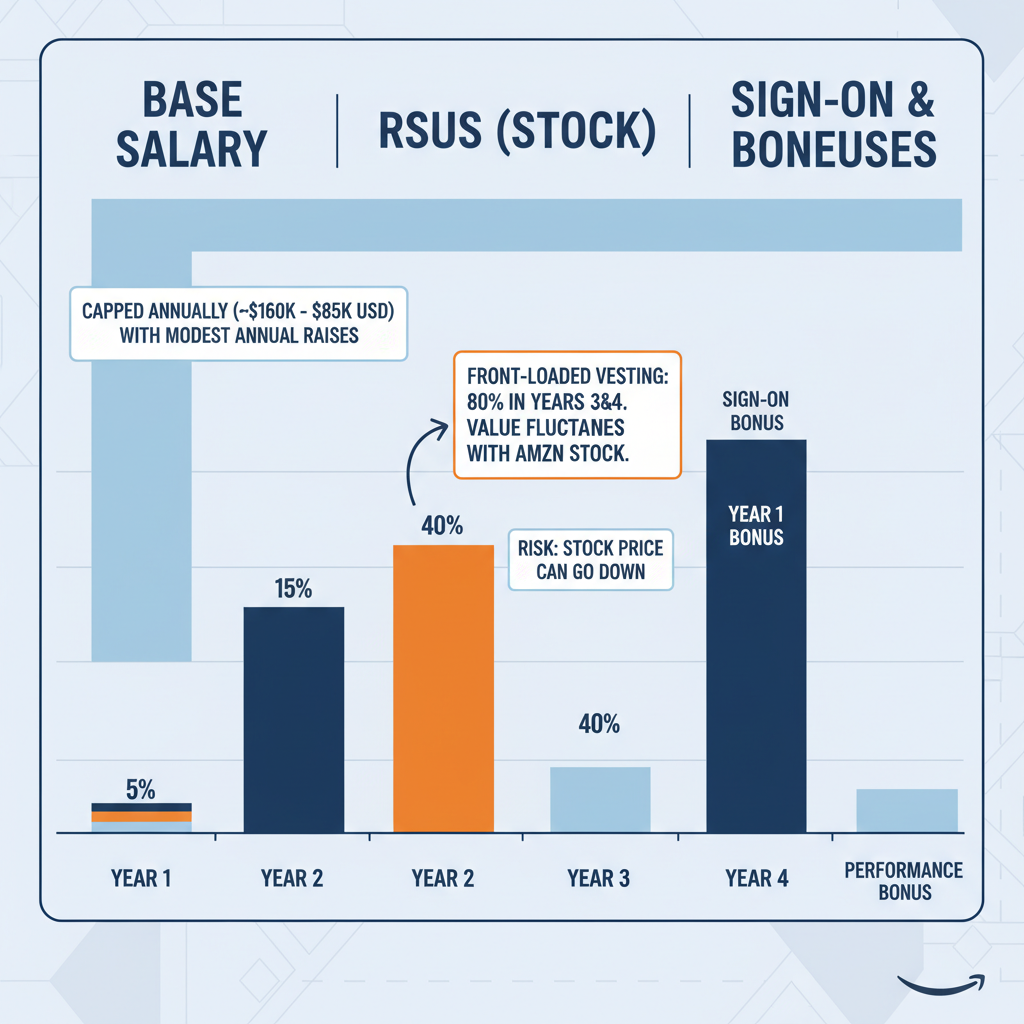
- Amazon is known for capping base salaries (and using stock to make up the difference).
- The exact cap moves over time and can differ by region, but the idea is consistent: once you hit that cap, extra value comes in stock, not base.
2. Restricted Stock Units (RSUs)
RSUs are a huge part of total compensation for managers, especially from L5 and up.
- You get a grant of Amazon stock as part of your offer.
- It vests over several years (commonly a front-loaded schedule, e.g., 5% / 15% / 40% / 40% of the total grant across years 1–4).
- The real value depends on Amazon’s stock price when it vests.
Example:
- You’re granted $120,000 in RSUs when hired.
- If it vests over 4 years and the stock price remains stable, that’s about $30,000/year on average.
- But if the stock goes up or down significantly, your realized pay changes.
3. Bonuses
Not every manager role gets large cash bonuses, but many do, especially in operations and higher levels.
- Sign-on bonuses: Common in the first 1–2 years to offset lower RSU vesting in those years.
- Performance bonuses: Less central than stock, but may exist for some teams/levels.

Base salary is the floor — stock grants and sign-on bonuses are where Amazon’s offers get interesting.
What Affects Your Amazon Manager Salary the Most?
1. Level (L4–L8+)
Everything at Amazon is anchored to job level:
- L4–L5: Entry to mid-level managers (area manager, some program managers).
- L6: Experienced managers, senior ICs stepping into big scope.
- L7: Senior managers, senior product/program/ops leaders.
- L8+: Directors and up — a completely different game.
Level often matters more than your exact job title.
2. Location
Total compensation heavily depends on whether you’re in:
- A high-cost tech hub (Seattle, Bay Area, NYC)
- A mid-cost city
- A lower-cost fulfillment center region
Even for the same level, a Seattle L6 PM will usually out-earn a small-city L6 ops manager.
3. Organization (AWS vs. Non-Tech vs. Ops)
- AWS / core tech: Often higher ranges, especially for PMs, Eng Managers, and senior ICs.
- Consumer / retail / corporate functions: More mixed, but still competitive.
- Fulfillment / logistics: Strong comp for local markets, but usually below top-end tech comp.
4. Performance and Refreshers
Over time, your RSUs can be “refreshed” based on performance.
- High performers are more likely to receive additional equity grants.
- This can significantly boost total comp in later years, beyond the initial offer.
Program, product, and engineering managers: different flavors of leadership, very different pay ceilings.
Is Being a Manager at Amazon Worth It Financially?
It depends what you’re comparing it to.
It’s often worth it if:
- You’re coming from lower-paying industries (traditional retail, non-tech corporate, smaller companies).
- You’re early in your career and want brand-name experience on your resume.
- You’re in or near a fulfillment center area where local averages are much lower.
You’ll want to think twice / negotiate hard if:
- You’re already in Big Tech or working at a FAANG/MANGA peer.
- You’re moving to a high-cost city and the offer doesn’t reflect that.
- The stock-heavy package feels risky to you.
Non-financial reality:
- Amazon is known for being fast-paced, metric-driven, and demanding.
- Some people thrive in that environment; others burn out.

High pay, high intensity vs. lower stress, lower upside — knowing your tradeoffs is part of evaluating the offer.
How to Evaluate an Amazon Manager Offer (Step-by-Step)
If you get an offer, don’t just stare at the base salary. Do this instead:
Step 1: Calculate 4-Year Total Compensation
-
Add up:
- Base salary × 4 years
- All sign-on bonuses
- Estimated value of RSUs (using a conservative stock price)
-
Divide by 4 to estimate an average annual comp.
This smooths out Amazon’s lumpy structure (small vesting early, heavy later).
Step 2: Compare Against Market
Look at:
- Similar level and role at other big tech or large companies.
- Your location (Seattle pay vs. midwest pay are two different planets).
If your average annual total comp is far below peers, you have a strong case to negotiate.
Step 3: Adjust for Lifestyle and Risk
Ask yourself:
- Do I want this pace of work?
- Can I handle operations-style hours (if it’s a warehouse/fulfillment role)?
- Am I comfortable with stock price risk?
Step 4: Negotiate (Within Reason)
At Amazon, you’ll typically have more leverage on:
- Sign-on bonuses
- RSU grants
Base salary is more constrained due to internal caps, but modest bumps are sometimes possible.
Don’t just look at Year 1: Amazon comp is designed as a four-year story.
Example Scenarios (So This Feels Real)
- Role: L4 Area Manager at a fulfillment center in the Midwest
- Base: $65,000
- Sign-on: $10,000 (Year 1 only)
- RSUs: Small grant worth ~$15,000 over 4 years
Year 1 total: ~$65,000 + $10,000 + ~$3,000 in stock ≈ $78,000
Not bad for early-career, especially in a lower-cost area. The tradeoff: intense hours and physical environment.
- Base: $145,000
- Sign-on: $30,000 Year 1, $20,000 Year 2
- RSUs: $160,000 over 4 years
Average annual total comp:
- Base: $145,000 × 4 = $580,000
- Sign-ons: $50,000 total
- RSUs: $160,000
- 4-year total ≈ $790,000 → about $197,500/year on average (before tax).
That’s highly competitive — but remember, this comes with Seattle’s cost of living and a demanding role.
- Base: $195,000
- Sign-on: $60,000 Year 1, $40,000 Year 2
- RSUs: $400,000 over 4 years
Rough math:
- Base (4 years): $780,000
- Sign-ons: $100,000
- RSUs: $400,000
- 4-year total ≈ $1.28M → about $320,000/year on average.
This is where Amazon manager salaries start to compete with other top-of-market tech comp, especially if the stock performs well.
Run the math across four years — that’s the real picture behind any Amazon manager offer.
How to Increase Your Odds of a Higher Amazon Manager Salary
If you’re aiming for the top of the range:
- Target the right orgs. Tech and AWS PM / Eng Manager roles tend to pay more than non-tech or purely internal roles.
- Optimize for level first. Getting hired at L6 instead of L5 can be a massive compensation difference.
- Come armed with competing offers. Other offers give you leverage, especially from comparable employers.
- Push on equity and sign-on. Those are often more flexible than base.
- Highlight scope and impact. Show experience owning large teams, big budgets, or mission-critical projects.
Level, org, and scope of impact are three of the biggest levers on your Amazon manager pay.
Final Thoughts: So… Should You Chase an Amazon Manager Role?
If your main question is “What is an Amazon manager salary, really?” the short answer is:
- It often ranges from low six figures for early managers to mid/high six figures for senior managers — with a big chunk in stock.
- Pay is competitive, especially in tech orgs and higher levels.
- The tradeoff is usually intensity: high expectations, metric-driven culture, and real ownership.
If you want brand-name experience, serious earning potential, and you’re okay with a demanding environment, an Amazon manager role can be a powerful move.
If you want calm, predictable 9–5 with minimal stress… you might want to keep scrolling.
Either way, now you can read an offer letter and actually understand what you’re looking at — which, honestly, is half the battle.
Leave a Reply