Is L4 Really The Lowest At Amazon?
If you’re staring at an Amazon offer letter with “Level 4” on it and wondering, “Wait… is L4 the lowest level at Amazon? Did they just lowball me?”, you’re not alone.
Let’s unpack how Amazon levels actually work, what L4 really means, and whether you should be offended, excited, or somewhere in between.

Quick Answer: Is L4 the Lowest at Amazon?
No, L4 is not the absolute lowest level at Amazon.
Amazon’s job levels (for corporate roles) generally start around L1–L3 for hourly or entry-level roles (like warehouse associates or some support positions) and then move into L4+ for corporate/tech positions.
So:
- For corporate/tech tracks, L4 is usually the first rung of the professional ladder.
- Across all of Amazon (including fulfillment centers, support, seasonal roles), there are levels below L4.

How Amazon Levels Work (Big Picture)
Think of Amazon’s leveling system as a company-wide language for:
- Scope and impact
- Expectations
- Compensation bands
- Career progression
Very simplified, the most common levels look like this:
- L1–L3: Hourly, operations, or very entry-level roles (e.g., fulfillment center associates, some support roles).
- L4: Junior engineer / entry-level professional (SDE I, business analyst, some program managers, etc.).
- L5: Mid-level (SDE II, PM II, area manager II, etc.). Often considered the “solid, independent” level.
- L6: Senior-level roles (Senior SDE, Senior PM, Ops Manager, etc.).
- L7+: Principal, Director, VP, and so on.
Each level has defined expectations for:
- Ownership (what size of problems you own)
- Autonomy (how much direction you need)
- Impact (team-level vs org-level vs company-level)

What Is an L4 at Amazon, Really?
Depending on the org, an L4 might map to titles like:
- Software Development Engineer I (SDE I)
- Data Analyst / Business Analyst I
- Program Manager I / Product Manager I
- Area Manager (Ops)
If you’re coming from school or with 0–2 years of experience, L4 is designed for you.
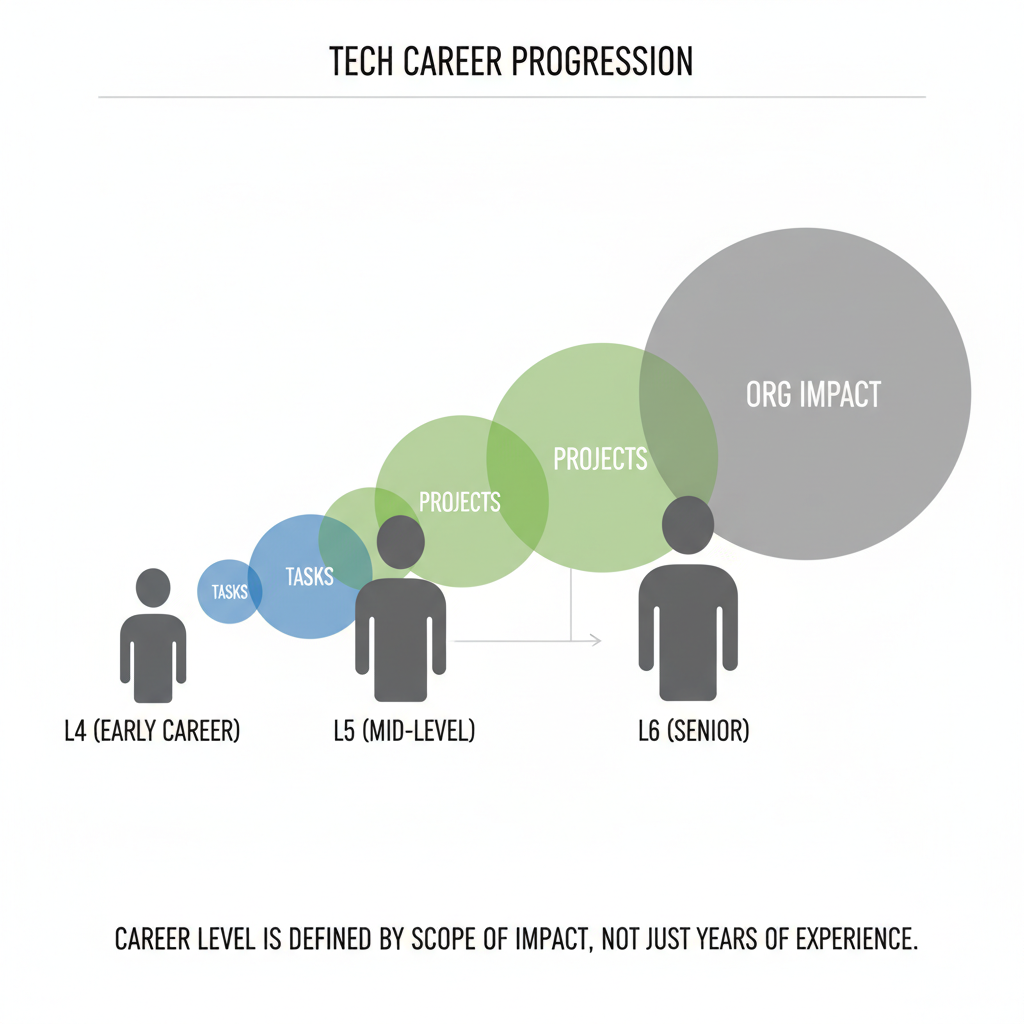
At L4, Amazon expects you to:
- Execute clearly scoped tasks or projects
- Learn Amazon’s systems, tools, and leadership principles
- Need some guidance, but not hand-holding on everything
- Show potential to grow into L5 within a few years
Think of L4 as: “We believe you can be dangerous with the right support, but you’re not fully independent yet.”
So Why Do People Say L4 Is ‘Low’?
Because context matters.
On the tech / corporate ladder, most people talk about:
- L4 → new grad / early career
- L5 → standard/mid-level
- L6 → senior
So when someone says, “They lowballed me at the lowest level,” they often mean:
“They hired me in at the lowest level for my job family, not the lowest level in the entire company.”
Examples:
- Many experienced engineers aim for L5 (SDE II) as their first Amazon role.
- Someone coming from 4–6 years at another big tech company might feel L4 is misaligned with their experience.

What Level Should You Be? (Rough Guide)
This varies by team and region, but here’s a rough, non-official guideline for tech roles like SDE:
- New grad / 0–1 year experience: L4 (SDE I)
- 2–4 years solid experience: Often L5 (SDE II) territory, depending on interview performance and scope at previous jobs
- 5–8+ years, with strong impact and mentorship/leadership experience: L6 (Senior SDE) is possible
For non-tech roles (PM, BA, Ops), the mapping is similar: L4 is early-career, L5 is solid mid-level, L6 is senior.
If you have:
- Internships + 0 full-time years → L4 is expected.
- 3–5 years of real, relevant experience and major wins → You can reasonably ask why you’re not L5.
Is L4 at Amazon Bad for Your Career?
Short answer: No. But you should be intentional about what you want from it.
Upsides of joining as L4:
- You get into Amazon’s ecosystem (brand name, internal mobility, big systems exposure).
- Expectations are somewhat lower than L5, giving you room to ramp.
- You can learn Amazon’s standards, tools, and culture without having to immediately perform at a mid-level or senior bar.
Potential downsides:
- Slower comp growth vs. starting at L5.
- It may take 2–3 years (or more) to get promoted to L5, depending on team, manager, business climate, and your performance.
- If you already are mid-level at another FAANG-type company, you might be temporarily stepping back.
Real use case #1:
A new grad SDE joins Amazon as L4, ships a ton of features, gets strong performance reviews, and is promoted to L5 in ~2 years. Their resume now says: “Amazon SDE II” and that unlocks future L5+ offers elsewhere.
Real use case #2:
A person with 4–5 years at a smaller startup joins Amazon as L4, feels under-leveled compared to peers, and has to spend time “re-proving” themselves. They later negotiate hard for L5 at their next company using their actual responsibilities, not just title.
How to Tell If You’re Under-Leveled at Amazon
Some questions to ask yourself:
1. Years of experience vs. expectations
- Do you already independently drive projects end-to-end?
- Have you mentored others, set technical direction, or owned critical systems?
2. What were you doing before?
If you were essentially doing L5-level work at another big tech company (or equivalent), L4 might be a step back.
3. What did the interview loop target?
- Recruiters often explicitly say, “We’re interviewing you for L4” or “for L5.”
- If you thought you were being evaluated for L5 and got L4, ask for feedback.
4. Compare scope, not just titles.
Titles across companies don’t match. Focus on:
- Size of projects
- Autonomy
- Decision-making power

Can You Negotiate Level at Amazon?
Sometimes, yes — but it’s not easy.
Level is usually locked in based on:
- Your resume and background
- Performance in interviews
- Internal calibration vs. Amazon’s bar for each level
What you can push on:
1. Ask directly about level rationale.
“Can you help me understand why this is at L4 instead of L5, given my X years and Y responsibilities?”
2. Provide concrete evidence.
Examples: owning critical systems, leading major launches, managing other engineers/PMs, setting technical direction.
3. If level won’t move, negotiate compensation.
Even if they won’t bump you to L5, you can sometimes improve:
- Base salary (within band)
- Sign-on bonus
- RSU grant size
4. Ask about promotion timelines.
“What does it typically take for someone to go from L4 to L5 on this team? What’s realistic?”
If the recruiter is firm that the level is non-negotiable, you still have options:
- Take the L4 and treat it as a 1–3 year stepping stone.
- Decline and continue interviewing where you can land directly at your target level.
When Saying Yes to L4 Makes Sense
You might seriously consider accepting an L4 offer if:
- You’re early in your career (0–3 years experience).
- You’re switching fields (e.g., non-tech → tech, or non-FAANG → FAANG) and need a “reset.”
- The role gives you high learning potential: great team, strong leaders, exposure to systems and scale you’ve never seen before.
- The comp is competitive for your location and life needs.
- You have a plan: “Join → crush it → L5 in ~2 years → reassess internally/externally.”
When You Might Push Back on L4
You might push harder (or walk away) if:
- You have 4–7+ years of relevant experience and clear mid-/senior-level scope already.
- You’re currently titled or leveled as mid/senior at another big, reputable company.
- Other companies are already offering you roles equivalent to L5 or above.
- The L4 comp is a significant step down from what you reasonably command.
Not every under-leveling situation is malicious — sometimes Amazon is just being cautious. But your career is yours to protect.
Final Thoughts: Is L4 ‘Lowest’? Should You Take It?
Let’s land this plane.
- Is L4 the lowest level at Amazon? No. There are levels below it. But L4 is the entry point for most corporate/tech career tracks.
- Does L4 mean you’re not good? Also no. It means Amazon sees you as early-career or still ramping to full autonomy.
- Can L4 be a great move? Absolutely — especially if you’re earlier in your journey, switching industries, or optimizing for learning and brand.
- Should you always accept L4? Not blindly. Compare your experience, other offers, growth trajectory, and how much the Amazon brand + experience matters for your long-term goals.
If you want, I can help you:
- Compare a specific L4 offer vs. your current role or another offer
- Draft an email to your recruiter asking about level or promotion expectations
- Break down whether your background is closer to L4 or L5 expectations
Your level is just the starting point. What you do with it is the part that actually writes your career story.
Leave a Reply