Amazon Area Manager Pay Explained

Late-night job board scrolling and wondering if the Amazon Area Manager paycheck really matches the pressure.
If you’ve ever scrolled through job boards late at night wondering, “Is being an Amazon Area Manager actually worth it?”, you’re not alone.
It’s one of those roles that sounds impressive on LinkedIn, comes with leadership responsibility early in your career, and—let’s be honest—you really want to know if the paycheck matches the pressure.
Let’s break down Amazon Area Manager pay in plain English: base salary, bonuses, stock, shift differentials, and what people actually take home.

Inside a high-volume fulfillment center, where Area Managers live at the intersection of people, safety, and performance metrics.
What Is an Amazon Area Manager, Really?
Amazon Area Managers are front-line leaders in fulfillment centers, sort centers, and delivery stations. They typically:
- Lead a team of 20–50+ hourly associates
- Manage safety, quality, and productivity on their shift
- Work on performance metrics (think: units per hour, error rates, on-time rates)
- Handle scheduling, coaching, and sometimes tough conversations
Most Area Managers are entry-level to early-career leaders. Many come in through Amazon’s college or university hiring pipeline (often called Level 4 or L4 Area Manager roles), but others transition from operations, logistics, or the military.
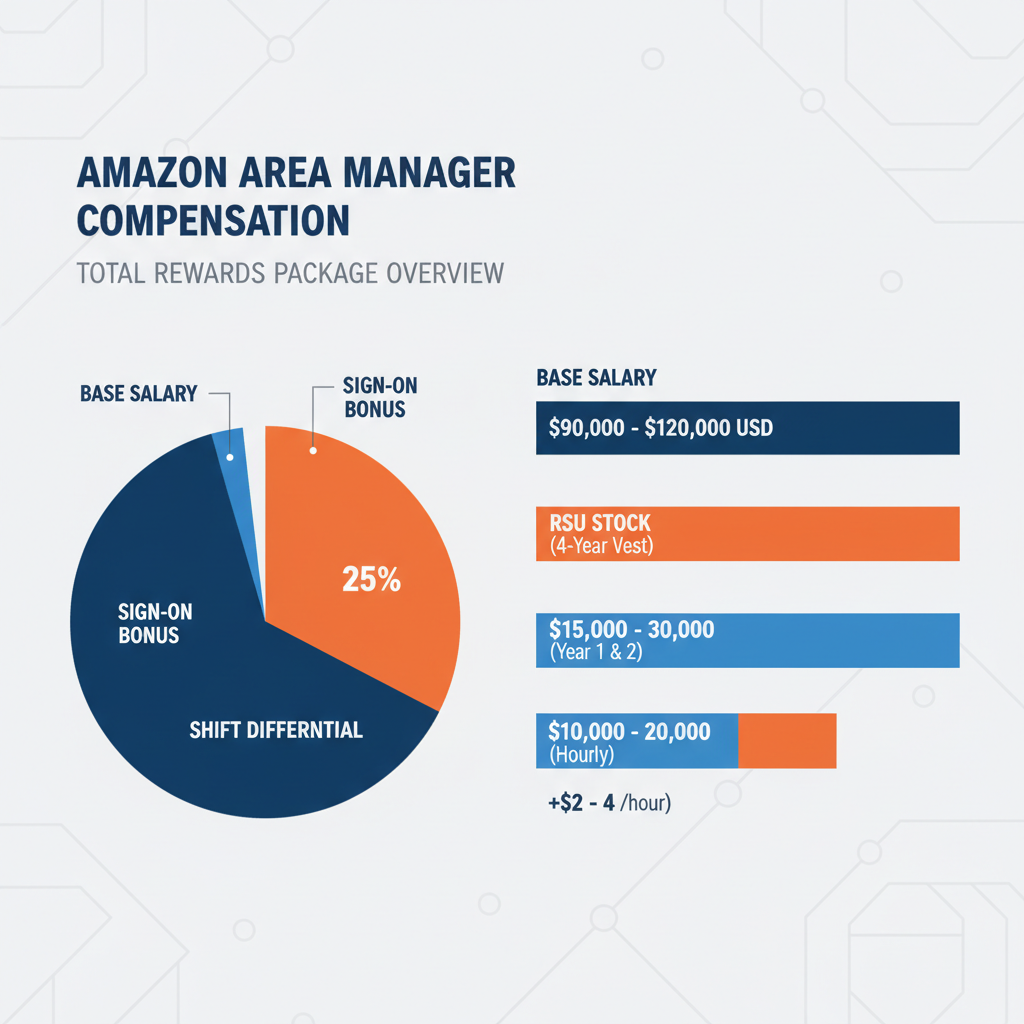
Compensation for Amazon Area Managers isn’t just one number—it’s a stack of base pay, bonuses, and stock.
How Much Does an Amazon Area Manager Make?
Let’s talk numbers.
Exact compensation can vary by location, shift, level (L4 vs L5), and experience, but here’s a realistic, U.S.-based snapshot using typical ranges gathered from common public data like Glassdoor/Indeed-style reports and anecdotal offers reported by candidates.
1. Base Salary
For an L4 Area Manager in a U.S. fulfillment or sort center, you’ll often see:
- Base salary: roughly $60,000 – $75,000 per year in many markets
- In higher-cost markets (California, New York, Seattle, major metros): often $70,000 – $85,000+
If you move up to L5 (Operations Manager / Sr. Area Manager-type roles), base can jump to around:
- $80,000 – $110,000+, depending on market and experience
These are ballpark ranges, not guaranteed numbers, but they’re a good starting frame.
2. Sign-On Bonuses
Amazon is famous for using sign-on bonuses to boost early-year compensation while long-term stock vests.
Typical patterns for Area Manager offers (especially for university hires) often look something like:
- Year 1 sign-on: a few thousand up to the mid-teens (e.g., $5,000 – $20,000), depending on location and level
- Year 2 sign-on: sometimes a smaller or second sign-on bonus
These are one-time or two-time payments, not permanent, so you shouldn’t treat them as recurring salary—but they do make your first year or two more lucrative.
3. Stock Compensation (RSUs)
Another big piece of Amazon Area Manager pay is stock (Restricted Stock Units, or RSUs).
For L4 managers, it’s common to see:
- A grant of Amazon stock that vests over 4 years
- Often backloaded (e.g., 5% in year 1, 15% in year 2, 40% in year 3, 40% in year 4 on some Amazon comp plans in the past)
The exact value will depend heavily on:
- The number of RSUs granted
- Amazon’s stock price over time
Practically, in many offers you’ll see an estimated annual stock value of a few thousand dollars per year when averaged over the 4-year vesting period. For L5 or higher, stock can become a much more significant part of compensation.
4. Shift Differential & Overtime Factors
Here’s where it gets interesting.
Many Amazon facilities run 24/7, and Area Managers often work non-traditional shifts:
- Nights
- Weekends
- “Front half” or “back half” (e.g., Sun–Wed or Wed–Sat)
While salaried managers typically don’t earn overtime, some locations and roles may include:
- Shift differentials for nights/graveyard shifts
- Extra stipends or incentives depending on site and shift
Unlike hourly associates, salaried Area Managers usually do not receive traditional overtime, even when working 45–55+ hours during peak periods.

When you stack base pay, bonuses, and stock together, you get a clearer picture of what Amazon is really offering.
Example: What Does Total Compensation Look Like?
Let’s run a hypothetical example for an L4 Area Manager in a mid-cost U.S. city:
- Base salary: $70,000
- Year 1 sign-on bonus: $10,000
- Estimated stock (averaged per year over 4 years): $3,000
Year 1 total comp (approximate):
- $70,000 (base)
- + $10,000 (sign-on)
- + $3,000 (stock value)
- = $83,000 total compensation
Year 3 total comp (once more stock is vested, but no sign-on):
- $70,000 (base; maybe a bit more with raises)
- + $6,000–$8,000 (if more stock is vesting in those years)
- = mid/high $70Ks to low/mid $80Ks equivalent, depending on raises and stock price
These numbers can be higher in big, expensive markets or at L5.

Office job vs ops leadership: similar earnings in some markets, but very different day-to-day reality.
How Does Amazon Area Manager Pay Compare to Other Jobs?
If you’re comparing offers, here’s how this role often stacks up:
Versus Typical Entry-Level Corporate Office Roles
Think: generic coordinator, analyst, or junior specialist roles.
- Many entry-level office jobs in mid-cost areas land in the $50K–$65K base range.
- Amazon Area Manager base tends to be slightly higher than that in many markets, especially when combined with bonuses and stock.
Versus Other Operations / Warehouse Leadership Jobs
At competitors (logistics companies, other e-commerce players, big-box retailers):
- Front-line supervisor roles may hover around $55K–$70K base.
- Amazon is often competitive or slightly higher, especially with sign-ons and stock.
Versus Staying Hourly and Working Tons of Overtime
Some people debate: stay as an hourly associate with overtime vs move into salaried management.
- Hourly + heavy overtime can sometimes match or exceed a new manager’s effective hourly rate, especially during peak.
- But manager roles typically offer faster career progression and more transferable experience.

The paycheck comes with trade-offs—especially around nights, weekends, and mental bandwidth.
The Trade-Offs: Pay vs. Work-Life Balance
Let’s be honest: the money isn’t the only part of the deal.
Hours & Schedule
Area Managers commonly report:
- 45–55+ hours per week, especially during peak seasons
- Non-traditional days off (your “weekend” might be Tue/Wed)
- Holidays and peak periods being all hands on deck
Stress & Responsibility
You’re responsible for:
- Meeting aggressive performance metrics
- Handling safety issues and incidents
- Coaching and sometimes disciplining team members
- Managing constant changes in volume and priorities
It can be energizing if you love ops, but draining if you expected a chill management job.
Career Growth
On the plus side:
- Strong performers can move into L5 Operations Manager roles
- Some transition into program management, HR, supply chain, or corporate roles
- Military veterans often find it a solid “first civilian role” that leverages leadership experience
To negotiate well, you need to see your offer as a layered package, not just a single salary line.
How to Negotiate or Maximize Your Amazon Area Manager Offer
If you’ve received (or expect) an offer, here’s how to approach it like a pro.
1. Understand the Components Clearly
Ask the recruiter to break down:
- Base salary
- Year 1 and Year 2 sign-on (if any)
- Number of RSUs and vesting schedule
- Relocation assistance (if applicable)
- Shift differential or special pay for nights/weekends
Don’t just look at the headline “total comp” in year 1—focus on years 2–4 as well.
2. Use Market Data as a Reference
Before your negotiation call, check recent:
- Salary reports on major job sites
- Location-specific data (e.g., your city vs national average)
You don’t need a 20-page spreadsheet. Just enough to say something like:
“In [City/Region], similar Area Manager roles seem to range around $X–$Y base. Given my experience in [leadership/logistics/military], I believe I’m at the higher end of that range. Is there flexibility to bring the base closer to $___?”
3. Prioritize What Matters to You
You might not move all parts of the offer, but you can often influence one or two. Consider whether you care more about:
- Higher base vs higher sign-on
- Location
- Shift (day vs night)
- Growth path vs short-term money
4. Ask (Politely) About Leveling
Sometimes the difference between L4 and L5 is huge over a few years.
If you have significant prior leadership experience, you can ask:
“Based on my background leading [X size teams / Y operations], I was curious if L5 was considered. If not, what would I need to demonstrate to be leveled there?”
Even if they don’t bump you immediately, you’ve signaled how you see your value.
Worth it or not? That depends on whether the pay truly aligns with the lifestyle you want.
Is Being an Amazon Area Manager Worth It for the Pay?
So, is it worth it? Let’s frame it honestly.
It’s probably worth it if:
- You want fast-track leadership experience in operations
- You’re okay with non-traditional hours and a high-intensity environment
- You value career growth into higher-paying roles over the next 3–5 years
It might not be worth it if:
- You highly prioritize work-life balance, evenings/weekends, and predictable schedules
- You’re mainly optimizing for max dollars per hour right now (some hourly + overtime setups can rival or exceed your effective hourly pay)
- You dislike fast-paced, metric-driven environments
Choosing this role is less about chasing one salary number and more about choosing a path.
How to Decide Your Next Move
If you’re still on the fence, here’s a quick framework:
- Map your 3–5 year goal. Do you want to be in operations leadership, supply chain, or a corporate role at a big company? This job can be a strong stepping stone.
-
Run the numbers for your life. Compare:
- Amazon Area Manager total comp (base + bonuses + stock)
- Your current role or other offers
- Cost of living in the specific city
- Reality-check the lifestyle. Watch day-in-the-life videos, read recent reviews from managers, and talk to someone currently in the role if you can.
- Decide your trade-offs. There’s no “perfect” job—only trade-offs you’re willing (or not willing) to make.
If you play it right, Area Manager can be the first step on a much bigger, better-paid career staircase.
Final Thoughts
Amazon Area Manager pay, in most U.S. markets, is solid for an early-career leadership role, especially when you factor in sign-on bonuses and stock. But the real question isn’t just “How much does it pay?”—it’s “What am I trading for that pay?”
If you’re hungry for responsibility, growth, and a name-brand company on your resume—and you’re okay with some chaos—it can be a launchpad.
If you want calm, consistent 9–5 with weekends free, the money might not feel worth the grind.
Either way, now you have the numbers and the nuance. The next move is yours.
Leave a Reply