Amazon Blue Shift: What It Really Means
If you’ve seen the phrase “Amazon blue shift” and thought, “Is this about space? Prime shipping? The logo color?” — you’re not alone.
Let’s untangle it.
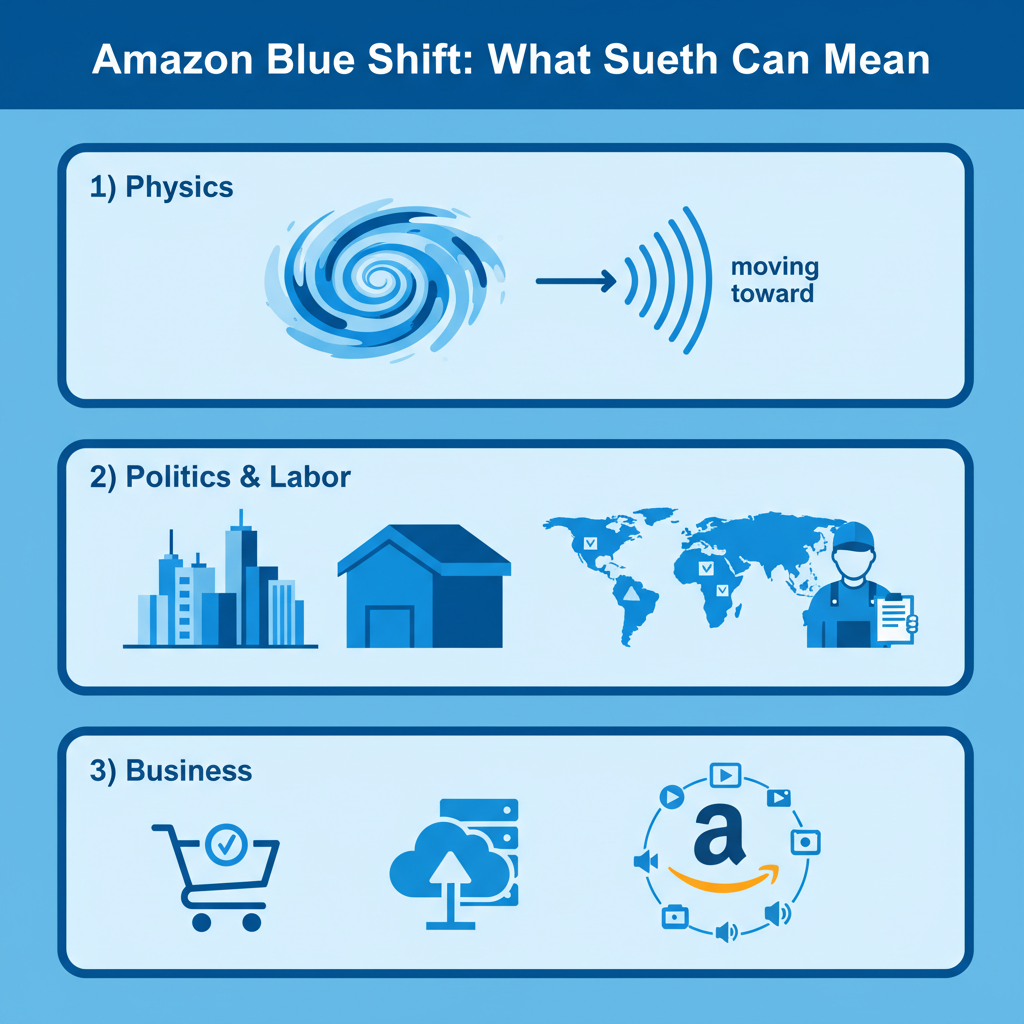
Depending on who’s saying it, Amazon blue shift can refer to three very different things:
- A physics concept about light and galaxies
- An election trend in Amazon-heavy regions
- A business/culture shift inside and around Amazon
We’ll hit all three so you’re never confused again.

1. The Science Meaning: What Is a Blue Shift?
First, the actual physics term: blue shift.
In astronomy, a blue shift happens when a light source (like a star or galaxy) is moving toward you. As it moves closer, the light waves get compressed, shifting toward the blue end of the spectrum.
- Moving toward you → blue shift (shorter wavelength, higher frequency)
- Moving away from you → redshift (longer wavelength, lower frequency)
You can think of it like sound:
- When an ambulance approaches, the pitch sounds higher (waves squeezed together)
- When it passes and moves away, the pitch drops (waves stretched out)
Blue shift is the same idea, but with light instead of sound.

2. So Where Does “Amazon Blue Shift” Come In?
Here’s where things get interesting.
The phrase “Amazon blue shift” isn’t a standard textbook term. Instead, it usually shows up in three kinds of conversations:
- Politics – describing voting patterns in regions dominated by Amazon (the company)
- Labor & economics – talking about how Amazon jobs are changing local communities
- Business / tech culture – referencing a shift toward Amazon’s ecosystem
Let’s walk through each, because context is everything.

3. The Political Angle: Amazon Jobs and the “Blue” Map
In U.S. politics, “blue” = Democratic and “red” = Republican.
Over the last decade, people have used phrases like “suburban blue shift” to describe suburbs that used to lean Republican but have slowly moved toward Democrats.
Now layer Amazon on top of that.
How Amazon Can Influence Voting Patterns
In areas where Amazon opens massive warehouses, data centers, or offices, a few things tend to happen:
- New jobs appear – logistics workers, drivers, engineers, managers, support staff.
- Demographics shift – younger workers, more tech workers, often more racial and ethnic diversity.
- Local politics change – new residents may bring different views on labor rights, housing, transport, and social policies.
When a big employer like Amazon moves in, commentators sometimes talk (informally) about a possible “Amazon blue shift”:
The idea: regions dominated by Amazon facilities might gradually shift more Democratic (blue) over time, similar to what happens in some tech hubs and urbanizing suburbs.
Is this a guaranteed, proven law of politics? No.
It’s more of a hypothesis + observation combo based on a few trends:
- Large employers can shape local political engagement (unions, worker protections, zoning fights)
- Young, diverse, and tech-adjacent populations tend to lean more blue on average in the U.S.
But politics are messy:
- Many warehouse locations are in historically conservative areas
- Local sentiment toward Amazon can be supportive (jobs!) or hostile (traffic, low wages, unions!)

4. The Labor & Culture Angle: Workers Shifting “Blue” Too
There’s another way “blue shift” shows up around Amazon: blue-collar vs. white-collar.
Amazon has become one of the biggest employers of blue‑collar workers in the U.S.:
- Warehouse associates
- Delivery drivers
- Sortation center workers
This has sparked:
- Unionization drives at warehouses
- Public debates about working conditions, pay, and surveillance
- High‑profile fights at facilities in places like Alabama and New York
In this context, people sometimes talk about a “blue shift” toward labor power:
A growing push for blue-collar worker rights in the shadow of a giant tech company.
This isn’t a formal label, more like a narrative shorthand:
- Amazon: giant, data‑driven tech/logistics machine
- Workers: organizing, voting, and speaking out
- Result: a kind of political and cultural shift toward prioritizing “blue‑collar” voices in tech‑adjacent spaces
5. The Business/Tech Meaning: Shifting Toward Amazon
There’s also a more metaphorical use: “blue shift” = shifting toward something, based on the physics idea that blue shift means motion toward you.
Apply that to Amazon:
- Retailers talk about customers shifting toward Amazon for faster shipping and lower prices
- Cloud users move toward Amazon Web Services (AWS) from on‑prem or other providers
- Sellers, authors, and brands shift their business models toward Amazon’s marketplace
People don’t always literally say “Amazon blue shift” here, but if they do, they usually mean:
A trend or migration toward Amazon’s ecosystem — in shopping, cloud, or digital content.
Examples:
- E‑commerce: Small brands closing physical shops and going all‑in on Amazon FBA (Fulfilled by Amazon).
- Cloud computing: Startups choosing AWS as default instead of building data centers.
- Entertainment: Authors and filmmakers using Amazon’s platforms (Kindle, Prime Video channels) as primary distribution.
In that sense, blue shift is a handy metaphor:
- Blue shift in physics → object moving closer
- “Amazon blue shift” → markets, users, or businesses moving closer to Amazon
6. Is “Amazon Blue Shift” an Official Term?
No.
There’s no single official, standard definition like you’d see in a physics textbook or an Amazon press release.
Instead, it’s:
- A mashup of a physics term (blue shift)
- Plus Amazon’s huge influence on jobs, politics, and markets
- Used by commentators, writers, and analysts as a metaphor or trend label
So whenever you see it, ask:
- Is this about politics? (blue = Democrats)
- Is this about workers or unions? (blue‑collar shift)
- Is this a metaphor for moving closer to Amazon? (ecosystem gravity)
Once you know the context, the meaning usually clicks.
7. Quick FAQ: Amazon Blue Shift, Explained Fast
A: Indirectly. Blue shift is an astronomy term for light from objects moving toward us. People borrow that image when they say “Amazon blue shift.”
A: Not specifically. Some analysts might use it metaphorically to mean markets or capital moving toward Amazon, but it’s not a standard Wall Street label.
A: Mostly no. The logo has blue in some contexts, but that’s not the core idea. The “blue” almost always comes from political blue, blue-collar, or the physics term.
A: Yes, in some political writing that’s exactly what it’s trying to describe: Amazon-heavy regions slowly shifting blue in voting patterns.
A: You can — but define it for your audience the first time you use it, because it’s not universally known.
8. How to Use the Term Without Confusing Everyone
Example: “We’re seeing an ‘Amazon blue shift’ here — as Amazon facilities move in, the local vote and workforce are trending more blue‑collar and blue‑leaning politically.”
Don’t just drop the phrase and walk away. Show:
- A region where voting patterns shifted after Amazon arrived
- Changes in unionization, wages, or worker activism
- A business moving more and more sales into Amazon’s ecosystem
- Political blue (Democratic)?
- Blue‑collar workers?
- Physics/“moving toward” metaphor?
It’s a useful metaphor, not a scientific law of society. Instead of “Amazon causes a blue shift everywhere,” say “we may be seeing a blue shift in…” or “some evidence suggests…”
Final takeaway: Amazon blue shift is best used as a thoughtful metaphor, backed by examples, not as a rigid technical term.
9. Wrap-Up: What You Should Remember
If you only remember three things about Amazon blue shift, make them these:
- Blue shift (original): A physics term for light from an object moving toward you.
- Amazon blue shift (politics and labor): A way to describe regions or workforces around Amazon shifting blue — politically, culturally, or toward stronger blue‑collar voices.
- Amazon blue shift (business metaphor): A narrative about customers, companies, and industries moving toward Amazon’s orbit – in shopping, cloud, and content.
Next time you see someone drop “Amazon blue shift” in a headline or thread, you’ll know exactly what questions to ask — and probably understand it better than they do.
Leave a Reply