Category: Uncategorized

  • $25 Amazon Prime Flights: Hype or Hack?



    $25 Amazon Prime Flights: Hype or Hack?


    $25 Amazon Prime Flights: Hype or Hack?

    Frustrated traveler closing a laptop with flight prices jumping and $25 Amazon Prime flights headlines in the background

    If you’ve ever rage-closed a flight search tab after watching prices jump $80 in 10 minutes, you are exactly the target audience for this topic.

    Because somewhere on the internet, you probably saw a headline like:

    “$25 Flights with Amazon Prime?!”

    …and immediately thought, Wait. I can get toilet paper, TV shows, and cheap flights with the same subscription now?

    Let’s unpack what’s real, what’s clickbait, and how to actually use Amazon + travel hacks to save money on flights (even if the viral “$25 flights Amazon Prime” thing isn’t quite what it sounds like).


    Split scene comparing a fantasy Amazon Prime $25 flight portal with the real mix of airline sales, rewards, and Amazon perks being stacked together

    First things first: Are there really $25 flights with Amazon Prime?

    Short answer: not in the simple, magical “log in to Amazon Prime → click Flights → everything is $25” way.

    There is no official Amazon Prime benefit today (as of December 22, 2025) that guarantees flat $25 flights the way Prime gives you free 2‑day shipping.

    So why does “$25 flights Amazon Prime” keep popping up?

    It’s usually a mash‑up of:

    • Old or misleading blog posts
    • Third‑party travel sites partnering with Amazon gift cards or promotions
    • People rounding down extreme deals (“I used points and a promo and basically paid like $25 for my flight”)

    But here’s the good news: you can use Amazon, Prime perks, and a few tools to effectively get flights for $25–$50 out of pocket—you just have to play the game a little smarter.

    Takeaway
    The $25 number is marketing sugar. The principle (stacking Prime-related perks + travel hacks to dramatically lower your flight cost) is real.

    Two-panel visual: fantasy Prime-only $25 flight portal versus realistic stack of sales, rewards, and Amazon benefits

    What people think “$25 flights with Amazon Prime” means

    Most of the hype around this phrase is based on one of these mental pictures:

    1. Prime has its own flight booking portal with exclusive prices (like Costco Travel, but Amazon‑ified).
    2. Prime members get a special travel discount that slashes normal fares down to something ridiculous like $25.
    3. Some hidden Amazon travel benefit exists that nobody is using yet.

    Reality check:

    • Amazon has dabbled in travel in the past (like its short‑lived hotel booking efforts), but there is no built-in Prime flight marketplace right now.
    • Any $25 price point usually comes from stacking: airline sales + credit card rewards + promo codes + gift cards—not a single magical Prime benefit.
    Takeaway
    There’s no secret Prime flight button. But we can absolutely bend a few systems to get effectively $25 flights.

    Infographic flowchart showing Amazon shopping turning into travel card points, airline miles, and a ticket costing $25 out of pocket

    The real play: How to use Amazon + Prime to make flights dirt cheap

    Instead of chasing a mythical $25 fare, think in terms of reducing your out-of-pocket cost down to that level.

    Here’s a realistic, step‑by‑step way to do that:

    1. Turn Amazon spending into free (or nearly free) flights

    If you already have Amazon Prime, odds are you’re spending a decent chunk on Amazon every year. With the right card and setup, all that spending can quietly build up travel rewards.

    What to do:

    • Use a travel rewards credit card as your default Amazon payment method.
    • Pick a card that earns points or miles that can be redeemed for flights (not just generic cash back).
    • Some cards offer higher points on online shopping, which can include Amazon.

    Example scenario:

    • You put $600 of Amazon purchases on a travel rewards card that earns 3x points on online shopping.
    • That’s 1,800 points.
    • Combine that with your other spending and a sign‑up bonus, and suddenly you have enough points to cover a $150 domestic ticket.
    • If you use points to cover $125 of that and pay $25 cash (taxes/fees), you just got a “$25 flight” powered by your Amazon shopping.
    Takeaway
    Your Amazon habit can quietly subsidize flights—if you route it through the right card.

    2. Use Amazon gift cards + promos to shrink your flight cost

    Another way these “$25” stories happen: people stack Amazon gift card deals with travel portals.

    Here’s how that looks in practice:

    1. Buy discounted Amazon gift cards when they pop up (from warehouse clubs, limited-time promos, or credit card offers).
    2. Use those Amazon balances to cover everyday spending you’d do anyway.
    3. Free up your actual cash for flights, or meet minimum spend on a travel card faster.

    Is this as clean as “Amazon Prime gives you a $25 flight”? No.

    Does it move real money around so you feel like you paid very little for a ticket? Yes.

    Mini case study:

    • You grab a promo: spend $50, get a $10 Amazon credit.
    • Do that a few times, plus a gift-card sale where you get an extra 10% value.
    • Because that covers random household stuff, you end up with an extra ~$60 actual cash in your bank that you don’t need for those items.
    • You then pounce on a $85 budget flight sale, using that $60 plus $25 out of pocket.
    Takeaway
    Small Amazon credits and gift card plays don’t feel like “flight money,” but stacked together they absolutely can turn into a $25 net flight.

    3. Use flight tools to find prices low enough that your points and credits matter

    Prime isn’t a flight search engine. So you still need real travel tools to find those bottom-of-the-barrel fares.

    Tools to use:

    • Google Flights – Excellent for scanning flexible dates and airports to find the cheapest combinations.
    • Hopper, Skyscanner, or Kayak – Great for tracking price drops and alerts.
    • Airline direct sites – Sometimes run flash sales or promo codes that aggregators don’t highlight well.

    Your game plan:

    1. Use a tool like Google Flights to set alerts on a route you care about (say, NYC → Miami).
    2. Wait for a good sale – maybe the price drops to $89 roundtrip.
    3. Combine:
      • Travel card points (cover $60)
      • Prime‑fueled Amazon spending that earned those points
      • A little leftover gift card or cash
    4. You’re now paying $20–$40 in actual cash. There’s your “$25 flight.”
    Takeaway
    Cheap fares + rewards you quietly earned while buying stuff on Amazon = believable sub‑$50 flights.

    Person juggling Amazon gift cards, promos, and credits that funnel into a flight fund piggy bank and a low-cost plane ticket

    But wait… could Amazon ever launch real Prime flight deals?

    This is the part where we speculate a bit.

    Amazon has:

    • A massive Prime subscriber base
    • A track record of bundling random benefits (music, groceries, photo storage, NFL streaming…)
    • The capability to partner with travel brands if it wants to

    So could we see something like “Prime Travel” or exclusive flight/ hotel deals in the future? It’s extremely plausible.

    If that happens, what might it look like?

    • Exclusive promo codes you only see when signed in as a Prime member.
    • A travel portal with small discounts or extra rewards for Prime (like 5% back in Amazon credit on flights).
    • Occasional flash promotions where a limited number of deeply discounted fares (maybe even $25) are available to Prime members.

    But that’s all potential future stuff, not reality today. Right now, any site promising a permanent, universal “$25 Prime flight” is, at best, oversimplifying and, at worst, just chasing clicks.

    Takeaway
    A true Amazon travel platform would make sense strategically—but don’t make financial decisions based on a rumor.
    Laptop with flight search tools and price alerts while a wallet in the foreground shows points and Amazon-related credits lowering a fare

    Common myths about $25 Prime flights (and what’s actually true)

    Let’s clear a few things up so you don’t fall for bad advice:

    Myth #1: “Prime members get special flight prices nobody else can see.”

    Reality: Airlines and travel agencies occasionally run targeted sales, but as of now there’s no official, always‑on Prime‑only flight pricing.

    What is real: Certain credit cards and shopping portals (sometimes advertised on Amazon or via email promos) give extra rewards or cash back on travel bookings.

    Myth #2: “There’s a secret Amazon URL where flights are $25 if you log in with Prime.”

    If there were, everyone on TikTok, Reddit, and your group chat would be screaming about it.

    What’s more likely: A limited-time promo or one-off campaign gets screenshotted and re‑shared forever with no date or context.

    Myth #3: “You’re missing out if you’re not booking flights through Amazon directly.”

    Again, Amazon does not operate a mainstream, public flight booking engine right now.

    What you can be missing out on:

    • Not using the right rewards card on Amazon purchases
    • Not stacking Amazon credits, gift cards, and promos to free up flight money
    • Not using proper flight search tools to find low base fares
    Takeaway
    Don’t worry about “secret” Prime flight portals. Focus on levers you actually control.

    Conceptual roadmap of money and Amazon perks flowing into a flight fund and resulting in a cheap plane ticket

    A simple framework to actually get near-$25 flights

    Here’s a no‑nonsense framework you can follow over the next few months:

    Step 1: Route your Amazon spend through a travel rewards card

    • If you don’t have one, consider a beginner‑friendly card with a solid sign‑up bonus and transferable points.
    • Set it as your default Amazon payment method.

    Goal: Turn every Prime purchase into future flight currency.

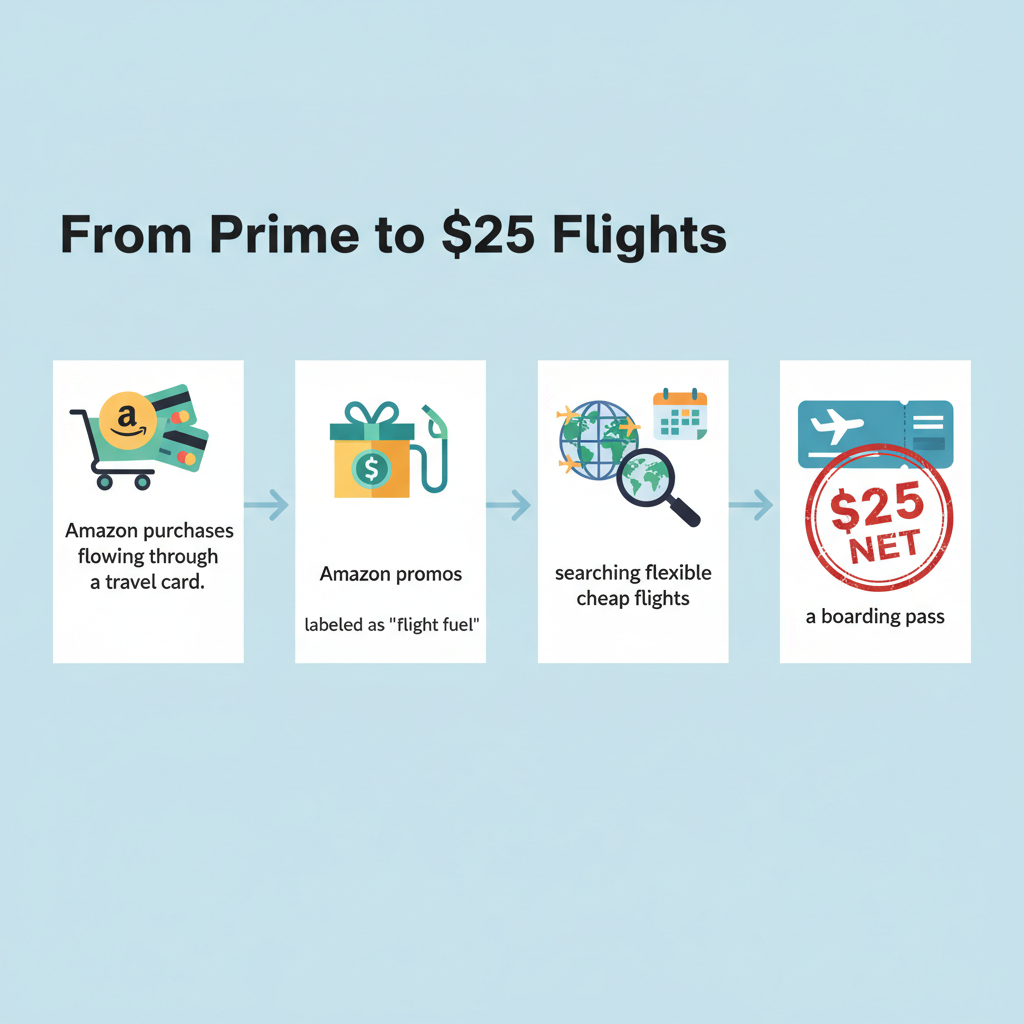
    Step 2: Treat Amazon promos like “flight fuel”

    • When you see offers like “Spend $X, get $Y in credit,” remember: that’s money you don’t have to spend elsewhere.
    • Keep a simple note or spreadsheet: “Amazon credits this month: $___”.
    • Match that number with how much you’re allowed to splurge on trips.

    Goal: Translate random credits and discounts into a mental “flight fund.”

    Step 3: Hunt smart for cheap base fares

    • Use tools like Google Flights to:
      • Search flexible dates (+/− 3 days)
      • Explore nearby airports
      • Set alerts on key routes
    • Be open to flying midweek or at off‑peak hours when prices dip.

    Goal: Find trips priced low enough that points + a small copay get you into that $25–$50 range.

    Step 4: Pounce when the math lines up

    1. Check your points balance.
    2. Check how much “extra” cash you effectively saved via Amazon credits and promos.
    3. Do the math: if your true out-of-pocket will be under $50, that’s your win.
    4. Then book it. Don’t overthink it into oblivion.
    Takeaway
    You’re not chasing a unicorn $25 sticker price—you’re engineering a $25 net cost.

    Four-step roadmap from Amazon Prime purchases to a boarding pass stamped with $25 net cost

    So… is chasing “$25 Amazon Prime flights” worth it?

    If you’re hoping for a hidden page on Amazon that spits out $25 tickets to anywhere: no, that’s not where your energy should go.

    But if you:

    • Already have Prime
    • Already spend regularly on Amazon
    • Are willing to be a little intentional with credit card selection, promos, and flight search tools

    …then yes, you can absolutely engineer situations where you’re paying $25–$50 for flights that would have cost you full price otherwise.

    Think of it this way:

    • Prime gives you convenience.
    • Your card gives you points.
    • Sales and promos give you leverage.
    • You give yourself $25 “how did I pull this off?” flights by connecting all of the above.

    The viral headline is mostly marketing. The strategy behind it? That’s where the real value is.

    If you want, I can help you design a mini “Prime-to-Points” setup tailored to how much you actually spend on Amazon and how often you fly.


  • Amazon Layoffs 2025: What Really Changed


    Amazon Layoffs 2025: What Really Changed

    Amazon Layoffs 2025: What Really Changed

    What the 2025 cuts actually mean for workers, careers, and the future of work inside and beyond Amazon.

    Illustration of Amazon 2025 layoffs in a modern corporate office

    If it feels like every time you refresh the news another tech giant is cutting jobs, you’re not imagining it.

    Amazon is once again at the center of that story in 2025 — with tens of thousands of roles on the line, AI in the spotlight, and a lot of people quietly wondering: “Is my job next?”

    Let’s unpack what’s actually happening with Amazon layoffs in 2025, why it’s not just “cost cutting,” and how this wave fits into a much bigger shift in how work is changing.


    Conceptual split scene of traditional work and AI-driven automation at Amazon

    Quick snapshot: What’s happening with Amazon layoffs in 2025?

    Here’s the 2025 picture in plain English.

    According to multiple reports and company memos:

    • Amazon is planning to cut up to 30,000 corporate jobs, its largest corporate reduction to date, affecting around 10% of its roughly 350,000 corporate employees.
      (reuters.com)
    • A confirmed 14,000 corporate roles are being eliminated as part of this restructuring, with reports suggesting further reductions toward that 30,000 target.
      (techcrunch.com)
    • Layoffs are concentrated in corporate functions like HR/People Experience & Technology (PXT), Devices & Services, Operations, and some AWS-related groups — even while other teams are still hiring.
      (techcrunch.com)
    • This comes on top of earlier, smaller rounds in 2025, including cuts in the Devices & Services division (Alexa, Echo, Kuiper, Zoox) and engineering roles in several key states.
      (geekwire.com)
    • Industry-wide, more than 120,000 tech employees have been laid off in 2025 alone, with AI and automation cited as major drivers at Amazon, Microsoft, Salesforce, and others.
      (indiatoday.in)

    Takeaway: This isn’t a one-off “oops we overhired” moment. It’s a multi‑year restructuring in how Amazon allocates people, capital, and technology.


    Infographic of resources moving from corporate roles to AI, AWS, and robotics at Amazon

    Why is Amazon cutting jobs in 2025 when business is… actually good?

    Here’s the weird part: Amazon isn’t shrinking because it’s failing.

    Amazon’s revenue and cloud business (AWS) are still growing, and the company is investing tens of billions of dollars in tech infrastructure to support AI and cloud services.
    (techcrunch.com) So why the layoffs?

    1. The AI pivot: Fewer humans doing the same work

    Amazon’s leadership has been unusually blunt: as it rolls out generative AI and AI “agents” across the company, it expects to need fewer people for many existing corporate roles.

    In internal and public memos, Amazon has framed this as:

    • AI is “the most transformative technology since the Internet” and they want to be leaner, with fewer layers, to move faster.
    • As AI tools spread internally, some jobs will shrink or disappear, while new types of roles emerge in AI, data, and infrastructure.
      (techcrunch.com)

    Fortune and others have connected the 2025 layoffs directly to Amazon’s automation and robotics strategy, especially in warehouses and logistics, raising questions about “robot‑driven unemployment.”
    (fortune.com)

    Takeaway: AI isn’t just a buzzword here. It’s literally being used as a justification for reducing headcount and reorganizing work.

    2. From “growth at all costs” to “efficiency at all costs”

    From 2020–2022, Amazon hired aggressively to handle pandemic‑era demand. When that demand normalized, the company started unwinding those bets:

    • 2022–2023: ~27,000 jobs cut in earlier rounds.
    • 2024–2025: additional layoffs in Twitch, Prime Video, MGM Studios, some HR teams, Devices & Services, and now this large 2025 corporate restructuring.
      (techcrunch.com)

    Layer that on top of pressure from investors to protect margins, and you get a very familiar tech‑sector formula:

    Grow like crazy → Overbuild → Market shifts → Wall Street gets nervous → “Efficiency” phase → Layoffs + automation.

    Takeaway: Even when profits and revenue look good, public tech companies are now rewarded for shrinking their cost base, not just expanding their top line.

    3. Reallocating to long‑term bets

    Amazon has been clear about where it is spending more:

    • Massive capex on cloud infrastructure to support AI and AWS.
      (techcrunch.com)
    • Strategic projects like Project Kuiper (satellite internet), advanced robotics, and fulfillment automation.

    The layoffs are part of a portfolio shift: fewer people in “traditional” corporate roles, more capital and specialized talent going into AI, infrastructure, and automation.

    Takeaway: This isn’t just cutting — it’s swapping one kind of investment (people in certain roles) for another (AI, infra, and a different talent mix).


    Scene of Amazon corporate employees navigating layoffs and internal transfers

    Who is most affected by the 2025 Amazon layoffs?

    Let’s break it down beyond the scary big numbers.

    Impacted groups and functions

    Based on reporting and internal communications referenced in coverage:

    • Corporate HR / PXT (People Experience & Technology)
      Reportedly one of the hardest‑hit areas, with some estimates suggesting double‑digit percentage cuts in certain HR functions as Amazon standardizes and automates people processes.
      (linkedin.com)
    • Devices & Services
      Includes Alexa, Echo, Zoox, and Kuiper. Roughly 100 roles were cut earlier in the year in this group alone, even as the division continues hiring in other areas.
      (geekwire.com)
    • Operations & supporting corporate roles
      Some operations‑adjacent corporate teams are being downsized as automation and robotics increase in fulfillment centers.
    • Selected AWS teams
      Amazon confirmed layoffs in certain AWS groups in 2025, describing them as necessary to “optimize resources” while still investing heavily in cloud innovation.
      (crn.com)

    Locations most in the spotlight

    Reports and local coverage have highlighted layoffs particularly affecting:

    • Major U.S. tech hubs (Seattle, the Bay Area, Northern Virginia)
    • Key engineering centers and certain states where Amazon has been consolidating teams and data‑center‑adjacent talent
      (thehrdigest.com)

    What it feels like internally

    From public statements and leaked memos, some consistent patterns:

    • Impacted corporate employees are typically given about 90 days to find a new role internally before severance kicks in.
      (techcrunch.com)
    • Amazon emphasizes that it is still hiring in priority areas, even as it cuts deeply elsewhere — creating a strange mix of anxiety and opportunity on the inside.

    Takeaway: It’s not a blanket collapse of jobs, it’s a very targeted reshuffle. Some roles are vanishing; others are growing at the same time.


    Panoramic illustration of tech industry layoffs and rising AI and cloud opportunities in 2025

    How do Amazon’s layoffs fit into the bigger 2025 tech layoff wave?

    Amazon is big, but it’s not alone.

    According to layoff trackers and news analyses:

    • Over 120,000 tech workers have lost jobs in 2025 so far across more than 250 companies.
      (indiatoday.in)
    • Amazon’s reductions (14,000 confirmed corporate cuts, up to 30,000 planned) put it in the top tier of 2025 job cutters, alongside firms like Verizon, IBM, Nestlé, Nissan, UPS, and multiple large tech players.
      (businessinsider.com)

    At the same time, there’s a parallel trend:

    • Companies cutting in customer service, operations, and mid‑level management…
    • While aggressively hiring for:

      • AI and machine learning engineers
      • Data infrastructure and cloud roles
      • Robotics, automation, and cybersecurity

    Takeaway: The job market isn’t dying; it’s tilting. If your skills map to the “old stack,” your risk is higher. If they map to the AI/cloud/automation stack, your opportunities are expanding — often at better pay.


    Professional evaluating career options amid AI and layoff changes at Amazon

    If you work at (or want to work at) Amazon, what should you do now?

    Let’s talk practical moves — whether you’re inside Amazon or eyeing it from the outside.

    1. Audit your role against the automation curve

    Ask yourself bluntly:

    • Is my work rules‑based, repetitive, or process‑driven?
    • Could a combination of AI tools and better internal systems reasonably do 60–80% of what I do?
    • Am I mostly approving, routing, or reporting, rather than designing, deciding, or inventing?

    If you’re answering “yes” to those, your role — at Amazon or anywhere — is at higher risk over the next few years.

    Move to make: Start shifting your responsibilities toward:

    • Owning metrics and outcomes, not just tasks
    • Designing systems and processes instead of just operating them
    • Working with AI tools (prompting, evaluation, integration) rather than ignoring them

    2. Pivot toward Amazon’s “big bets” skills

    Regardless of whether you stay at Amazon, pay attention to where it’s investing:

    • Cloud & AWS: architecture, security, data platforms
    • Generative AI & agents: applied ML, prompt engineering, evaluation, product roles that integrate LLMs into workflows
    • Automation & robotics: controls, simulation, industrial engineering, logistics optimization

    You don’t need to become a PhD researcher. Even for non‑technical professionals, you can:

    • Learn to design AI‑augmented workflows (e.g., using AI to triage tickets, draft responses, or surface insights)
    • Build basic analytics skills (SQL, dashboards, experimentation)
    • Become the person who can bridge ops + product + AI in your niche

    3. Treat internal mobility like a 90‑day startup

    If you’re an Amazon employee in a at‑risk org and given a 90‑day internal search window, treat it as a mini startup sprint:

    1. Clarify your story in 2–3 sentences: what problems you solve and what you want next.
    2. Target teams aligned with AI, cloud, infra, or clear strategic initiatives.
    3. Reach out directly to hiring managers and skip relying solely on internal postings.
    4. Show you can help with automation — don’t fight the trend; stand in front of it.

    4. Build a portable narrative beyond “I worked at Amazon”

    The 2022–2025 Amazon layoff cycles have already created a large alumni wave, many of whom land quickly at other tech firms, startups, or in consulting.

    What separates fast landers from the long job search?

    • They don’t lead with: “I was a Level X at Amazon.”
    • They lead with:
      “I owned X metric, improved it by Y%, and did it under Z constraints. Here’s how I’d do something similar for you.”

    In a market where your previous company might also be cutting, you win by translating your experience into concrete, future‑relevant impact.

    Takeaway: Your employer brand (Amazon, FAANG, etc.) might get you a first look. Your story of impact + adaptability gets you the offer.


    Professional at a crossroads between automated work and AI-focused careers

    What does this mean for the future of work at Amazon?

    Zooming out, what do Amazon layoffs in 2025 tell us about where things are headed?

    1. Corporate headcount isn’t sacred anymore

    The old assumption was: automate warehouses and blue‑collar work, keep corporate headcount pretty stable.

    2025 blows that up.

    Automation is now eating into white‑collar, managerial, and support functions, and Amazon is explicitly saying that AI will allow it to run leaner at the corporate level.
    (techcrunch.com)

    2. “AI fluency” becomes a baseline, not a bonus

    If Amazon believes AI is as transformative as the internet, then not being AI‑literate in a few years will likely feel like not being internet‑literate today.

    For most knowledge workers that means:

    • Comfort using AI tools in day‑to‑day workflows
    • Understanding what AI is good at (patterns, text, code) versus what still requires human judgment
    • Being able to design processes that intentionally blend humans and AI

    3. Stability looks different now

    Long‑term job security inside a single big tech company is no longer the “safe” path it once appeared to be.

    Stability increasingly looks like:

    • A portable skill stack (AI‑aware, data‑literate, systems‑thinking)
    • A strong network across companies and sectors
    • The ability to relearn and reposition every few years as tech shifts

    Takeaway: The safest thing you can do in a period of mass restructuring is not to cling to one employer — it’s to relentlessly upgrade the skills and relationships that travel with you.


    Forward-looking illustration of a worker choosing an AI-driven career path

    So… should you be worried?

    Some truth, with minimal sugar‑coating:

    • If your current job (at Amazon or anywhere) is mostly repetitive digital work that AI is getting good at, you should be concerned — and proactive.
    • If you lean into AI, automation, metrics, and cross‑functional problem‑solving, you can often turn this same wave into leverage.

    Amazon layoffs in 2025 are not just a corporate drama headline; they’re a preview of how large companies will:

    1. Use AI to justify shrinking some roles, and
    2. Rapidly expand others that build, run, and orchestrate those AI systems.

    You don’t control the first part.

    You do control how quickly you move toward the second.

    If you take one step this week, make it this: pick one task you do regularly, and ask, “How could I use AI or automation to handle 50–80% of this?” Then experiment.

    That small mindset shift is exactly the kind of thing that will matter — at Amazon, or anywhere else tech decides to reinvent work next.


  • Amazon Layoffs: What’s Really Going On?


    Amazon Layoffs: What’s Really Going On?

    Amazon Layoffs: What’s Really Going On?

    A brutally honest look at how Amazon is reshaping its workforce—and what it means for you.

    If it feels like every few months there’s another headline about an Amazon layoff, you’re not imagining it.

    Since late 2022, Amazon has gone from pandemic-era hyper‑hiring to some of the biggest job cuts in corporate history, and 2025 is shaping up to be another brutal chapter.

    Let’s unpack what’s happening, why it’s happening, and what it actually means if you work in tech, retail, or anywhere near Amazon’s orbit.

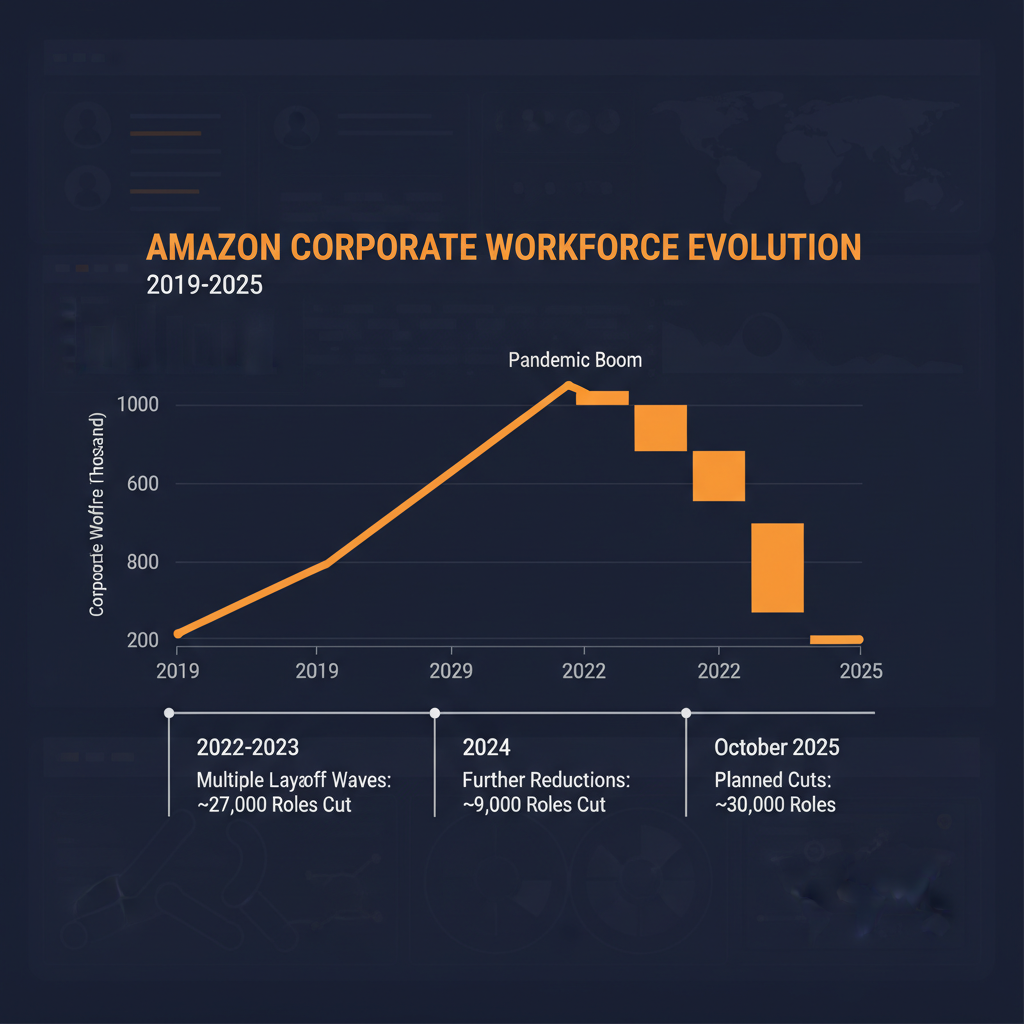
    Infographic illustrating Amazon workforce growth and layoffs from 2019 to 2025

    Quick recap: How big are the Amazon layoffs?

    Here’s the rough timeline of major Amazon layoffs since the pandemic:

    • Late 2022 – early 2023: About 27,000 roles eliminated across corporate teams like devices, HR, and retail, one of Amazon’s first truly massive modern layoffs. According to multiple reports tracked by Layoffs.fyi and business media, these cuts landed heavily in divisions like Alexa, gaming, and communications.
    • 2024: Smaller but steady restructuring waves touched communications, sustainability, and parts of the North America Stores team, with a few hundred jobs cut here and there as Amazon continued to “re-prioritize” around profitability and AI. (economictimes.indiatimes.com)
    • October 2025: Amazon announces its largest corporate layoff since 2023—plans to cut around 30,000 corporate jobs, roughly 10% of its ~350,000 corporate workers. That’s on top of earlier reductions and targets non‑frontline roles in HR (especially the People Experience and Technology unit), operations, devices and services, and Amazon Web Services (AWS). (technology.org)
    • Late 2025 follow‑ons: Inside that broader restructuring are more localized cuts, like 370 jobs at Amazon’s European HQ in Luxembourg and additional layoffs in Washington state, which include engineers and program managers. (timesofindia.indiatimes.com)

    Put together, you’re looking at tens of thousands of Amazon jobs gone or going away between 2022 and 2025, mostly in corporate and tech roles rather than warehouses and delivery.

    Takeaway: This isn’t a one‑off “oops, we over‑hired.” It’s a multi‑year strategic downsizing and reshaping of who Amazon employs and for what.

    Office scene contrasting Amazon’s crowded pandemic-era hiring with emptier post-layoff floors

    Why is Amazon laying off so many people?

    There isn’t just one reason. It’s a cocktail of:

    1. Pandemic over‑hiring that never fully unwound

    Between 2019 and 2022, Amazon more than doubled its workforce to keep up with lockdown‑era demand. Online sales exploded, logistics networks ballooned, and the company staffed up accordingly. (indmoney.com)

    When people went back to stores and demand normalized, Amazon was left with:

    • Teams sized for a once‑in‑a‑century surge
    • Growth curves that flattened
    • Profit pressures from rising costs and slower e‑commerce expansion

    So some roles became redundant—not because the workers were bad, but because the business reality changed.

    Takeaway: Amazon built for 2030 demand, then discovered it was still living in 2024.

    2. AI and automation are officially “the main character”

    Amazon isn’t shy about this: leadership repeatedly says AI is as transformative as the early internet, and they’re reorganizing the company around it. (theoutpost.ai)

    That shows up in two ways:

    • Corporate and admin roles: Advanced AI is now handling forecasting, data analysis, logistics planning, and even parts of customer support. That reduces the need for large, layered management structures and some mid‑level roles.
    • Operations and fulfillment: Investments in robotics and automation mean Amazon can run warehouses and logistics networks with fewer humans per package processed—a trend that’s still in early innings. (indiatoday.in)

    Leadership is blunt: if AI or automation can do something cheaper, faster, and at scale, Amazon will absolutely go that way.
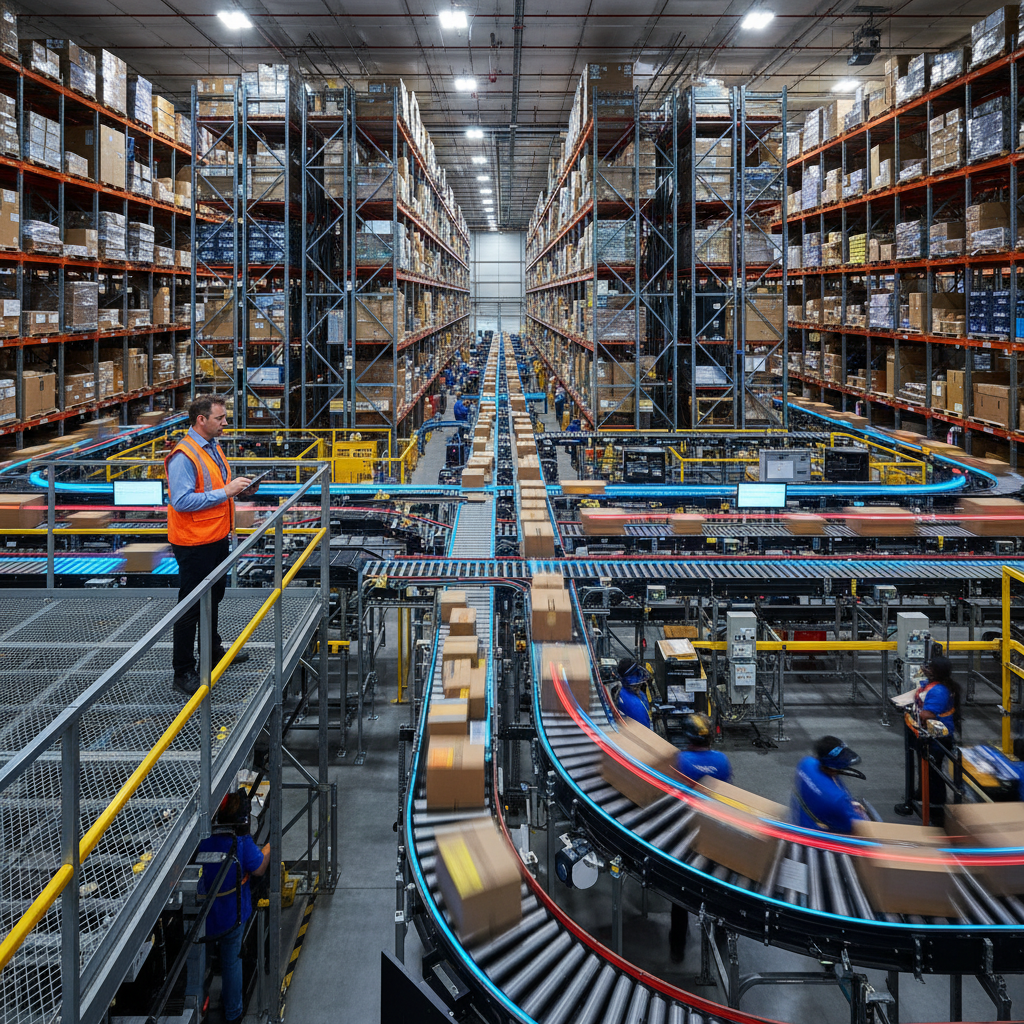
    Takeaway: These layoffs aren’t just cost cuts—they’re a workforce swap: fewer traditional roles, more AI, robotics, and hard‑tech work.

    3. Cost control and Wall Street pressure

    Amazon’s investors care about profitability, not just growth.

    • Analysts estimate that cutting roughly 13,800+ managerial roles could save $2.1–$3.6 billion per year, given typical salary bands. (economictimes.indiatimes.com)
    • At the same time, Amazon’s capital spending is exploding, jumping toward $100 billion a year to fund data centers, chips, and infrastructure for AI and cloud. (techxplore.com)

    To reconcile “spend big on AI” with “please improve margins,” Amazon is trimming headcount, especially in roles perceived as bureaucratic or duplicative.

    Takeaway: The math is simple: fewer people + more AI + higher capital spend = a business that looks leaner on paper.

    4. “Too much bureaucracy” (Amazon’s words, not mine)

    Andy Jassy and senior leaders talk a lot about removing layers and running Amazon “like the world’s largest startup.” (businessinsider.com)

    Some signals:

    • The company launched a “Bureaucracy Mailbox” in 2024 so employees could report inefficiencies, and claims to have already implemented hundreds of suggestions to streamline operations.
    • Internal messaging around the 2025 layoffs repeatedly mentions simplifying org structures, “faster decision‑making,” and pushing for “more ownership” per person. (economictimes.indiatimes.com)

    In practice, this often translates into:

    • Fewer managers
    • Larger spans of control
    • More pressure on the people who remain

    Takeaway: If you’ve ever thought “This meeting could’ve been an email,” Amazon is trying to fire the meeting.

    Futuristic AI and robotics-driven operations hub replacing many traditional roles

    Who is most at risk in Amazon layoffs?

    From what’s been reported so far, the most affected roles aren’t warehouse pickers—they’re corporate and office‑based jobs.

    Based on recent rounds:

    • Human Resources / People Experience and Technology (PXT): Some estimates suggest up to 15% cuts in certain HR areas, as automation handles more of the routine work and the org gets smaller overall. (ibtimes.co.uk)
    • Operations & corporate support functions: Program managers, operations analysts, and other backbone roles are being thinned out, especially where AI tools or new systems reduce manual coordination.
    • Devices and Services (e.g., Alexa, some consumer hardware): This division has already seen several waves of cuts as Amazon re‑evaluates long‑term bets and prioritizes what it thinks can actually make money.
    • AWS and related cloud units: Not immune. Even though AWS is Amazon’s profit engine, it’s also being restructured to align with AI and cloud priorities, meaning some older or non‑core initiatives get trimmed. (technology.org)

    Meanwhile, Amazon is still hiring aggressively in:

    • AI and machine learning
    • Cloud infrastructure and chips
    • Robotics and automation
    • Certain logistics and seasonal operations (think: 250,000 seasonal roles during peak holiday demand, even while corporate staff are being cut). (business-standard.com)

    Takeaway: It’s less “Amazon is shrinking” and more “Amazon is changing what kinds of jobs it wants to pay for.”

    Emotional office scene of employees dealing with layoffs and tense role discussions

    What it feels like on the inside (and yes, it’s messy)

    Public announcements are polished; the internal experience is not.

    Common themes from internal memos and reporting:

    • Drawn‑out anxiety: Many 2025 layoffs were telegraphed in advance (“restructuring,” “role reviews,” “multi‑year transformation”), leaving teams in limbo for weeks or months.
    • Return‑to‑office as a pressure valve: Reports suggest that strict in‑office requirements in 2025—five days a week in some orgs—were partly intended to nudge people to quit voluntarily. Employees who didn’t comply risked being treated as voluntary resignations, sometimes with reduced severance. (technology.org)
    • Patchwork severance: Corporate employees generally receive some combination of notice periods, internal transfer chances, and severance, but the exact package can vary widely by role, geography, and business unit. Recent memos mention things like 90 days to apply internally before termination. (theoutpost.ai)

    Takeaway: From the outside, this looks like “rational restructuring.” From the inside, it often feels like months of uncertainty followed by a calendar invite titled something like “Discussion about your role.”

    Forward-looking collage of workers upskilling and adapting to an AI-driven job market

    If you work at Amazon (or a similar company), how do you protect yourself?

    No, you can’t single‑handedly stop macroeconomics or AI trends. But you can make yourself less layoff‑target‑shaped.

    1. Move closer to revenue, AI, or infrastructure

    Roles that:

    • Directly drive revenue (sales, high‑impact product, key customer teams)
    • Build or run AI, cloud, or core infrastructure
    • Own clearly measurable outcomes

    …tend to be safer than roles that just “support” or “coordinate.”

    If you’re in a support role, look for ways to:

    • Own specific metrics (e.g., “I reduced ops defects by 18% in my area”).
    • Attach your work to clearly strategic initiatives—especially AI, automation, or cost savings.

    2. Learn the tools that are changing your job

    If AI and automation are why jobs are being cut, you have two choices:

    • Compete with the tools
    • Learn to run the tools

    Guess which group gets laid off first.

    Even if you’re not an engineer, getting comfortable with:

    • Data analysis tools
    • Internal automation platforms
    • AI‑powered productivity or operations tech

    …makes you more valuable and harder to replace.

    3. Assume nothing is permanent: build your external optionality

    Even in a company as huge as Amazon, stability is not guaranteed.

    Start now:

    • Keep your LinkedIn, résumé, and portfolio up to date.
    • Maintain a warm network—ex‑coworkers, recruiters, people at partner firms.
    • Save an emergency fund if you can; severance is helpful but not always predictable.
    • Track internal and external openings, even if you’re not actively applying.

    If the worst happens, you’re already in motion instead of starting from zero in panic mode.

    4. Mentally separate your identity from your job

    This is the hard one.

    When layoffs happen, high‑achieving employees often internalize it as personal failure. But these cuts are clearly driven by macro strategy—AI shifts, capital allocation, investor expectations—not by the individual worth of the people leaving.

    Your value is not defined by one company’s spreadsheet.

    Takeaway: Use Amazon’s restructuring as a forcing function: upgrade your skills, relationships, and financial buffer before you need them.

    Data-driven visualization of large-scale layoffs across major tech companies including Amazon

    What do Amazon layoffs mean for the broader job market?

    Amazon isn’t operating in a vacuum.

    In 2025 alone, tens of thousands of roles across tech and adjacent industries—Meta, Microsoft, Intel, UPS, TCS, and others—have been cut as companies retool around AI and automation. (businessinsider.com)

    A few big-picture implications:

    • Corporate tech roles are less “safe” than they felt in the 2010s. Even profitable companies will cut aggressively if they think their org chart is bloated.
    • AI is replacing some jobs and creating others, but not at the same company, in the same city, or on the same timeline. You might lose a logistics PM role in Seattle and find your best opportunity is an AI operations role in Austin or a different industry entirely.
    • Regulators and policymakers are watching. When a single employer like Amazon can erase or shift tens of thousands of jobs in a few years, conversations around labor protections, retraining, and AI governance get louder.

    Takeaway: Amazon is both a mirror and a megaphone. What happens there is likely to echo across the rest of the economy.

    Split-screen scene of corporate uncertainty and future-focused career reinvention

    So… should you be worried?

    If you:

    • Work in a large corporate environment
    • Are in a role that’s mostly coordination, documentation, or internal support
    • Rarely touch AI, automation, or direct revenue

    …then yes, you should be paying attention—not in a “panic at 2 a.m.” way, but in a “time to update my playbook” way.

    On the other hand, Amazon’s story is also a roadmap:

    • Follow where the company is investing, not just where it’s hiring.
    • Shift into roles that build or leverage AI, automation, or revenue‑critical products.
    • Treat stability as something you create for yourself, not something any employer can guarantee.

    The Amazon layoffs are brutal, but they’re also brutally clear about where work is headed.
    Your move is to get ahead of that curve—before a calendar invite with an ominous subject line forces you to.


  • Amazon Blueshift: The Next E‑Commerce Frontier


    Amazon Blueshift: The Next E‑Commerce Frontier


    Amazon Blueshift: The Next E‑Commerce Frontier

    How Amazon’s growing gravity field is pulling brands, logistics, and customer expectations into its orbit—and what to do about it.

    If you’ve ever watched Amazon expand and thought, “Wow, that escalated quickly,” you’re not wrong.

    But there’s a new phrase quietly bubbling up in tech and retail circles: “Amazon blueshift.” And no, it’s not a new Prime color theme.

    This idea captures something big: how Amazon is pulling the whole retail universe toward it—faster, closer, and more tightly integrated—much like a galaxy moving toward you in astrophysics.

    Let’s unpack what that means, why it matters for brands, and how you can surf this shift instead of getting flattened by it.


    Futuristic Amazon-like space station pulling in retail planets and satellites with a blue-tinged cosmic blueshift effect

    Amazon’s gravity field: a cosmic metaphor for how its ecosystem pulls brands, logistics, and customer expectations closer every year.

    What Is “Amazon Blueshift,” Really?

    In physics, blueshift happens when an object in space moves toward you so fast that the light it emits shifts toward the blue end of the spectrum. Things are getting closer, fast.

    Translate that into e‑commerce:

    Amazon blueshift = the accelerating pull of Amazon on brands, sellers, logistics, and even customer expectations—forcing everything in online retail to move closer to its ecosystem.

    It’s not an official Amazon product name; think of it as a strategic lens to understand what’s happening:

    • More brands feel compelled to sell on Amazon.
    • More logistics networks are being optimized around Amazon’s infrastructure.
    • Customer expectations—delivery speed, price transparency, reviews, returns—are being set by Amazon and then imposed on everyone else.

    Quick takeaway: Blueshift = Amazon’s gravity field getting stronger, faster.

    Split-screen of a shopper whose default is Amazon and a brand founder realizing their traffic originates from Amazon searches

    Customer habits bending toward Amazon: when “online shopping” and “open Amazon” quietly become the same action.

    Why Amazon’s “Gravity” Keeps Increasing

    You can’t talk about Amazon blueshift without looking at three core forces: customers, infrastructure, and data.

    1. Customers: The Habit You Can’t Ignore

    For millions of people, “online shopping” basically means “open Amazon.”

    Even when they eventually buy elsewhere, they:

    • Search Amazon first to compare prices.
    • Read Amazon reviews.
    • Use Amazon for product discovery.

    That means:

    • If you’re not on Amazon, some customers assume you don’t exist.
    • If you are on Amazon but weakly represented, people assume you’re weaker than your competitors.

    Blueshift effect: The more customers default to Amazon, the more brands feel pulled into selling there, optimizing listings, and running ads.

    Mini-scenario:

    • A new home-gym brand launches with a beautiful DTC site.
    • 6 months in, 60% of their traffic comes from people who first searched their brand name on Amazon.
    • Those same shoppers complain: “Why can’t I get this with Prime?”
    • The brand grudgingly launches on Amazon… and within a year, Amazon is their top channel.

    Takeaway: Customer habit is the first and strongest source of Amazon’s blueshift.

    Expansive Amazon logistics network of fulfillment centers, conveyor belts, trucks, and drones connected to homes on a digital map

    Fast shipping as a weapon: a continent-wide mesh of fulfillment centers and last-mile delivery that few brands can match alone.

    2. Infrastructure: Fast Shipping as a Weapon

    Amazon has spent decades—and hundreds of billions—building:

    • Massive fulfillment centers
    • Last‑mile delivery networks
    • Same‑day and next‑day shipping in key regions

    Most retailers simply cannot match that economically.

    So what happens?

    • Small and mid‑size brands lean on Fulfillment by Amazon (FBA) to stay competitive on speed.
    • Even big brands that once swore they’d build their own logistics now quietly use Amazon for certain SKUs or regions.

    Blueshift effect: As more businesses rely on Amazon’s logistics backbone, they become:

    • Operationally dependent on Amazon’s rules.
    • Strategically constrained by Amazon’s fee structure and policies.

    Takeaway: Amazon blueshift isn’t just about where you list products; it’s about whose trucks and warehouses your business depends on.

    Amazon search bar at the center of a dark interface radiating colorful streams of data and sponsored product tiles

    Owning the digital shelf: Amazon’s search bar as the core gravity well for data, discovery, and high-intent shopping.

    3. Data & Discovery: Owning the Digital Shelf

    Think about everything Amazon sees:

    • What people search for
    • What they compare
    • Where they bounce
    • Which price points convert best
    • How seasons, trends, and even weather affect buying

    That data compounds daily—and powers Amazon’s:

    • Recommendation engine
    • Private‑label strategy
    • Ad platform (Sponsored Products, Brands, Display)
    • Inventory and pricing optimization

    For brands, this means:

    • Amazon is often the primary product search engine where people discover you.
    • You’re forced to play by Amazon’s ad rules (and rising costs) to stay visible.

    Blueshift effect: The more shoppers search on Amazon, the more powerful its data becomes—and the harder it is for other retailers or ad platforms to compete on pure commerce intent.

    Takeaway: In an Amazon blueshift world, visibility = paying the toll in ads and optimization inside their ecosystem.

    Various real-world Amazon brand scenarios visualized around a central marketplace interface

    Real-world ripples of blueshift: DTC brands, legacy wholesalers, and aggregators all colliding inside the same marketplace.

    How Amazon Blueshift Shows Up in Real Life

    This isn’t just theory. Here’s how the blueshift looks when you’re actually running a business.

    Example 1: The DTC Darling That Eventually “Gives In”

    • A skincare brand launches as proudly DTC‑only.
    • They grow via Instagram, TikTok, and email, and start hitting $500k/month.
    • Then they notice: search volume for their brand name on Amazon keeps climbing.
    • Resellers and grey‑market listings pop up with inconsistent pricing.
    • Customers DM them: “Is this real? Why aren’t you on Amazon?”

    End result?

    They:

    • Launch an official Amazon storefront.
    • Move their bestsellers into FBA.
    • Use Amazon ads to protect their branded keywords.

    Revenue grows—but now a huge chunk of their brand is mediated by Amazon.

    Example 2: The Wholesale Brand That Becomes Invisible

    • A long‑established kitchenware brand primarily sells via big‑box retail and wholesalers.
    • They don’t invest in Amazon seriously; third‑party sellers control their listings.
    • Product pages have bad photos, missing bullets, and outdated info.
    • Competitors aggressively optimize their Amazon presence.

    Guess who looks like the more modern, trustworthy brand to a new shopper?

    Not the legacy player.

    Example 3: The Aggregator Play

    Aggregators and private‑label operators exist almost entirely because of Amazon blueshift:

    • They buy small Amazon‑native brands.
    • Use Amazon’s data to optimize listings, pricing, and ads.
    • Scale those brands largely within Amazon’s ecosystem.

    Their whole thesis: Amazon’s gravity is so strong that great Amazon‑native brands are a scalable asset class.

    Takeaway: Whether you’re resisting or embracing, you’re already living in an Amazon‑blueshifted market.

    Brand strategy planet with separate orbits for Amazon storefront and DTC website illustrating differentiated channel roles

    Designing your orbit: using Amazon as one powerful path around your brand planet—without letting it become the only one.

    Is Amazon Blueshift Good or Bad for Brands?

    Like most powerful forces, it’s both.

    The Upside

    1. Instant trust
      Being on Amazon, especially with Prime and good reviews, can shortcut skepticism. Customers think, “If it’s on Amazon and fulfilled by them, it’s probably fine.”
    2. Frictionless buying
      Saved cards, familiar UX, easy reorders—your conversion rates often look better simply because checkout is so smooth.
    3. Built‑in discovery
      Amazon search, recommendations, and category browsing put you in front of shoppers who may never have found your website.

    The Downside

    1. Margin pressure
      Referral fees, FBA costs, ad spend—your gross margin can get quietly eaten.
    2. Data ownership
      You see the outcomes (sales, returns, reviews), but Amazon owns the deepest behavioral data.
    3. Brand dilution
      On Amazon, your brand lives in a world of filters, comparison grids, and competitor ads on your own product page.
    4. Platform risk
      Policy changes, category restrictions, listing suspensions—these can hit overnight.

    Takeaway: Amazon blueshift gives you reach and speed, but you pay with margin, control, and dependency.

    Orbital diagram of Amazon and DTC channels around a central brand planet with labeled roles and tactics

    Channel choreography: your DTC site as the brand universe, Amazon as the high-traffic storefront facing the wider galaxy.

    How to Thrive in an Amazon Blueshift World

    You can’t turn off gravity. But you can learn orbital mechanics.

    Here’s how to make Amazon blueshift work for you instead of against you.

    1. Decide Your Amazon Role: Core Channel or Satellite?

    You don’t need the same strategy as everyone else. Ask:

    • Will Amazon be our main revenue engine or a supporting channel?
    • Are we optimizing for reach (mass exposure) or brand control (tight narrative, higher margins)?

    Possible approaches:

    • Amazon‑first: Most revenue from Amazon, DTC site as support. Typical for commodity or search‑driven products (supplements, home goods, accessories).
    • Balanced: Strong on both Amazon and DTC, with product differentiation by channel (bundles on DTC, bestsellers on Amazon).
    • DTC‑first, Amazon‑strategic: Use Amazon mainly to own your brand terms, protect against resellers, and capture searchers who refuse to leave Amazon.

    Takeaway: If you don’t define Amazon’s role, it will define one for you.

    2. Control Your Amazon Presence Before Someone Else Does

    In a blueshift environment, “no Amazon strategy” is still a strategy—and usually a bad one.

    Minimum viable Amazon strategy:

    1. Claim your brand and listings
      – Register your brand (Brand Registry).
      – Make sure key products have official listings that you control.
    2. Clean up your product pages
      – High‑quality images and video.
      – Clear, benefit‑driven bullet points.
      – Optimized titles that balance keywords + readability.
    3. Police your presence
      – Monitor for unauthorized sellers.
      – Watch for counterfeit or confusing listings.

    Takeaway: Even if Amazon is a small part of your revenue, it’s a big part of your perceived legitimacy.

    Channel differentiation diagram showing Amazon focused on scale and DTC focused on storytelling and deeper loyalty

    Different channels, different jobs: let Amazon excel at convenience while your own site owns depth, story, and loyalty.

    3. Use Amazon for Acquisition, Not Just Revenue

    Think of Amazon as a top‑ and mid‑funnel engine, not just a place where money shows up.

    Ways to leverage it:

    • Use Amazon to introduce people to your hero products.
    • Encourage post‑purchase engagement that leads people to your:
      • Email list
      • Product registration pages
      • Community or educational content

    You can’t aggressively funnel people off‑platform (Amazon hates that), but you can:

    • Include inserts focused on education, community, and care—not just discounts.
    • Deliver amazing customer support that naturally surfaces your other touchpoints.

    Takeaway: Don’t let Amazon keep all your customer relationship equity.

    4. Differentiate by Channel (So You’re Not Just Competing on Price)

    One smart response to Amazon blueshift: make different channels do different jobs.

    Ideas:

    • On Amazon:

      • Offer your most popular SKUs.
      • Keep pricing competitive but not race‑to‑the‑bottom.
      • Focus on convenience and social proof (reviews, Q&A).
    • On your DTC site:

      • Offer bundles, limited editions, subscriptions, or customizations not available on Amazon.
      • Tell the deeper brand story (origin, mission, behind‑the‑scenes).
      • Build community, loyalty programs, and education hubs.

    Takeaway: In a blueshifted market, your website should be your brand universe, and Amazon your high‑traffic storefront.

    Circular ecosystem view of Amazon, marketplaces, and owned channels tied together in a de-Amazonization strategy

    Build optionality: enjoy Amazon’s gravity while quietly engineering exits and alternate orbits.

    5. Watch Your Dependency: Build “De‑Amazonization” Options

    Enjoy the benefits, but quietly prepare for scenarios where Amazon changes the rules.

    Smart moves:

    • Invest in owned channels: Email, SMS, community, and organic search.
    • Diversify marketplaces where it makes sense: Walmart, Target, niche platforms—especially if your category over‑indexes there.
    • Keep operational redundancy: Don’t put 100% of your logistics into one system if it would cripple you to move.

    A useful mental model:

    Treat Amazon like a powerful ally with its own agenda—not like a benevolent landlord.

    Takeaway: The best way to use Amazon’s gravity is to orbit it, not live on it.

    Strategic planning war-room with a holographic Amazon ecosystem and owned channels labeled dependency, diversification, and beyond Amazon

    The slingshot move: using Amazon’s momentum to propel your brand further, not to trap it in a single orbit.

    So… What Should You Do Next?

    If the idea of Amazon blueshift resonates with you, here are three practical next steps:

    1. Audit your current Amazon presence
      – Search your brand + key products on Amazon.
      – List what you control, what you don’t, and where customers might get confused.
    2. Decide your 12–24 month Amazon role
      – Core engine? Strategic channel? Brand‑protection only?
      – Align your catalog, pricing, and operations with that choice.
    3. Design your “beyond Amazon” plan
      – How will you grow your own audience, storytelling, and community so Amazon is powerful but not everything?

    Because in a universe shaped by Amazon blueshift, the winners aren’t the ones who ignore Amazon—or the ones who surrender everything to it.

    They’re the ones who use its gravity to slingshot their brand further than they could ever go alone.


  • Amazon Nitro North: Secure, Sovereign, High-Performance AWS


    Amazon Nitro North: Secure, Sovereign, High-Performance AWS


    Amazon Nitro North: Secure, Sovereign, High-Performance AWS

    If you’ve ever heard someone in a meeting say “Nitro” and just nodded like you totally knew what that meant… this is for you.

    And no, Amazon Nitro North is not a new AWS region somewhere above Santa’s workshop. It’s more of a design pattern—a mindset:

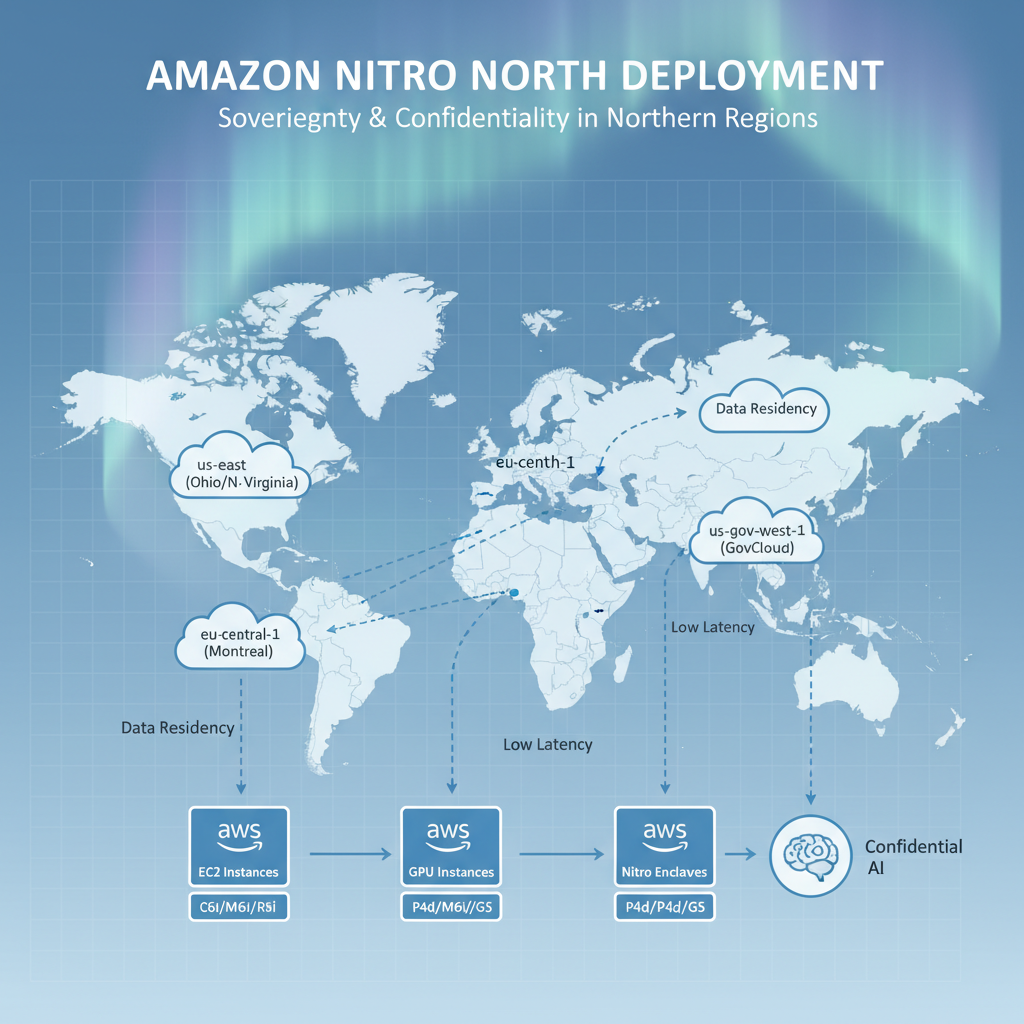
    Using Nitro-based AWS infrastructure in northern, sovereignty-obsessed regions (U.S., Canada, Nordics, EU North, GovCloud, and emerging EU sovereign regions) to get security, performance, and data residency without losing your sanity—or your auditors.

    Let’s unpack what the AWS Nitro System actually is, why it matters for cloud security and data sovereignty, and how you can weaponize it for your “we really care about data residency” workloads.


    High-level conceptual diagram of the AWS Nitro System showing decomposed components and secure, high-performance cloud infrastructure

    1. What Is the AWS Nitro System?

    Think of Nitro as AWS looking at the old-school hypervisor stack and saying, “Yeah, no. We can do better.”

    Traditional hypervisors try to do everything. Nitro rebuilds virtualization from the ground up, splitting responsibilities into tightly scoped, hardened components. That’s the foundation of Nitro-based AWS infrastructure.

    1.1 Nitro Cards: The Specialized Muscle

    Nitro Cards are dedicated hardware offload engines. Each card has a specific job and, unlike some of your projects, it actually does it:

    • Nitro Card for VPC – handles networking
    • Nitro Card for EBS – handles block storage
    • Nitro Card for instance storage – manages local NVMe / Nitro SSD

    By offloading networking and storage:

    • Your host CPU is freed up for your workloads
    • You get predictable performance instead of “it’s slow because neighbors” drama
    • A big chunk of the previous “hypervisor magic” is now hard-wired and locked down in silicon
    Takeaway: Nitro Cards are like bouncers for your EC2 instances—specialized, strict, and not chatting with your data.

    1.2 Nitro Security Chip: The Hardware Bouncer

    This is the root of trust in the AWS Nitro System.

    The Nitro Security Chip:

    • Enforces secure boot with hardware-backed verification
    • Continuously checks firmware integrity
    • Blocks unauthorized firmware changes
    • Is designed so even AWS operators can’t log into your instance

    Let that last sentence sink in. No “oops, a support engineer SSH’d into prod” scenarios. The architecture literally prohibits administrative access to your instances from AWS.

    Takeaway: If your compliance team had a wishlist, “no cloud operator access” was probably near the top. Nitro checks that box in Sharpie and is a cornerstone of secure cloud infrastructure.

    1.3 Nitro Hypervisor: Diet Hypervisor, Zero Bloat

    Nitro uses a minimal KVM-based hypervisor that:

    • Only does CPU + memory virtualization and device assignment
    • Has no general-purpose OS
    • Has no networking or storage stack

    Result?

    • Tiny attack surface
    • Fewer bugs to fear
    • Performance that’s “nearly indistinguishable from bare metal” for many workloads

    And for a bunch of instance families, you can even go bare metal (*.metal) while still being protected by the Nitro Security Chip.

    Takeaway: Nitro turned the hypervisor from a chubby Swiss Army knife into a lean, mean, isolation machine.

    1.4 What This All Adds Up To

    By decomposing virtualization into hardware, firmware, and a tiny hypervisor, the AWS Nitro System:

    • Shrinks the trusted computing base (TCB)
    • Cuts out operator/admin access
    • Frees more CPU and memory for your workloads
    • Delivers instances that are fast, cost-efficient, and secure

    In other words, Nitro is the invisible secure cloud infrastructure upgrade your workloads deserve, even if your CFO doesn’t appreciate the poetry of ASIC offload.


    Visualization of Nitro Cards as specialized hardware modules offloading networking and storage from EC2 hosts

    2. Why Nitro Exists: Escaping the Traditional Hypervisor Swamp

    Old-school virtualization (Xen, VMware, Hyper-V) uses a big privileged domain (Dom0, management OS, etc.) to:

    • Own the hardware
    • Run tons of drivers
    • Handle networking and storage
    • Expose management APIs

    That works, but:

    • Big OS = big attack surface
    • Drivers and services = bug buffet
    • Misconfig or exploit = potential tenant isolation issues
    • Hypervisor overhead = wasted CPU/RAM you still pay for

    AWS took the “what if we just… didn’t?” approach:

    • Move networking and storage to Nitro Cards
    • Move trust to the Nitro Security Chip
    • Strip the hypervisor down to the bare minimum

    That’s why Nitro-based AWS infrastructure is especially attractive in:

    • Financial hubs (New York, Toronto, London)
    • Government / defense regions (e.g., GovCloud (US))
    • Privacy-obsessed northern Europe (Stockholm, Nordics, EU North)

    When people say “Nitro in the north” or “Amazon Nitro North,” they’re basically talking about:

    Nitro-backed EC2 capacity in regions where data can’t leave, security can’t compromise, and latency can’t suck.


    Cybersecurity-focused illustration of the Nitro Security Chip acting as a hardware bouncer and root of trust for secure cloud workloads

    3. Why Nitro Is a Big Deal for Northern (and Global) Workloads

    3.1 Security: No-Operator-Access and Locked-Down Control Plane

    Nitro’s big flex: AWS operators do not have admin access into your instances.

    Practically, that means:

    • No secret SSH backdoor for AWS
    • No “hypervisor console” for them to peek at your workloads
    • EC2 operations (start/stop/attach volume) go through signed, authenticated APIs on Nitro hardware
    • Firmware is loaded from encrypted, verified storage on every boot

    If your world involves:

    • PII
    • Financial records
    • Healthcare data
    • Law-enforcement / national-security workloads

    …being able to say “even the cloud provider can’t log in” is extremely helpful when auditors show up with clipboards and suspicion.

    Takeaway: Nitro gives you zero-operator-access bragging rights. That’s gold in regulated environments and a huge differentiator when you’re building secure cloud infrastructure for sensitive workloads.

    3.2 Performance: More Server for You, Less for Overhead

    By kicking most virtualization work off to hardware:

    • Your instances get more of the host’s CPU and RAM
    • Networking and storage are fast and predictable
    • EBS and Nitro SSDs can hit serious throughput and IOPS in the latest generations

    Perfect for:

    • High-frequency trading
    • Real-time analytics
    • Low-latency APIs and AI inference close to users in North America and the Nordics
    Takeaway: Nitro turns “shared cloud” into “feels-like-bare-metal cloud” for a lot of workloads—especially when deployed as Nitro-based AWS infrastructure in a northern region.

    3.3 Cost: Performance Per Dollar That Doesn’t Make You Cry

    Because AWS can run more efficient, Nitro-powered hosts:

    • They operate denser, more efficient fleets
    • They can price many Nitro-based instance families more aggressively
    • You get more usable resources per dollar (i.e., fewer ghost CPUs eaten by hypervisor overhead)

    Pair that with cooler climates and renewable energy in northern regions, and you get solid price/perf plus bonus ESG points.

    Takeaway: Nitro doesn’t just make things faster; it improves the performance-per-dollar equation for your Nitro-based AWS infrastructure.

    Conceptual visualization of Nitro Enclaves as isolated, heavily fortified chambers inside EC2 instances for confidential computing

    4. Nitro Enclaves: Confidential Computing for Paranoid Adults

    If Nitro is the foundation, Nitro Enclaves are the panic room.

    They let you carve out isolated execution environments inside a Nitro-based EC2 instance that:

    • Have no external network access
    • Have no persistent storage
    • Have no direct SSH/shell access (not even for root on the parent)
    • Talk only via vsock (a secure local socket) with the parent instance

    You also get attestation:

    • Prove to an external system that:
      • You’re on real Nitro hardware
      • The enclave is running the exact expected code/image

    This is often tied to KMS, so keys are only released to “good” enclaves.

    Takeaway: Nitro Enclaves are where you put the logic and data that sit firmly in the “if this leaks, I quit” category.

    4.1 Popular Northern Use Cases

    You see Nitro Enclaves lighting up in Amazon Nitro North style architectures across:

    • Financial services
      • Decrypt/process payments
      • Hold private keys
      • Run risk models on sensitive data
    • Healthcare
      • Process PHI/PII for analytics or AI
      • Run identity matching or de-anonymization securely
    • Public sector / defense
      • Identity verification pipelines
      • Sensitive analytics and intel workloads

    These all pair local data residency (e.g., eu-north-1, ca-central-1, GovCloud) with confidential compute. That combo is basically what “Amazon Nitro North” is hinting at: regional sovereignty plus Nitro-backed confidential computing.

    Takeaway: If your threat model includes “admins” and “cloud provider staff,” enclaves are your new best friend.

    Architectural map-style illustration of Amazon Nitro North deployments across U.S., Canada, and Northern Europe regions with Nitro-based compute and enclaves

    5. Nitro and AI: Keeping Your Models and Prompts Out of the Gossip Columns

    Welcome to 2024/2025, where every architecture diagram now has at least one box labeled “AI” circled in red.

    Nitro is quietly one of the big reasons AWS can say:

    • For Nitro-based GPU and accelerator instances (P, G, Trainium, Inferentia, etc.), Amazon personnel can’t see your models or data running on those machines.

    So if you’re:

    • Running LLM inference on GPUs in eu-north-1 for a Nordic bank
    • Training healthcare models in us-east-1 for a U.S.-only environment
    • Doing AI in ca-central-1 under Canadian residency rules

    …Nitro is part of the guarantee that your:

    • Model weights
    • Customer prompts
    • Training data

    aren’t being snooped, even by the provider.

    Combine that with:

    • Nitro Enclaves for key management and sensitive preprocessing
    • Attestation to prove workloads are running where and how you claim

    And you can build:

    • End-to-end confidential AI pipelines:
      • Data lands encrypted
      • Keys are released only to attested Nitro (or enclave) nodes
      • Training/inference runs in operator-free environments
    Takeaway: Nitro is the unglamorous hero behind secure AI in the cloud, especially in northern, compliance-heavy regions that fit the Amazon Nitro North pattern.

    Reference architecture for a Nordic fintech on Nitro in eu-north-1 showing frontends, core banking, enclaves, and AI tiers with regional data residency

    6. Designing an “Amazon Nitro North” Architecture

    Let’s glue this together into something that looks like an actual platform rather than a cool buzzword mashup.

    6.1 Step 1: Pick the Right Region and Instance Families

    1. Region selection (the “North” part):
      • U.S.: us-east-1, us-east-2, us-west-2, or GovCloud (US) for stricter controls
      • Canada: ca-central-1
      • Europe: eu-north-1 (Stockholm), plus various eu-west-* and upcoming northern/EU sovereign regions

      These give you low-latency access to northern users and help you meet data residency and data sovereignty requirements.

    2. Instance families (the “Nitro” part):
      • General/compute: M6/M7, C6/C7, R6/R7 (Intel, AMD, Graviton)
      • Memory / DB: R* families, some X* families
      • AI & GPU: P*, G*, trn*, inf*
      • Bare metal: *.metal when you need low-level control but still want Nitro security
    Takeaway: Step one of “Amazon Nitro North” is basically: move to a northern region that meets your sovereignty needs and stop using dinosaur instance types. Build on Nitro-based AWS infrastructure by default.

    6.2 Step 2: Use Nitro Enclaves Where You Actually Lose Sleep

    Good places to start:

    • Key management / decryption
      • Keys live in KMS
      • Only released to attested enclaves
    • Payment processing / PII workflows
      • Parent instance receives encrypted payloads
      • Enclave does decryption + sensitive logic
      • Only returns minimal results (tokens, flags, decisions)

    Auditors love this pattern because:

    • Privileged admins can’t read the raw sensitive data
    • You can prove that the enclave is running exactly what you say it is
    • Data never leaves your chosen northern region
    Takeaway: Don’t enclave all the things. Enclave the things your CISO actually yells about.

    6.3 Step 3: Turn On NitroTPM and Measured Boot Like a Responsible Adult

    Nitro-based instances support NitroTPM, a virtual TPM 2.0 anchored in Nitro’s hardware trust.

    Use it to:

    • Implement measured boot (hashing boot components as the system starts)
    • Verify instance integrity automatically before:
      • Handing out app secrets
      • Registering nodes into high-trust clusters (payments, KYC, auth, etc.)

    This aligns beautifully with:

    • NIST
    • ISO 27001
    • SOC 2
    • And every security framework that loves the phrases “root of trust” and “measured boot”
    Takeaway: TPM + Nitro = your chance to be the security team’s favorite application team for once—and strengthens your secure cloud infrastructure story.

    Detailed Nordic fintech architecture on Nitro in eu-north-1 with frontends, core banking, enclaves, AI tier, and security overlays

    7. Real-World-Style Example: A Nordic Fintech on Nitro

    Let’s pretend you’re a fintech in Stockholm. You care about:

    • EU data residency
    • Banking secrecy
    • Regulator-induced insomnia

    Here’s your Amazon Nitro North setup in eu-north-1:

    1. Frontend & APIs
      • Run on Graviton-based M7g/C7g (Nitro-backed, cost-efficient, good perf)
      • TLS everywhere, PII stripped from logs before storage
    2. Core Banking / Ledgers
      • On R7 instances (memory-friendly)
      • EBS encrypted via KMS with region-locked CMKs
    3. Sensitive Payloads in Nitro Enclaves
      • Card numbers, ID docs, etc. only decrypted inside Nitro Enclaves
      • KMS keys are released only after enclave attestation passes
    4. Fraud Detection & AI
      • Models train and infer on Nitro-based GPU instances in eu-north-1
      • Training data encrypted at rest, decrypted only into attested Nitro nodes
    5. Compliance Story
      • NitroTPM-based measured boot for key services
      • Evidence showing:
        • No operator access
        • Region-only data residency
        • Enclave-based protection of the crown jewels
    Takeaway: That’s Amazon Nitro North as an actual thing you can build today, not just something that sounds good on a slide.

    Map-style architectural diagram highlighting Nitro-based deployments in northern AWS regions with data residency and confidential AI

    8. Getting Started with Nitro in Your Own Environment

    Action items before this just becomes another “nice blog I read once”:

    1. Inventory your EC2 fleet
      • Spot old, non-Nitro dinosaurs (T2, M3, C3, etc.)
      • Plan migrations to Nitro families in your target region
    2. Pick your “north” (if sovereignty matters)
      • U.S.? GovCloud / east / west.
      • Canada? ca-central-1.
      • Europe? eu-north-1 or another EU region aligned with your laws.
    3. Choose one sensitive use case for Nitro Enclaves
      • Payment tokenization
      • Identity verification
      • Key management
      • Start small: one service, one enclave workflow.
    4. Turn on NitroTPM + measured boot in your golden images
      • Update AMIs / OS configs
      • Integrate integrity checks into your secret distribution logic
    5. Loop in security and compliance early
      • Hand them AWS’s Security Design of the AWS Nitro System whitepaper
      • Map Nitro features to your controls:
        • “No operator access”
        • “Secure boot”
        • “Confidential compute (enclaves)”
        • “TPM-backed attestation”
    Takeaway: You don’t have to refactor your whole platform to get Nitro benefits. Start with region, instance families, one enclave use case, and TPM, and grow your Nitro-based AWS infrastructure from there.

    Big-picture conceptual visualization summarizing Nitro-based secure, sovereign cloud infrastructure across northern regions

    9. The Big Picture: What “Amazon Nitro North” Really Means

    Underneath the marketing-adjacent phrasing, here’s what we’re actually talking about:

    • Nitro =
      • Nitro Cards + Nitro Security Chip + minimal hypervisor
      • No-operator-access design
      • Strong isolation + performance close to bare metal
    • North =
      • Regions like us-east-*, ca-central-1, eu-north-1, GovCloud, and EU sovereign builds
      • Data residency, low latency to northern users, and stricter compliance
    • Amazon Nitro North (in practice) =
      • Architectures that use Nitro-based AWS infrastructure, Nitro Enclaves, NitroTPM, and northern regions to deliver:
        • Sovereign, local data processing
        • Confidential computing for sensitive and AI workloads
        • High performance per dollar
        • A secure cloud infrastructure story that makes auditors significantly less grumpy

    If you care about security, performance, and “our data must stay here” in the U.S., Canada, or Europe, building on Nitro in a northern region isn’t just a nice idea—it’s pretty much the new baseline for modern, sovereign cloud architectures.


  • Amazon India BIE Salary Guide 2025


    Amazon India BIE Salary Guide 2025


    Amazon India BIE Salary Guide 2025

    Dynamic illustration of a Business Intelligence Engineer at Amazon India surrounded by SQL, charts, and dashboards

    Business Intelligence Engineer Salary at Amazon India (2025 Guide)

    So you want to be a Business Intelligence Engineer at Amazon India—basically the person who speaks fluent SQL, charts, and business jargon while everyone else is still asking, “Wait, what’s a metric?”

    Good news: the Amazon Business Intelligence Engineer salary in India is solid. Bad news: you might start dreaming in window functions.

    Here’s your no-nonsense, slightly-sarcastic 2025 guide to Business Intelligence Engineer salary at Amazon India—what you can realistically earn, how it changes by level and location, and what you need to do to be more “top of band” and less “thanks for applying.”


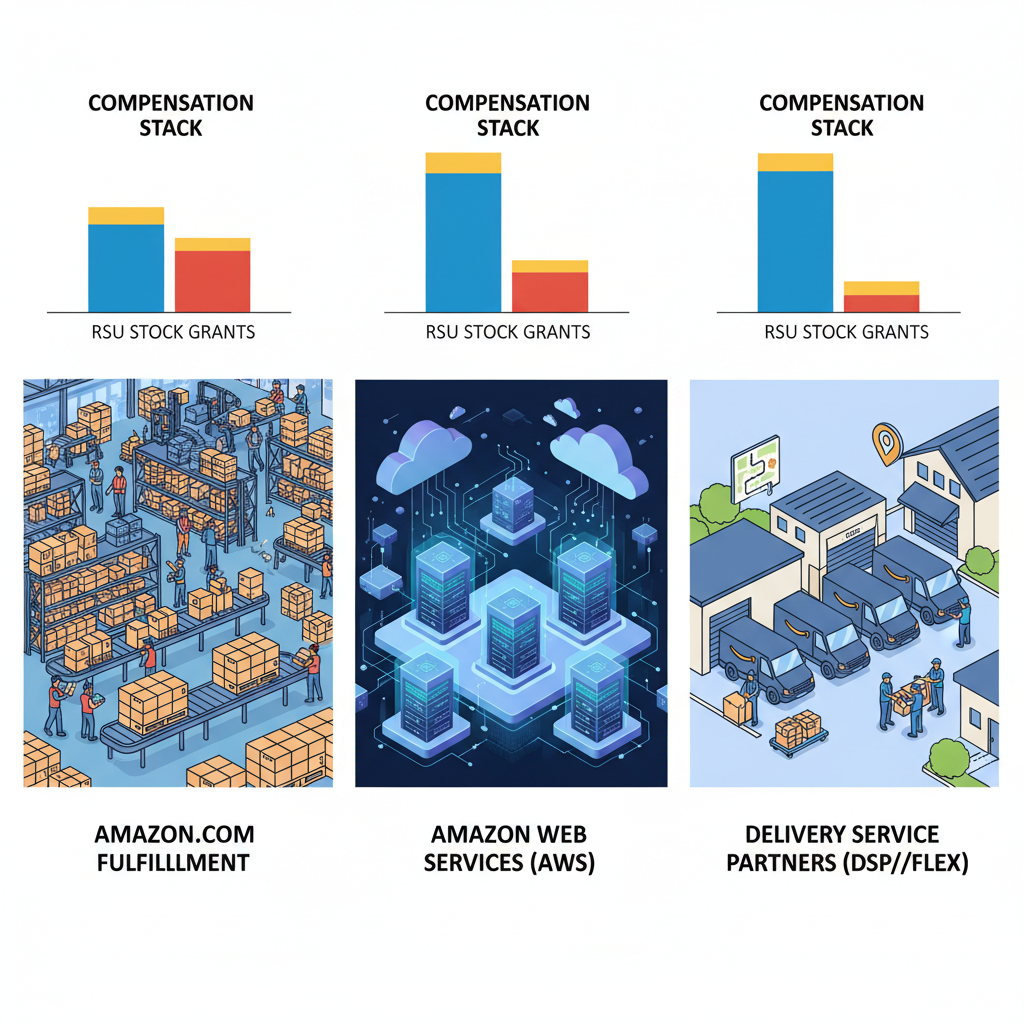
    Conceptual infographic of Amazon India BIE compensation structure as a three-part thali with base, bonus, and RSUs

    What Does a Business Intelligence Engineer Do at Amazon?

    Think of a Business Intelligence Engineer (BIE) at Amazon as:

    • 30% data engineer
    • 40% analyst
    • 30% product/business brain

    Or if you’re more visual: one part SQL wizard, one part Excel therapist, one part “why are our metrics tanking this week” detective.

    You sit at the crossroads of:

    • Data engineering – pulling, transforming, and modeling data so it doesn’t look like it came out of a blender
    • Analytics – designing metrics, building dashboards, finding patterns, and doing deep-dives
    • Business decision-making – helping PMs, Ops, Finance, and Marketing stop guessing and start deciding

    Typical BIE chores (sorry, “responsibilities”) at Amazon:

    • Writing complex SQL on Redshift / data lakes that can scare junior analysts and impress hiring managers
    • Building metrics, dashboards, and automated reporting (QuickSight, Tableau, internal tools)
    • Running experiments / A/B tests, then explaining the results to someone who mostly cares about “did conversion go up?”
    • Partnering with PMs / Ops / Finance to answer “why is this happening?” instead of just “what happened?”
    • Defining data requirements, catching data issues, and making sure your dashboards don’t lie

    Because these decisions often move millions of dollars, Amazon is happy to pay a premium for BIEs who can:

    • Own end-to-end analytical systems, and
    • Influence roadmaps rather than just refresh dashboards

    Translation: if you can think like a product person and code like a BI nerd, your Amazon BIE salary in India tends to go up and to the right.


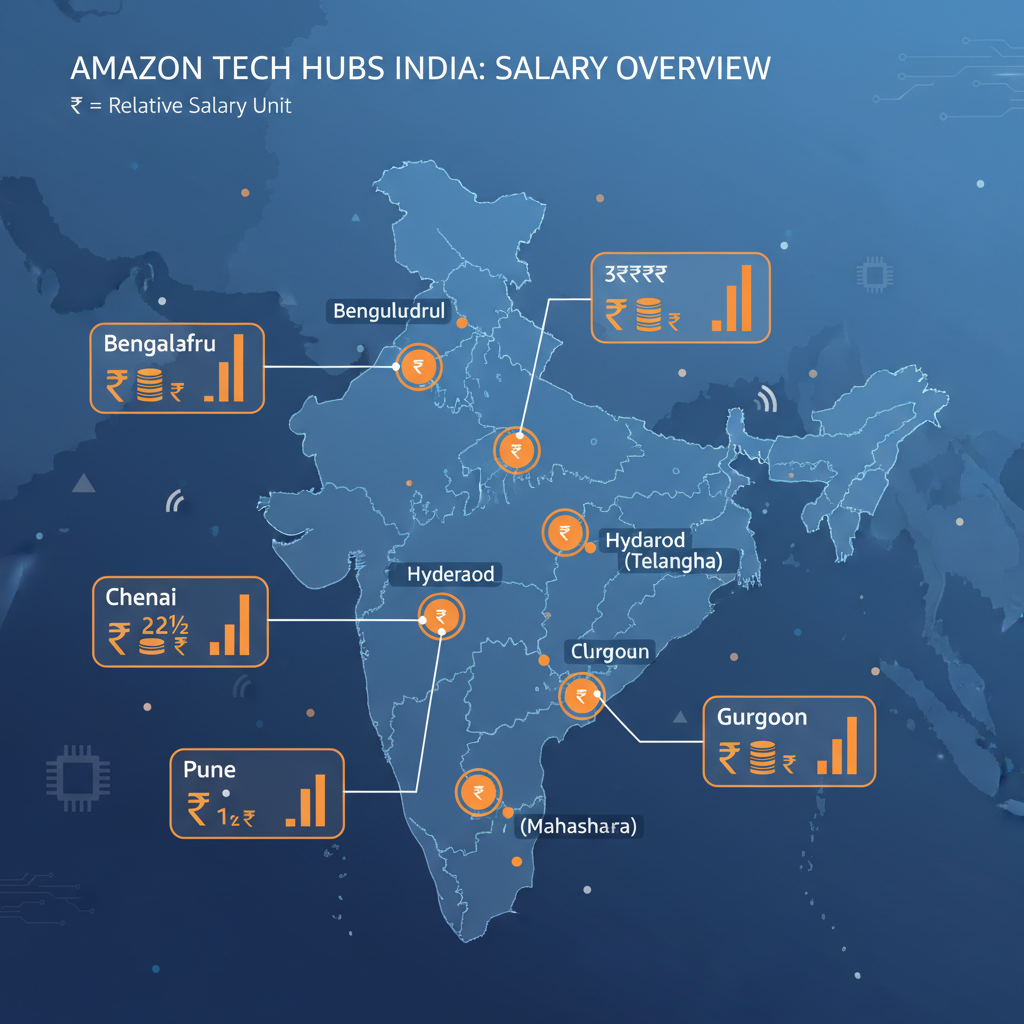
    Infographic style visualization of Amazon India BIE salary structure with rupee symbols and stock graphs

    Salary Structure for Amazon BIEs in India

    Amazon compensation is like a thali: multiple items, some spicy, some confusing.

    The usual components of Business Intelligence Engineer compensation at Amazon India:

    1. Base salary
      • Fixed yearly amount (paid monthly)
      • The thing HR mentions the most
    2. Performance bonus
      • Typically a percentage of base
      • Depends on your performance + team/company performance
      • Not usually the biggest piece, but still nice
    3. Stock (RSUs – Restricted Stock Units)
      • Amazon shares that vest over 4 years
      • Often backloaded (years 3 & 4 are juicier)
      • The part that makes your “CTC” look way more attractive in PPT slides

    Most “total compensation” numbers you see online = base + bonus + RSUs (averaged per year).

    If you ignore RSUs while comparing Amazon India BIE salary offers, that’s like ordering a pizza and throwing away all the cheese.


    Career ladder illustration of Amazon India BIE levels from L4 to L7+ with increasing rupee signs and responsibility

    Entry-Level / Junior BIE Salary (L4, ~0–2 years)

    This is the “I can write SQL and I brought my Kaggle portfolio” stage of your Business Intelligence Engineer career at Amazon India.

    Typical backgrounds:

    • Engineering / CS / Stats / Math / Economics
    • BI or data analyst internships
    • Tier-1/Tier-2 colleges or killer projects / internships

    Based on recent data for entry-level Business Intelligence Engineer (0–2 years) at Amazon India:
    (webpeak.org)

    Entry-Level (L4) – 2025 Snapshot

    • Total compensation: ~₹14–22 LPA
    • Base: ₹10–14 LPA
    • Bonus: ~5–10% of base
    • RSUs: ₹2–6 LPA (annualized over 4 years)

    This is broadly aligned with BI roles like “Business Intelligence Developer / Analyst” on Indeed, typically ₹9–15 LPA depending on team and city.
    (Indeed India)

    What actually helps you not start at the absolute bottom of the band for an Amazon L4 BIE salary in India:

    • Strong SQL (joins, window functions, subqueries, CTEs)
    • Some data modeling sense (dimensions, facts, star schema)
    • Solid internships, ideally in product / analytics / tech
    • Clear thinking in case / analytics interview questions

    Translation: side projects > buzzwords on your resume.


    Upward salary path for mid-level Business Intelligence Engineers at Amazon India

    Mid-Level BIE Salary (L5, ~2–6 years)

    Welcome to “we trust you to not break production dashboards… most of the time.”

    By L5, you’re expected to:

    • Work independently and not ask your manager how to write every query
    • Own complex dashboards, pipelines, or data models for a domain
    • Influence key product/ops decisions with your analysis
    • Mentor junior BIEs / analysts and review their work

    Recent Levels.fyi data for Amazon Business Intelligence Engineer salary in India (L5):
    (levels.fyi)

    • Total compensation (L5 BIE):
      • Low end: ~₹41.9 LPA (~₹4.19M)
      • Average: ~₹47.4 LPA (~₹4.74M)
      • Rough split:
        • Base: ~₹38.8 LPA
        • Stock: ~₹5.8 LPA
        • Bonus: ~₹2.8 LPA

    Independent India-specific breakdowns for mid-level BIE salary at Amazon India:
    (webpeak.org)

    Mid-Level (L5) – Indicative Range

    • Total compensation: ~₹25–40 LPA
    • Base: ₹18–26 LPA
    • Bonus: 10–20% of base
    • RSUs: ₹6–12 LPA

    Why such a wide range in Amazon mid-level BIE salary in India?

    • Lower vs higher end of L5
    • Team (AWS, Ads, Consumer, Ops, etc.)
    • Location (Bengaluru/Hyderabad often slightly higher)
    • How badly Amazon wanted to stop you from going to another FAANG

    If you’re already L4 somewhere with 2–3 years’ experience and strong projects, getting leveled at L5 can be your single biggest compensation jump.


    Senior-level salary visual for Amazon India Senior BIEs with stock and responsibility icons

    Senior BIE Salary (L6, ~6–12 years)

    This is the “I don’t just build dashboards; I define what the business should even be looking at” level of Business Intelligence Engineer salary at Amazon India.

    At L6, expectations jump:

    • You own analytics for a large product area or business line
    • You design data models, metrics, experimentation frameworks across teams
    • You’re in regular conversations with Sr PMs, Sr Managers, Directors
    • You lead other BIEs/analysts technically, even without people-manager responsibilities

    Levels.fyi estimate for L6 BIE salary in India:
    (levels.fyi)

    • Median total comp: ~₹67.1 LPA (₹6.71M)
    • Common band: ₹60–75 LPA, roughly:
      • Base: ~₹53.3 LPA
      • Stock: ~₹22.6 LPA
      • Bonus: often smaller or blended into overall cash packages

    Independent salary estimates put Senior Business Intelligence Engineer salary at Amazon India (L6) roughly in the ₹40–65+ LPA total range, with the top end heavily driven by RSUs.
    (webpeak.org)

    6figr data (small sample, but still useful):
    (6figr.com)

    • Average Senior BIE: ~₹42.4 LPA
      • Range in their sample: ~₹40.4–49.4 LPA
      • Example profile:
        • 6.4 years experience
        • Base: ~₹35.6 L
        • Stock: ~₹7.1 L
        • CTC: ~₹42.7 LPA
    Key decoding tip:
    6figr is mostly verified but small sample → realistic but often understates the high end.
    Levels.fyi tends to capture more aggressive packages, especially AWS/Ads/top teams.

    Principal and lead-level Amazon India BIE salary curve with emphasis on RSU-heavy compensation

    Principal / Lead-Level BIE Salary (L7+)

    Now you’re in “we’re trusting you with org-wide data strategy and very expensive meetings” territory.

    Typical responsibilities:

    • Defining data strategy and standards across large orgs
    • Owning metrics frameworks, experimentation practices, BI tooling direction
    • Partnering with Directors/VPs on high-stakes decisions
    • Leading large cross-functional initiatives and influencing multiple teams

    Market breakdowns indicate for Principal/Lead Business Intelligence Engineer salary at Amazon India:
    (webpeak.org)

    Principal / Lead (L7+) – Rough Range

    • Total compensation: roughly ₹65 LPA → ₹1.2 crore+
    • Very RSU-heavy at the top end

    At this level, comp becomes extremely individualized:

    • Your negotiation skills
    • Which org you join (AWS vs Consumer vs Ads vs Fintech, etc.)
    • Amazon’s stock price and timing of grants
    • How rare your skill profile is for that org

    Short version: if you’re L7, your problem is less “what’s the salary band?” and more “how do I not check my stock price 17 times a day?”


    Stylized map of India showing major Amazon tech hubs and city-wise BIE salary differences

    City-Wise Amazon BIE Salary Differences in India

    Yes, location still matters. No, you can’t just say “remote from Goa” and expect Hyderabad numbers. Yet.

    Major Amazon tech hubs in India:

    • Bengaluru
    • Hyderabad
    • Chennai
    • Pune
    • Gurgaon (Delhi NCR)

    Bengaluru

    Big hub for tech, AWS, Ads, Seller Services.

    Glassdoor data for Amazon Business Intelligence Engineer salary – Bangalore:
    (Glassdoor)

    • Total pay range: ~₹18–29 LPA
    • Median total pay: ~₹22 LPA
    • Median base: ~₹19 LPA
    • Additional (bonus + stock): ~₹4–8 LPA

    This mostly reflects L4–early L5 BIE salary in Bangalore. L6+ numbers go well beyond this.

    Hyderabad

    Amazon’s largest tech hub in India.

    Frequently cited as offering ~5–10% higher compensation than some other cities for hot skills.
    (webpeak.org)

    Hyderabad + in-demand org (AWS/Ads) is often a very spicy combo for Amazon BIE salary in Hyderabad.

    Chennai & Pune

    Smaller than BLR/HYD, but still solid engineering hubs.

    Comp is competitive, though often with slightly lower upper variance.
    (webpeak.org)

    So: strong pay, slightly fewer “blow-your-mind RSU” stories.

    Gurgaon (Delhi NCR)

    Focus on Amazon Pay, Retail, Operations, Consumer.

    Compensation is broadly in line with Bengaluru, especially for L5+.
    (webpeak.org)

    Net takeaway for city-wise Business Intelligence Engineer salary at Amazon India:

    • HYD/BLR are usually at the top end
    • Other cities are very competitive, just with tighter ranges and fewer extreme outliers

    Dashboard-style comparison of different data roles and salary ranges at Amazon India

    Amazon BIE vs Other Data Roles in India

    Is BIE the “best” data role? Depends what you like more: product + business, or ML models + crying over feature engineering.

    Recent comparison across India-based data roles at Amazon:
    (webpeak.org)

    Role Approx. Salary Range (India)
    Business Intelligence Engineer ₹18–45 LPA (mid/senior often higher)
    Data Analyst ₹6–15 LPA
    Business Intelligence Analyst ~₹9 LPA (Indeed avg)
    Business Intelligence Developer ~₹14.7 LPA (Indeed avg)
    Data Scientist ₹12–35 LPA
    Data Engineer ₹15–40 LPA
    Product Analyst ₹10–25 LPA

    How to read this:

    • BIE is clearly above vanilla data/BI analyst roles in terms of pay and scope
    • Data Engineers / Data Scientists can have similar or slightly higher ceilings, especially at senior levels
    • BIEs get strong business exposure and can pivot into:
      • Product Analytics Lead
      • Data Science (with upskilling)
      • Product Manager (with enough scar tissue from working with PMs)

    So if you like the intersection of business + engineering, the Business Intelligence Engineer role at Amazon India is very well-positioned.


    Conceptual graphic showing factors that influence Amazon India BIE salaries including level, team, location, skills, and negotiation

    Factors That Influence Your Amazon BIE Salary in India

    Think of your salary as a function:

    Salary = f(level, team, location, skills, negotiation)

    Let’s unpack.

    1. Level (L4 vs L5 vs L6…)

    The single biggest factor behind your Amazon Business Intelligence Engineer salary in India.

    • L5 can easily be 1.5–2x L4
    • L6 can be another 1.5–2x L5 when RSUs kick in hard
      (levels.fyi)

    So even if your interviews go okay, which level you get mapped to is what really decides your comp bracket.

    Hot tip: if you’re borderline between L4 and L5, extra polishing on system-design-ish BI topics and strong examples of ownership can push you up a level.

    2. Team & Org

    Some orgs are simply richer (in margins, not just vibes):

    • AWS
    • Ads / Marketing Tech
    • High-margin or high-growth product lines

    These teams often:

    • Have more budget
    • Compete harder with external market
    • Offer better upside in RSUs and sometimes sign-ons

    If you’re talking to a revenue-critical or high-visibility team, your negotiation power—and your potential Amazon India BIE salary—tends to go up.

    3. Location

    We covered this earlier, but to recap:

    • Hyderabad & Bengaluru often slightly higher
    • Other locations are still strong, but fewer extreme outliers
      (webpeak.org)

    Location won’t usually double your pay, but it can give you a decent 5–10% bump plus better team options.

    4. Skill Depth and Breadth

    Your comp gravitates upward if you bring:

    • Deep SQL skills (performance tuning, complex joins, window functions)
    • Strong data warehousing background (Redshift, BigQuery/Snowflake-like systems)
    • BI tools: QuickSight, Tableau, Power BI, or similar
    • Comfort scripting in Python / Java / Scala for automation
    • Experience designing metrics, experimentation frameworks, and KPI trees

    In other words, if you can both build the pipeline and argue intelligently about which metric should be on the leadership dashboard, your Business Intelligence Engineer salary at Amazon India has room to climb.

    5. Negotiation & Comp Cycles

    Amazon can play with:

    • Initial RSU grant size
    • Sign-on bonuses (1–2 years)
    • Adjustments during performance / comp cycles

    You have more negotiation leverage if:

    • You have competing offers (FAANG, top startups, strong product companies)
    • You’re being hired into an urgent/hard-to-fill role

    Be polite but firm. You’re not haggling over vegetables; you’re negotiating your 4-year earnings.


    Aspirational scene of a candidate preparing for Amazon BIE interviews with SQL, leadership principles and target L5 compensation on screen

    How to Position Yourself for a High Amazon BIE Salary

    If your goal is not just “get in” but “get in at the top half of the band,” here’s what to focus on.

    Build a Strong Portfolio

    Show, don’t just tell:

    • Public dashboards using real or public datasets
    • Case studies showing your work led to:
      • Revenue uplift
      • Cost reduction
      • Operational efficiency
      • Customer experience improvement
    • Kaggle / open-source / analytics blog posts that show how you think

    Hiring managers love clear business impact more than “I used 18 libraries in Python.”

    Master the Core Tech Stack

    Bare minimum skill set that actually moves the Amazon BIE salary needle:

    • SQL
      • Complex joins, nested queries, CTEs
      • Window functions
      • Query optimization basics
    • Data modeling
      • Star/snowflake schemas
      • Dimensions, facts, SCDs
    • Visualization & storytelling
      • Executive-ready dashboards
      • Clear narratives: “Here’s what happened, why, and what to do”
    • Scripting
      • Python or similar for automation, ETL, heavier analysis

    You don’t necessarily need to be a full-on data engineer… but you shouldn’t be scared of a pipeline, either.

    Practice Amazon-Style Interviews

    Get ready for three main categories:

    • SQL & data modeling
      • Real-world style problems; not just “select * from”
    • BI / analytics case rounds
      • Metric design
      • Experiment analysis
      • Root-cause deep-dives
    • Behavioral / Leadership Principles
      • Ownership, Dive Deep, Deliver Results, Bias for Action, etc.

    Performing strongly here can mean being leveled L5 instead of L4, or L6 instead of L5—and that’s tens of lakhs per year difference in your Business Intelligence Engineer salary at Amazon India.


    Summary visualization of Amazon India BIE salary bands from entry-level to principal

    Summary: What Can You Realistically Expect in 2025?

    Let’s stitch this into one clean mental model for Amazon BIE salaries in India (2025):

    • Entry-level (L4, 0–2 years):
      • ~₹14–22 LPA total
      • Base ~₹10–14 LPA, small bonus + RSUs
    • Mid-level (L5, 2–6 years):
      • ~₹25–40+ LPA total
      • Real-world medians often in the ₹40–47 LPA range for strong L5s with healthy RSUs
        (webpeak.org)
    • Senior (L6, 6–12+ years):
      • Typically ₹40–65+ LPA
      • Some packages in ₹60–70 LPA+ territory when stock is generous
    • Principal (L7+):
      • Roughly ₹65 LPA → ₹1.2 crore+
      • Very individualized, RSU-heavy

    Across the board, Amazon remains one of the top-paying employers for Business Intelligence Engineers in India, especially once you hit L5 and above, where stock and bonuses start to matter a lot more than just base salary.


    Focused candidate at a home office mapping next steps to land a high Amazon India BIE salary

    Next Steps

    If you’re actually aiming for this (and not just here for salary voyeurism):

    1. Study current Amazon BIE JDs
      • Note their tech stack & responsibilities
      • Map against your current skills and gaps
    2. Benchmark your profile
      • Use Levels.fyi, Glassdoor, 6figr, and similar tools
      • Set realistic target bands for your level and city
      • Example: “L5 in Bangalore with 4YOE → target 35–45 LPA”
    3. Create a focused prep plan
      • 4–6 weeks: hardcore SQL + data modeling practice
      • 2–3 weeks: BI case studies, metric design, experiment analysis
      • Parallel track: Leadership Principles examples prepared in STAR format
    4. Negotiate smartly when you get an offer
      • Prioritize: level → RSUs → sign-on → base
      • Use competing offers for leverage, without being obnoxious

    If you want something more tailored, share your experience (years), current CTC, and target city, and we can sanity-check what level and Amazon Business Intelligence Engineer salary in India to aim for—and where to focus your prep to actually get there.


  • Amazon Operations Manager Salary in 2025: The Real Numbers


    Amazon Operations Manager Salary in 2025: The Real Numbers


    Amazon Operations Manager Salary in 2025: The Real Numbers

    Amazon operations is not a cozy MacBook-at-a-café situation. It’s 5 a.m. handoffs, broken conveyors, and headcount puzzles — but the paycheck and stock can absolutely make the chaos feel worth it. Here’s the no‑BS breakdown of what Amazon Operations Managers really earn in 2025, and what actually moves the numbers.


    Amazon fulfillment center interior with operations manager reviewing salary and compensation dashboards

    Amazon Operations Manager Salary in 2025: What You Really Earn (and What Affects It)

    If you’ve ever found yourself Googling “Amazon Operations Manager salary” while also wondering if you’ll ever sleep again during Peak… welcome, friend.

    Let’s be honest: Amazon operations is not a “cozy laptop at a coffee shop” job. It’s “5 a.m. shift handoff, 200 associates, 10 broken conveyors, and someone just called out” energy. The upside? The Amazon Operations Manager salary is usually solid enough that you’ll at least feel better while chugging that third energy drink.

    Below is the no‑BS breakdown of what an Amazon Operations Manager earns in 2025 in the U.S., how that pay changes by level, location, and business unit, and what you can realistically expect as your career levels up.


    Infographic style visualization of Amazon Operations Manager compensation overview with base, bonus, and stock

    Overview: How Much Does an Amazon Operations Manager Make?

    Across U.S. Amazon Operations Manager roles (corporate, not DSPs), the compensation picture in 2025 looks roughly like this:

    • Estimated total pay: about $132,000–$187,000 per year
    • Median total compensation: around $155,000 per year
    • Median base salary: about $109,000 per year
    • Typical additional compensation (bonus + stock): about $46,000 per year
      (Glassdoor)

    That total pay number for an Amazon Operations Manager salary includes:

    • Base salary
    • Annual bonus / performance pay
    • The yearly value of RSUs (restricted stock units) vesting over time

    On job boards that show base salary only, you’ll see lower figures. For example, Indeed currently shows:

    • Average base for Operations Manager (Amazon.com, U.S.): ~$101,564/year
    • Range: about $47,000 to $176,000
      (Indeed)

    Key idea your wallet cares about:

    • Base = guaranteed “pay the rent” money
    • Stock and bonus = “maybe I’ll actually retire one day” money

    Key takeaway:
    If you include base, bonus, and stock, many U.S. Amazon Operations Managers land in the low‑ to mid‑$100Ks early on, and can grow into the mid‑$100Ks to $200K+ as they move up levels.

    If you’re trying to benchmark your own Amazon Operations Manager salary expectations, always think in terms of total compensation, not just base.


    Warehouse career ladder infographic showing Amazon operations career levels L4 to L7 with compensation ranges

    Salary by Level: L4, L5, L6, L7 Operations Roles

    Amazon’s pay is tightly linked to its internal leveling system. For operations and fulfillment, you’ll mostly see:

    • L4 – Area Manager / entry‑level ops roles
    • L5 – Operations Manager / sometimes Senior Area Manager
    • L6 – Senior Operations Manager / larger building or multiple teams
    • L7 – Regional / multi‑site ops leader

    Data from Levels.fyi and similar sources show operations compensation at Amazon spanning roughly $72.3K to $177K total, with a median around $86K across all ops roles, not just managers.
    (Levels.fyi)

    That’s not the full story for Operations Managers specifically, so let’s clean it up by level and see how the Amazon Operations Manager salary grows over time.

    L4 (Entry-Level Operations / Area Manager)

    Think of L4 as your “welcome to the chaos” starter kit. Titles here include Area Manager in fulfillment or sort centers.

    • Typical total comp: ~$70K–$75K per year
    • Approx breakdown:
      • Base: ~$57K
      • Stock: ~$8K (annualized)
      • Bonus: ~$7K

      (Levels.fyi)

    These roles might not have “Operations Manager” in the title yet, but they’re often the pipeline into L5.

    Section takeaway: L4 is your “prove you can run a shift without burning the building down” phase—lower Amazon Operations Manager salary territory, but with a solid runway to L5.

    L5 (Operations Manager)

    L5 is where the actual “Operations Manager” title becomes common and your life becomes a blur of metrics dashboards and headcount planning.

    This is the core Amazon Operations Manager level most people ask about when they search for “Amazon Operations Manager salary in 2025.”

    • Typical total compensation: ~$100K–$130K+
    • Example breakdown (recent U.S. data):
      • Base: $82K–$91K
      • Stock: $18K–$29K
      • Bonus: $13K–$23K
      • Total: often $104K–$123K+

      (Levels.fyi)

    This maps well to external medians for an L5 Amazon Operations Manager salary:

    • Base salary around $100K–$110K
    • Plus stock and bonus pushing many folks into the $110K–$140K all‑in territory

    Section takeaway: L5 is the “real” Operations Manager sweet spot: solid six‑figure Amazon Operations Manager salary potential, big scope, and the start of meaningful stock.

    L6 (Senior Operations Manager)

    At L6, you’re usually:

    • Running an entire building, or
    • Overseeing multiple large teams or complex functions across shifts

    Translation: If anything major breaks, it’s your problem.

    • Typical total comp: ~$160K–$210K+
    • Common L6 Ops Manager package examples:
      • Base: $120K–$134K
      • Stock: ~$31K–$52K
      • Bonus: ~$32K–$44K
      • Total: often around $180K–$205K+

      (Levels.fyi)

    These numbers line up with Glassdoor’s upper‑end estimates for Ops Managers:

    • Total pay can hit high‑$100Ks to low‑$200Ks, depending on performance and equity.
      (Glassdoor)

    Section takeaway: L6 is where the Amazon Operations Manager salary starts to feel distinctly “big tech” instead of “generic logistics.”

    L7 (Senior / Regional Operations Leader)

    L7 is less “I run a shift” and more “I run multiple sites or major regional operations.”

    • Typical U.S. L7 business/ops band:
      • High‑$100Ks to mid‑$200Ks+ total comp
      • With a huge chunk coming from stock

      (Levels.fyi)

    Your day job becomes a mix of strategic planning, budget ownership, and trying to remember the names of all the buildings you’re responsible for.

    Section takeaway: L7 pay is very strong, but the bar (and the scope) jumps dramatically. This is “VP pipeline” territory, and the Amazon Operations Manager salary at this level competes with other big‑tech leadership roles.


    Three-way comparison graphic of Amazon.com, AWS, and DSP ops environments with stacked compensation elements

    How Amazon Ops Manager Pay Varies by Business Unit

    Here comes a spicy truth: not all Amazon Operations Manager roles are created equal. Same title, very different life (and paycheck).

    Let’s break down how your Amazon Operations Manager salary can change based on where you sit in the company.

    1. Amazon.com (Core Retail & Fulfillment)

    This is the classic warehouse/logistics universe:

    • Fulfillment centers (FCs)
    • Sort centers (SCs)
    • Delivery stations
    • Core retail operations

    Pay here is solid, especially at L5+:

    • Indeed average (U.S. Operations Manager, Amazon.com):
      • Base around $101,564/year
      • Ranges like $81,900 – $150,100/year depending on location and seniority

      (Indeed)

    • All‑in (base + stock + bonus) typically tracks the $130K–$180K range for many L5/L6 roles.
      (Glassdoor)

    Section takeaway: Core fulfillment ops = strong six‑figure Amazon Operations Manager salary potential at L5+, especially in higher‑pay markets.

    2. Amazon Web Services (AWS)

    AWS is basically the overachieving sibling: more technical, more margins, more money.

    • Indeed average (U.S. Operations Manager, AWS):
      • Base around $148,235/year
      • Range: roughly $75,000 to $228,000 base

      (Indeed)

    Add equity, and:

    • L6/L7 AWS Ops & Biz Ops roles can easily land $200K+ total comp.

    Section takeaway: If your skills and background are AWS‑friendly, AWS Ops roles generally deliver a higher Amazon Operations Manager salary than warehouse/logistics ops at the same level.

    3. Amazon DSP (Delivery Service Partners) & Flex

    Here’s where things get confusing. These sound like “Amazon Ops,” but they’re not corporate Amazon employees.

    • Amazon DSP Operations Manager
      • Average around $63,520/year
      • Range: $31,000–$96,000
      • About 14% below U.S. national average for ops managers

      (Indeed)

    • Amazon Flex Operations Manager (estimates):
      • Around $77,309/year base in the U.S.

      (Indeed)

    These roles are part of partner ecosystems, not Amazon corporate payroll. No big‑tech stock, no big Amazon RSU stories.

    Section takeaway: If you’re chasing big‑tech‑style Amazon Operations Manager salary and RSUs, you want Amazon corporate (Amazon.com or AWS), not DSP or Flex partners.


    Infographic of key drivers of Amazon Operations Manager pay including level, stock, performance and business unit

    What Drives Differences in Amazon Operations Manager Salary?

    Even if you and another Ops Manager share the same level and job title, your Amazon Operations Manager salary might look very different. Here are the biggest levers.

    1. Location (Cost of Labor, Not Just Cost of Living)

    Amazon pays based on cost of labor in a market, which tracks how competitive pay has to be to hire people there.

    High‑pay markets like:

    • Seattle
    • San Francisco Bay Area
    • New York City

    …tend to offer higher bands, especially for AWS or tech‑adjacent roles.

    For example:

    Move that same level to a lower‑cost market, and both your base pay and stock targets may slide down accordingly.

    Section takeaway: Two L5s in different cities can have very different Amazon Operations Manager salaries. Always check ranges by city and business unit, not just title.

    2. Level (L4 vs L5 vs L6)

    This is the single biggest driver of your Amazon Operations Manager salary.

    Jumping L4 → L5 or L5 → L6 often means:

    • $30K–$60K+ increase in total comp
    • Larger stock grants
    • Higher annual bonuses

    Levels.fyi data shows U.S. ops medians roughly jumping from:

    • ~$72K total (L4)
    • ~$123K total (L5)
    • $200K+ total (L6)
      (Levels.fyi)

    Section takeaway: Getting leveled correctly often matters more for your long‑term Amazon Operations Manager salary than haggling a few thousand dollars in base.

    3. Stock Grants and Vesting Structure

    Amazon loves RSUs almost as much as it loves metrics.

    Typical stock vesting has historically been heavily back‑weighted, often something like:

    • Year 1: 5%
    • Year 2: 15%
    • Year 3: 40%
    • Year 4: 40%

    (Exact structure can vary by role and year, but the back‑loading idea is consistent.)

    What this means for your effective Amazon Operations Manager salary:

    • Years 1–2 comp may look underwhelming compared to the “total target” number they quote.
    • Years 3–4: things suddenly look much better as big chunks of stock vest.

    This is especially true at L6 and L7, where:

    • Stock can add tens of thousands of dollars per year to your effective pay.

    Section takeaway: Don’t just ask, “What’s my base?” Ask for the 4‑year stock grant, vesting schedule, and any sign‑ons before deciding how good the Amazon Operations Manager salary package really is.

    4. Performance and Role Scope

    Within the same level, two people at Amazon can have:

    • The same title
    • Very different scope & results
    • Very different refresh grants and bonuses

    Larger or more complex responsibilities often mean better upside:

    Higher stock refreshers and bonuses tend to go to:

    • Leaders of large / flagship fulfillment centers
    • Those in high‑impact AWS or central ops teams
    • High‑rated performers (strong annual reviews, top‑tier metrics)

    Section takeaway: Once inside, how you perform and where you sit in the org can seriously impact your long‑term Amazon Operations Manager salary growth.


    Comparison chart of Amazon operations titles like business operations manager and sales operations manager with salary ranges

    Amazon Operations Manager vs. Other Ops Titles

    Not all “ops” titles are created equal, even inside Amazon.

    Some related titles and their reported U.S. pay:

    • Business Operations Manager (Amazon.com)
      • Average base: ~$100,149/year
      • Range: $42,000–$182,000

      (Indeed)

    • Sales Operations Manager (Amazon.com)
      • Average base: ~$133,448/year
      • Range: $65,000–$225,000
      • Well above national average for that title

      (Indeed)

    • Business Operations Manager (Levels.fyi, all levels)
      • Total comp spans ~$81.6K (L4)$272K (L7) in the U.S.
      • Median around $95.9K across submissions

      (Levels.fyi)

    Patterns you might notice:

    • Roles closer to revenue or strategy (sales ops, biz ops, central ops)
      • → Often higher comp than pure warehouse leadership at the same level
    • AWS and Ads ops/biz roles tend to outpay retail/FC roles

    Section takeaway: If you can position yourself toward business, sales, or AWS ops, you may unlock a higher effective Amazon Operations Manager salary with less steel‑toed‑boots time.


    Aspirational scene of an Amazon operations leader reviewing compensation and career growth paths

    Realistic Expectations by Career Stage

    Let’s put all this into human terms: what can you expect, roughly, at different points in your career—assuming U.S., corporate Amazon ops, and “average but solid” performance?

    New Grad / Early Career (0–3 Years Experience)

    You’re likely targeting:

    • Role: L4 Area Manager or similar junior ops role
    • Total comp: ~$70K–$80K (base + bonus + annualized stock)

    Timeline:

    • With strong performance, L4s can often move to L5 in ~1–3 years, depending on org, location, and your ability to juggle metrics without crying.

    Section takeaway: Early on, Amazon isn’t printing money for you—but for entry‑level ops, it’s competitive, and a strong launchpad toward a six‑figure Amazon Operations Manager salary at L5.

    Mid-Level Ops Professional (3–7+ Years Experience)

    You’ve seen some things. Maybe too many things. You’re now targeting:

    • Role: L5 Operations Manager or Senior Area Manager
    • Total comp: commonly $110K–$140K all‑in, higher in expensive cities or AWS/central ops
      (Glassdoor)

    This stage is where:

    • Performance reviews
    • Your mastery of Leadership Principles
    • Site / program results

    …heavily influence whether you move up to L6.

    Section takeaway: Mid‑career ops at Amazon pays well and builds serious leadership muscle—but promotion pace (and your next‑level Amazon Operations Manager salary) is highly performance‑driven.

    Senior Ops Leader (7–12+ Years Experience)

    Here you’re in “I lead the whole circus, not just a ring” territory.

    • Role: L6 Senior Operations Manager or equivalent
    • Total comp: often $170K–$210K+, sometimes higher with strong equity and performance
      (Glassdoor)

    Scope at this level can include:

    • Entire fulfillment centers
    • Multi‑team operations across shifts
    • Major program ownership in AWS or central ops

    Section takeaway: L6 is where your Amazon Operations Manager salary goes full big‑tech—if you can handle the scope and intensity.


    Amazon operations leader in a meeting room analyzing offer details with base, equity, and bonus graphs

    How to Maximize Your Offer as an Amazon Operations Manager

    If you’ve got an interview lined up—or an offer on the table—it’s time to do more than nervously nod at whatever number they say.

    1. Know the Market Bands Before You Negotiate

    Do your homework like you’re cramming before finals:

    Walk into the conversation with:

    • A clear target range for your Amazon Operations Manager salary in your city
    • Evidence to back it up (“Based on recent L5 Ops Manager reports in Seattle, I’m targeting $X–$Y total comp.”)

    Section takeaway: The person who knows the numbers usually wins the negotiation—or at least loses less.

    2. Negotiate Level and Equity, Not Just Base

    Amazon is known for tight base bands but more flexibility on equity.

    What this means:

    • Getting evaluated as L5 vs L4, or L6 vs L5, can be worth far more than an extra $5K–$10K in base
    • Within a level, pushing for a higher RSU grant can add tens of thousands over your 4‑year vest

    If your recruiter says:

    • “Base is pretty fixed in this band,”
      Try:

      • “Can we explore more on equity and sign‑on, especially given my competing offers and experience?”

    Section takeaway: Think in four‑year total comp, not just first‑year base. Level + equity are your biggest levers to boost your actual Amazon Operations Manager salary.

    3. Leverage Competing Offers (Tactfully)

    If you have offers from:

    • Other big‑tech players
    • High‑paying logistics or manufacturing companies

    Use them (without being obnoxious):

    “I’m really excited about Amazon, but I do have another offer at $X total comp. If we can get closer to that with equity or sign‑on, I’d feel confident moving forward.”

    Amazon won’t always match base salaries from certain big‑tech competitors, but they often adjust:

    • RSU grants
    • Sign‑on bonuses

    …to close the gap.

    Section takeaway: Other offers are negotiation fuel—especially for stock and sign‑on. Use them politely, but absolutely use them to improve your Amazon Operations Manager salary.


    Stylized infographic weighing pros and cons of Amazon Operations Manager role and salary

    Is an Amazon Operations Manager Salary “Worth It”?

    Here’s the question your future burnout is quietly whispering: “Is it worth it?”

    Pros

    • Strong compensation growth as you move from L4 → L5 → L6
    • Chance to lead huge teams and massive operations, which looks phenomenal on a resume
    • Equity upside if Amazon stock performs well over your vesting years
    • Transferable skills in operations, people leadership, and metrics that many industries value

    Cons

    • Ops roles, especially in fulfillment/logistics, often mean:
      • Night or weekend shifts
      • Long hours, especially around Prime Day and holidays
      • High pressure on metrics and cost savings
    • Stock‑heavy compensation = your actual realized earnings depend on:
      • Vesting schedule
      • Stock price performance
    • The lifestyle isn’t for everyone. If “fire drill” is your least‑favorite phrase, consider biz ops or AWS over FC roles.

    Section takeaway: The Amazon Operations Manager salary can be very attractive, especially from L5 upward—but you’re trading for intensity, scale, and a steep learning curve.


    Confident Amazon operations professional looking over a fulfillment center with a strategic career and salary roadmap

    Final Thoughts & Next Steps

    Quick recap for late‑2025 U.S. corporate Amazon operations:

    • A typical L5 Operations Manager can expect about $110K–$140K total compensation, depending on city and business unit
    • L6 Senior Operations Managers often land $170K–$210K+, with heavy stock influence
      (Glassdoor)
    • Pay varies widely by unit (Amazon.com vs AWS vs DSP/Flex) and location

    If you’re serious about maximizing your Amazon Operations Manager salary, your logical next moves:

    1. Pick your target flavor of ops: FC/SC, AWS ops, biz ops, or sales ops
    2. Pull current comp data for your city and level from Glassdoor, Levels.fyi, Indeed, and similar sites
    3. Prep for interviews with a focus on Amazon’s Leadership Principles—they heavily influence which level (and salary band) you land at
    4. Plan a negotiation script that hits base, equity, sign‑on, and level, backed by real market data

    If you’re still reading, you officially have more stamina than half the candidate pool—and that’s a very good sign for your future in Amazon operations.


  • Who Really Competes With Amazon in 2025?


    Who Really Competes With Amazon in 2025?


    Who Really Competes With Amazon in 2025?

    Illustration of Amazon as a multi-layered empire surrounded by rival kingdoms across retail, cloud, streaming, and grocery in 2025

    Amazon is that overachiever from high school who did varsity sports, debate club, jazz band, and somehow still launched a startup before graduation.

    Impressive? Yes.
    Unbeatable? Not even close.

    Behind the Prime hype, free shipping, and 2‑day (or faster) delivery, Amazon is taking hits from all directions: retail, cloud computing, streaming, digital advertising, and grocery. Different battlefields, different Amazon competitors, very different games.

    This breakdown maps the real Amazon competition in 2025—by business line, not by brand halo.


    Amazon Isn’t One Business—It’s a Stack of Empires

    Conceptual graphic showing Amazon as a stack of business empires with competitors for each layer

    Talking about “Amazon competitors” as if there’s one tidy list is like asking, “Who competes with Disney?”

    Do you mean theme parks, movies, streaming, merchandise, or your kid’s imagination?

    Same with Amazon. Under one logo, you’ve actually got multiple mini‑empires—and each has its own set of top Amazon competitors:

    • E‑commerce & marketplaces – Amazon.com, 3P marketplace
    • Cloud computing – AWS (Amazon Web Services)
    • Digital content & streaming – Prime Video, Twitch, Audible
    • Advertising – Amazon Ads / retail media
    • Grocery & physical retail – Whole Foods, Amazon Fresh, Amazon Go

    Each business line has its own boss battle. So instead of “top 10 Amazon rivals,” it’s more useful to build a segmented map of who’s fighting where—and how.

    If you’re trying to understand Amazon competitors in 2025, you need to look at each arena separately.


    1. E‑Commerce & Marketplaces: The Main Event

    Global e‑commerce battlefield map showing Amazon surrounded by Walmart, Alibaba, regional and niche marketplaces

    This is the Amazon most shoppers think of first: the search bar where you type “phone charger” and get 9,000 options, including one that might burn your house down.

    In U.S. retail e‑commerce, Amazon is still the big kid on the playground, capturing 40%+ of all retail e‑commerce sales in 2025. It’s miles ahead of Walmart, Apple, eBay, and most other Amazon alternatives.

    But zoom out globally—or drill into niches—and the Amazon competition looks a lot more intense.

    1.1 Walmart: The Omnichannel Heavyweight

    If Amazon is the internet’s mall, Walmart is America’s front yard.

    • Walmart is the #2 online retailer in the U.S., with tens of billions in e‑commerce sales and consistent double‑digit growth.
    • Its 4,700+ U.S. stores function as local fulfillment centers: same‑day delivery, curbside pickup, in‑store returns—things Amazon can’t easily replicate without owning every strip mall in America.

    How Walmart challenges Amazon in e‑commerce:

    • Omnichannel superpower
      – Order online, pick up in store.
      – Return that 11 p.m. impulse buy in 30 seconds at the service desk.
      – Check real‑time local inventory before leaving the house.
      For busy families, this experience often beats “Prime in 2 days.”
    • Price perception
      Walmart’s entire brand is: “We’re cheap, and we know it.”
      On everyday essentials, it can match or undercut Amazon—and more importantly, shoppers believe Walmart will be cheaper, which is half the battle.
    • Grocery dominance
      Walmart is the online grocery leader in the U.S., ahead of Amazon Fresh. Groceries create habits. If someone is already ordering milk and eggs from Walmart, adding paper towels and shampoo is a tiny extra step.
    Takeaway: For daily essentials and especially groceries, where “pick it up today” beats “get it in two days,” Walmart is one of the most serious Amazon competitors in the U.S. e‑commerce market.

    1.2 Alibaba Group: The Global Marketplace Giant

    Plot twist: by GMV (gross merchandise volume), Alibaba is bigger than Amazon globally.

    • Alibaba ≈ 23% of global GMV
    • Amazon ≈ 12%
      (Yes, Amazon is #2. The internet has layers.)

    Alibaba isn’t a single website; it’s an ecosystem of marketplaces and platforms that compete with Amazon in different ways:

    • Taobao & Tmall – China’s core C2C and B2C marketplaces
    • AliExpress – China‑to‑world cross‑border marketplace
    • Alibaba.com – Global B2B sourcing and wholesale

    How Alibaba competes with Amazon:

    • Factory‑to‑buyer pricing
      On AliExpress, shoppers are often buying almost directly from manufacturers. Middlemen get erased, and prices reflect that.
    • Global export infrastructure
      Manufacturers use Alibaba to sell directly to global retailers, Amazon sellers, and end consumers. Alibaba isn’t just an Amazon alternative; it’s also the supply engine behind many Amazon listings.
    • APAC stronghold
      In China and much of Southeast Asia, people don’t “check Amazon” by default. They start with Alibaba platforms.
    Takeaway: Outside the U.S., especially in Asia‑Pacific, Alibaba is as important as Amazon. For sourcing, B2B transactions, and APAC‑focused strategies, it’s one of the most powerful Amazon competitors in the world.

    1.3 eBay: The Treasure Hunter’s Paradise

    eBay is like that band you loved in high school. You don’t talk about them much anymore, but they’re still touring and doing just fine.

    It remains a top U.S. e‑commerce player, especially for:

    • Used and refurbished products
    • Collectibles and rare items
    • Auction‑style and C2C sales

    eBay’s market share is in the single digits versus Amazon’s ~40% in U.S. e‑commerce, but it dominates a very specific lane:

    • It owns the pre‑owned / collector / “slightly sketchy but fascinating” niche.
    • Amazon has never seriously tried to copy eBay’s auction culture or its C2C format.
    Takeaway: When the item is weird, rare, used, discontinued, or nostalgia‑charged, eBay still holds mindshare Amazon doesn’t. For that slice of online shopping, it’s a go‑to Amazon alternative.

    1.4 Target, Best Buy, Costco & the Big‑Box Squad

    Individually, these retailers are smaller than Amazon. Collectively, they’re extremely annoying to it.

    Target

    • Leans into design‑forward, slightly‑upscale vibes and strong private‑label brands.
    • Invests heavily in same‑day fulfillment via Shipt, curbside pickup, and drive‑up options.
    • Operates Roundel, its own retail media network—essentially “Amazon Ads, but in red.”

    Best Buy

    • Dominates consumer electronics both online and in‑store.
    • Offers in‑person demos, advice, and Geek Squad installation/support.
    • This “come touch the TV and talk to a human” experience is something Amazon struggles to match.

    Costco

    • Runs on a membership‑driven, bulk‑buying cult model.
    • Competes directly with Amazon’s bulk offerings and Subscribe & Save.
    • Wins with low margins, large pack sizes, and intense customer loyalty.
    Takeaway: Big‑box retailers chip away at Amazon where touching, trying, or instantly picking up products beats endless SKUs and fast shipping.

    1.5 Global & Niche Marketplaces: Death by a Thousand Segments

    Outside the U.S., Amazon is often not the default shopping app. Other Amazon alternatives dominate their home turf:

    • China: JD.com, Pinduoduo
    • India: Flipkart
    • Southeast Asia: Shopee
    • Europe: Otto, Zalando
    • Japan: Rakuten

    At the same time, niche marketplaces go after specific verticals where the “everything store” model isn’t ideal:

    • Etsy – Handmade, vintage, and “I could maybe make that, but I won’t” goods.
    • Wayfair – Furniture and home goods, with deep catalog and richer content than a tiny Amazon thumbnail.
    • DTC brands – Warby Parker, Allbirds, Glossier, and others skip Amazon entirely to own the customer relationship.
    Takeaway: Specialization often beats the everything store. In categories where brand, community, curation, or experience matter a lot, niche marketplaces and DTC brands become compelling Amazon alternatives.

    1.6 New Chaos Agents: Temu, Shein & TikTok Shop

    Then you’ve got the disruptors.

    Temu & Shein

    • Push ultra‑low prices that make Amazon’s “deal of the day” look bougie.
    • Use direct‑from‑manufacturer sourcing plus aggressive discounting and promotions.
    • Grow virally through social media, creators, and gamified apps.

    TikTok Shop

    • Lets shoppers buy directly inside TikTok. See it, like it, buy it—before the video ends.
    • Merges discovery + entertainment + checkout in a single scroll.

    Strategically, this is dangerous for Amazon because:

    • Gen Z is increasingly starting product discovery on TikTok, Shein, or Temu—not on Amazon.
    • Discovery is shifting from “type keyword into a search bar” to “algorithm serves it to you.”
    Takeaway: The next generation of shoppers may not treat Amazon as their default. Long‑term, these new platforms might become the most disruptive Amazon competitors in e‑commerce.

    2. Cloud Computing: AWS vs. the Other Sky Gods

    Futuristic skyline in the clouds showing AWS, Azure, GCP and other cloud providers sharing the sky

    Behind every streaming service, AI model, SaaS app, and questionable crypto project sits a very real cloud bill.

    AWS (Amazon Web Services) is Amazon’s profit engine and remains #1 in cloud infrastructure with roughly 29–31% global market share in 2025.

    But the other hyperscalers are not playing support roles.

    2.1 Microsoft Azure: The Enterprise Favorite

    Azure holds roughly 20–23% of global cloud market share, making it AWS’s closest rival.

    Azure’s competitive edge against AWS:

    • Microsoft ecosystem integration
      If your IT department lives inside Windows Server, Office/Microsoft 365, and Active Directory, Azure feels native.
      Azure slots neatly into existing enterprise workflows.
    • Hybrid cloud strength
      Many large companies don’t want to go 100% cloud. They want a hybrid mix of on‑premises infrastructure and cloud services. Azure leaned into this hybrid model early.
    • AI stack, Copilot & OpenAI integration
      Azure is tightly woven into Microsoft’s AI strategy—from enterprise copilots to custom AI services powered by OpenAI.
    Takeaway: For enterprises already committed to Microsoft, Azure is often the easiest and most politically palatable “yes” compared to AWS.

    2.2 Google Cloud Platform (GCP): The Data Nerd

    Google Cloud holds about 10–13% global market share. Smaller than AWS and Azure, but disproportionately influential in data‑heavy and analytics‑driven businesses.

    Why teams choose GCP over AWS or Azure:

    • BigQuery & analytics – Industry‑leading data warehousing, analytics, and BI tooling.
    • Open‑source credibility – Kubernetes, TensorFlow, and general “developer‑friendly” reputation.
    • AI & ML strengths – Strong machine learning tools, model training infrastructure, and ML‑ops capabilities.

    Many companies adopt a multi‑cloud strategy: AWS for core infrastructure, GCP for analytics and AI, maybe Azure for Microsoft‑centric workloads.

    Takeaway: If your business lives and dies by data, GCP will be in the evaluation set—even if AWS remains your primary cloud provider.

    2.3 Other Cloud Rivals: The Specialists

    Not everything runs on the big three.

    • Alibaba Cloud – #4 globally, dominant in China, gaining ground in APAC. Important if you operate heavily in Asia.
    • Oracle Cloud – Go‑to choice for Oracle database–heavy stacks and specific enterprise workloads.
    • IBM Cloud, Salesforce, Tencent Cloud – Relevant in particular verticals, geographies, or high‑compliance environments.

    These platforms don’t dethrone AWS, but they slice off profitable niches and keep pressure on pricing and feature velocity.

    Takeaway: In cloud computing, AWS is still king—but it rules in a room full of other heavily armed royalty.

    3. Streaming & Digital Content: Prime Video, Twitch & Co.

    Home entertainment scene showing Prime Video alongside Netflix, Disney+, Hulu and gaming streams from Twitch and YouTube Gaming

    You signed up for shipping; you stayed for The Boys and Thursday Night Football. That’s Amazon’s content strategy in a nutshell.

    Some estimates put Prime Video at ~20–22% of U.S. subscription streaming in 2025—essentially neck‑and‑neck with Netflix for the top spot.

    The Main Streaming Competitors

    • Netflix – Still the global benchmark. Huge catalog, strong originals, and deep international reach.
    • Disney+ / Hulu / ESPN+ – Families, franchises (Marvel, Star Wars, Pixar), and live sports. That combo is hard and expensive to counter.
    • Max (HBO), Paramount+, Peacock – Big back catalogs and valuable sports rights of their own.
    • Apple TV+ – Lean catalog of very polished originals, tied tightly into Apple’s hardware ecosystem.

    How Amazon competes in streaming:

    • Bundle arbitrage
      Prime Video is bundled into the broader Prime membership with shipping, music, and other perks. Shoppers rarely decide “Should I pay just for Prime Video?”—they already have it, then discover the content.
    • Live sports and blockbuster originals
      Amazon pours serious money into tentpoles like NFL Thursday Night Football, The Lord of the Rings: The Rings of Power, and region‑specific originals.
    • Cross‑promotion flywheel
      Fire TV, Alexa, the Amazon homepage, and even Kindle devices all push viewers toward Prime content—and Prime content pushes viewers back to Amazon shopping.

    On the gaming and creator side:

    • Twitch goes head‑to‑head with YouTube Gaming and other live‑streaming platforms for creator attention.
    • Amazon Luna explores cloud gaming alongside Xbox Cloud Gaming and NVIDIA GeForce Now—still niche, but strategically important.
    Takeaway: In entertainment, Amazon is not the default the way it is in e‑commerce. It’s one heavyweight among many, and here Netflix, Disney, and others are just as central to the conversation.

    4. Advertising: Amazon vs. Google & Meta for Your Ad Dollars

    Business-style illustration of Amazon Ads competing with Google, Meta, and other retail media networks

    Somewhere along the way, Amazon quietly morphed into an ad giant. Brands now pay handsomely to be the first thing shoppers see when they search “toothpaste.”

    Amazon’s ad business generates tens of billions in annual revenue, growing north of 20% year over year.

    Amazon’s Main Advertising Competitors

    • Google (Alphabet) – Dominates search advertising and YouTube video ads. Still the default for “intent + eyeballs.”
    • Meta (Facebook & Instagram) – Owns social discovery, interest‑based targeting, and performance‑driven campaigns through Feed, Stories, and Reels.

    Amazon’s unfair advantage in advertising:

    It owns the checkout moment.

    • When you advertise on Amazon, shoppers are usually in “I’m about to buy something” mode.
    • Conversion rates are high and advertisers can tie ad spend directly to revenue. CFOs love that.

    Meanwhile, other retailers are building their own retail media networks to compete with Amazon Ads:

    • Walmart Connect, Target Roundel, Instacart Ads, Kroger Precision Marketing, and others all pitch the same idea:
      “Advertise with us; we control both eyeballs and receipts.”
    Takeaway: Google and Meta still dominate overall digital ad share, but in retail media and commerce‑driven advertising, Amazon is the pace‑setter—with a rapidly growing pack of retailer competitors.

    5. Grocery & Physical Retail: The Mundane, Massive Battlefield

    Street scene comparing Amazon grocery options with Walmart, local grocers, Instacart and DoorDash

    Groceries aren’t glamorous, but they quietly drain a huge share of consumer spend every single week.

    Amazon attacks this space via:

    • Whole Foods
    • Amazon Fresh
    • Same‑day and 2‑hour delivery options in select markets

    Unlike online retail, Amazon is not the dominant player in grocery.

    The Real Grocery Bosses

    • Walmart – Again. It’s #1 in U.S. grocery, both offline and online.
    • Traditional grocers – Kroger, Albertsons, plus a zoo of strong regional chains. They have:
      • Habit (the weekly grocery trip)
      • Proximity (stores close to home)
      • Long‑standing relationships with shoppers
    • Instacart, DoorDash
      They don’t own farms or stores, but they control:

      • The app customers open
      • The data and shopping interface
      • The last‑mile delivery experience

    That means these intermediaries own a big slice of the customer relationship, even when the groceries come from a different brand’s store.

    Amazon’s grocery problem:

    For pantry staples, sure—people trust Amazon. But for fresh food and weekly habits, many shoppers still prefer:

    • To see and inspect produce and meat
    • To trust their local store
    • To stick with the shopping routines they’ve always had
    Takeaway: In grocery, Amazon is a strong but far from terrifying competitor. Habits, geography, and “I like my local store” often beat algorithmic convenience.

    6. Where Amazon Still Has a Real Edge

    Stylized visualization of Amazon’s integrated strengths in logistics, Prime, AWS, and data

    After all this talk about Amazon competitors, why is the company still so effective?

    Because some of its structural advantages are incredibly hard to copy:

    • Logistics & scale
      Amazon’s fulfillment network is a marvel of speed, density, and automation. Competing with that as a smaller retailer or marketplace is brutal.
    • Prime ecosystem
      Free shipping, video, music, gaming perks, exclusive deals—bundled into one subscription. Most Amazon alternatives can match one or two of those benefits, not the entire bundle.
    • Cloud + retail synergy
      AWS prints cash, and that cash funds long‑term bets in retail, devices, and AI. Amazon is also its own best AWS showcase—battle‑testing infrastructure at enormous scale.
    • Data & personalization
      Shopping history, watch history, browsing behavior, device usage—all feed into extremely effective recommendations and ad targeting.
    Takeaway: Amazon is not invincible, but it is deeply entrenched. Competitors can (and do) win individual battles; beating the entire Amazon empire across all fronts is a much bigger ask.

    7. What This Means for Brands, Sellers & Builders

    Strategic workspace showing a multi-platform plan across Amazon and its many competitors

    Here’s where all this analysis about Amazon competition actually becomes useful.

    7.1 Don’t Build Your Life on One Platform

    If 90–100% of your revenue comes from Amazon Marketplace, you’re living dangerously.

    • Fees change.
    • Policies shift.
    • Competitors can outspend you on Amazon Ads or copy your listing overnight.

    Diversify your channels:

    • List on Walmart.com, eBay, Etsy, TikTok Shop, and relevant regional marketplaces.
    • Build and invest in your own Shopify or DTC site so you control your customer list, margins, and brand.

    7.2 Lean Into What Amazon Is Bad At

    Look for areas where Amazon’s strengths don’t translate into an advantage:

    • Brand‑heavy experiences – Luxury, premium, or story‑driven brands usually do better in their own storefronts or curated platforms than on a crowded Amazon results page.
    • Community‑driven products – Think Etsy sellers, fandom‑driven merch, Patreon‑style creator products, or niche communities.
    • Service‑intensive offerings – Installation, customization, consulting, or support‑heavy products that can’t be reduced to a simple Buy Now button.

    7.3 Treat AWS as a Powerful Option—not the Default

    If you’re building software, SaaS, or AI products:

    • Evaluate Azure for its enterprise integration and AI copilots.
    • Consider GCP if analytics, ML, and data engineering are core to your business.
    • Think about multi‑cloud or hybrid strategies when they help with resilience, compliance, or pricing leverage.

    7.4 Look Beyond Amazon Ads

    If you’re running paid media:

    • Test Walmart Connect, Target Roundel, Instacart Ads, and other retail media networks in your category.
    • Map your ad spend to where your customers actually shop, not just where they might browse or research.

    Conclusion: Amazon Is Dominant—but It Shares the Playground

    High-level visual summary of Amazon’s position among global competitors across all major business lines

    Amazon leads in:

    • U.S. e‑commerce
    • Global cloud infrastructure via AWS
    • A rapidly growing ads and streaming stack layered on top

    But it does not operate alone, and it’s not a monopoly in any of its major arenas. Real Amazon competitors are everywhere:

    • E‑commerce: Walmart, Alibaba, regional marketplaces, Temu, Shein, TikTok Shop, and niche players all carve out serious territory.
    • Cloud computing: Azure and GCP are credible, fast‑growing rivals with their own superpowers.
    • Streaming & digital content: Netflix, Disney, and traditional media giants are anything but passive.
    • Advertising: Google and Meta still dominate digital ad share while retail media networks rise around Amazon Ads.
    • Grocery: Walmart, local grocers, and app‑based intermediaries still own a huge share of everyday spend.

    For brands, sellers, and builders, the moral is straightforward:

    • Don’t treat Amazon as the only gatekeeper.
    • Do treat it as a critical piece of a broader, multi‑platform strategy.

    Use Amazon where it’s strong. Avoid it where it’s weak. And remember: even the “Everything Store” doesn’t get to own everything.


  • Amazon Area Manager Salary in 2025: What You Really Get Paid


    Amazon Area Manager Salary in 2025: What You Really Get Paid


    Amazon Area Manager Salary in 2025: What You Really Get Paid

    A no-fluff breakdown of Amazon Area Manager salary, total compensation, and what actually drives your offer in 2025—beyond the internet chaos and cherry‑picked pay screenshots.

    Amazon Area Manager overseeing a busy fulfillment center floor with dashboards and metrics on a tablet

    Amazon Area Manager Salary: What You Really Get Paid (and Why It Varies So Much)

    Trying to pin down Amazon Area Manager salary data from the internet is like asking five toddlers what “dinner” means. You’ll get chaos, crumbs, and at least one answer involving chicken nuggets.

    You’ve probably seen:

    • “$60K base, not bad!”
    • “I’m making $90K+ my first year!”
    • “Bro I just live at the warehouse now.”

    They’re all…sort of right. This guide un-messes it and gives you a realistic look at Amazon Area Manager pay, total compensation, and what actually drives your offer.


    Chart showing core responsibilities and daily tasks of an Amazon Area Manager in a fulfillment center

    What Is an Amazon Area Manager?

    Think of an Amazon Area Manager as the shift quarterback of a fulfillment center, sort center, or delivery station—except your “team” is 20–50+ warehouse associates, your field is 800,000 square feet, and your coach is…a dashboard full of metrics yelling at you in red.

    Typical setup:

    • Level: Mostly L4 Amazon Area Manager, occasionally L5 if you’ve done this dance before
    • Function: Operations / Logistics
    • Usual background:
      • Recent college grads
      • Military vets
      • Early-career folks with leadership or operations experience

    What you actually manage:

    • 20–50+ associates per shift
    • Safety, productivity, and quality goals (yes, the infamous metrics)
    • A specific “slice” of the building:
      • Picking
      • Packing
      • Stowing
      • Inbound
      • Outbound

    High responsibility, fast pace, lots of pressure. In return, Amazon serves up solid pay + bonus + stock and a crash course in “how to manage chaos without crying in the bathroom” (no promises).

    If you’re trying to understand whether Amazon Area Manager jobs are worth it, the compensation package is a big part of the story.


    Infographic breakdown of Amazon Area Manager compensation including base pay, bonus, sign-on, and RSUs

    How Much Do Amazon Area Managers Make? (2025 Snapshot)

    Before we dissect every number, let’s zoom out.

    Overall market estimates (U.S.)

    Different salary sites give different numbers, but they’re in the same rough ballpark for Amazon Area Manager salary in the U.S.:

    • Indeed:
      • Average: ~$69,000/year
      • Range: $35,000–$109,000
      • Based on thousands of postings + employee reports
    • Salary.com:
      • Average: ~$77,500/year
      • Most people: $65,000–$87,000

    That range is wide enough to park a delivery van in because it includes:

    • High-cost vs low-cost areas
    • L4s vs more experienced folks
    • Different business units (FCs, sort centers, specialty ops)
    • Good bonus/stock years vs “eh” ones

    To actually make sense of Amazon Area Manager pay, we need to talk levels, especially L4.


    Stylized chart showing Amazon L4 Area Manager base salary, bonus, and stock as parts of total compensation

    L4 Amazon Area Manager: Base Pay + Total Compensation

    If you’re early in your career and searching for Amazon Area Manager L4 salary, you’re almost definitely looking at L4.

    Glassdoor’s self-reported data paints a pretty clear picture for L4 Area Managers in the U.S.:

    • Median total compensation: ~$77K–$83K/year
    • Typical total range: ~$69K–$93K/year
    • Median base salary: ~$63K–$67K
    • Additional pay (bonus + stock): ~$13K–$18K/year

    So if you see an offer like:

    • Base: $64,000
    • Sign-on bonus: $10,000 (paid over 1–2 years)
    • RSUs (Amazon stock): $8,000–$15,000 vesting over 2–4 years

    …you are very much in “normal L4 human” territory. You’re not being underpaid, and you’re not secretly a VP.

    What’s in “additional pay” for an Amazon Area Manager?

    “Additional pay” is Amazon-speak for “all the stuff that doesn’t directly appear on your every-two-weeks paycheck”:

    • Annual performance bonus
      • Depends on your performance and your building’s performance
    • Sign-on bonus
      • Super common for new grads, relocations, and in-demand markets
    • RSUs (Restricted Stock Units)
      • Amazon stock that vests over time (2–4 years is typical)
    • Sometimes shift differential
      • Extra pay for nights/weekends at certain sites

    Takeaway: if you only look at the base Amazon Area Manager salary, you’re missing a hefty chunk of what you’re actually getting paid.


    Split-screen city comparison showing Amazon Area Manager pay bands in high and low cost-of-living markets

    Location Matters: Big City vs Small Town Pay

    Your paycheck in New York is not going to look like your paycheck in rural Midwest—and Amazon absolutely knows that.

    From Indeed’s city breakdown for Amazon Area Manager salary by location:

    • New York, NY: ~$97K–$98K/year
    • Los Angeles, CA: ~$96K–$97K/year
    • Atlanta, GA: high $80Ks–low $90Ks

    Meanwhile, in lower cost-of-living areas, total compensation often sits around $70K–$80K for L4s.

    Simple rule of thumb

    • Tier 1 markets (NYC, SF Bay Area, LA, Seattle):
      • Higher base
      • Larger RSU grants
      • Still expensive to exist there, so don’t @ me about rent
    • Mid-tier cities:
      • Usually near national averages
      • Think ~$70K–$80K total comp for L4
    • Smaller / rural markets:
      • Lower end of the Amazon Area Manager pay range
      • But cheaper housing, food, and maybe an actual parking spot

    Translation: your spreadsheet needs both salary and cost of living to make sense.


    Career ladder from L4 Area Manager to L5 Operations Manager showing rising compensation and scope

    How Pay Changes With Experience and Level

    Most folks start as L4 and then move up if they:

    • Don’t quit
    • Don’t get fired
    • Impress the right number of bar raisers and senior managers

    Rough progression for Amazon Area Manager career path:

    L4 Area Manager (Entry-Level)

    • Base: roughly low-to-mid $60Ks
    • Total comp: typically high $70Ks to low $80Ks
    • More in high-cost cities, a bit less in low-cost markets

    L5 Area Manager / Operations Manager (More Experienced)

    You’ve proven you can run an area without setting the metaphorical building on fire.

    • Base: often $80Ks+
    • Total comp: $90Ks–$110K+
    • Bigger:
      • Stock grants
      • Bonuses
      • Scope (more headcount, more responsibility, more “Why is this metric red at 3 a.m.?” moments)

    Takeaway: the jump from L4 to L5 is meaningful—in both pay and how often your phone rings on your day off.


    Balance between steady base salary and fluctuating stock and bonuses for Amazon Area Managers

    Salary vs. Total Compensation: Why Stock and Bonuses Matter

    Two numbers you’ll keep seeing when researching Amazon Area Manager compensation:

    • Base salary: The money that just…shows up. We like this.
    • Total compensation: Base + bonuses + stock value (and this is what recruiters love to quote).

    Base salary (your “steady” money)

    For L4s, Glassdoor data suggests:

    • Base is ~80%+ of total comp. For example:
      • Total comp: $77K
      • Base: $63K (~82%)
      • Additional: $14K (~18%)

    So yes, base is the anchor. But that other ~20%? That’s your vacation money, debt payoff money, or “I finally buy a couch that isn’t from college” money.

    Bonuses

    Types you’ll see as an Amazon Area Manager:

    • Sign-on bonus
      • Paid in year 1 (and maybe year 2)
      • Designed to make up for stock that vests later
    • Performance bonus
      • Depends on:
        • Your performance
        • Your site’s performance
      • Smaller percentage at L4, bigger later on

    RSUs (Amazon Stock)

    Here’s where things get spicy:

    • You get a grant (say, RSUs worth $20K at offer time)
    • They vest over 2–4 years
    • Actual value = Amazon’s stock price at vesting

    If the stock soars? You’re smiling.
    If it tanks? That “$20K value” is suddenly more of a “nice thought.”

    This is why:

    • Different years = different “average total comp”
    • Different people online sound like they work at completely different Amazons

    Comparison of Amazon Area Manager pay versus similar operations leadership roles at other companies

    How Amazon Area Manager Salary Compares to Similar Roles

    If you’re shopping around (and you should), here’s how Amazon Area Manager pay usually stacks up:

    • Big-box retailers / logistics (Target, Walmart distribution, UPS/FedEx, etc.):
      • Often similar base pay
      • Less emphasis on stock/RSUs
      • Sometimes more predictable operations, sometimes not
    • Smaller companies / generic “operations manager” titles:
      • Sometimes lower pay
      • Often less weekend/night grind
      • Less brand-name power, but sometimes more flexibility
    • Corporate rotational programs (non-operations):
      • Pay: similar or slightly lower early on
      • Work: more PowerPoint, fewer forklifts
      • Lifestyle: often closer to 9–5, fewer 3 a.m. metric emergencies

    Net-net: Amazon’s total package + brand + growth is very competitive, especially for:

    • New grads
    • Early-career folks eyeing supply chain / ops / general management

    Visualization of realistic first year earnings for an Amazon L4 Area Manager in 2025

    Realistic First-Year Earnings as an Amazon Area Manager

    Let’s answer the “What will I actually make?” question—because that’s what matters when you’re evaluating Amazon Area Manager jobs.

    For a typical L4 Area Manager in 2025 in the U.S.:

    • Base salary: $62K–$70K
    • Bonus + sign-on + stock vesting: $5K–$20K
    • Total first-year comp: usually $70K–$90K+

    Higher end:

    • Expensive cities
    • Strong offers with bigger sign-ons and RSUs
    • In-demand buildings/operations

    Lower end:

    • Lower-cost markets
    • Smaller facilities or non-core operations
    • Less aggressive stock/sign-on structure

    If someone says they’re making way above this as an L4, they’re likely:

    • In a top-tier market with strong stock + sign-on
    • Or they’ve rolled in promos/raises from previous years into their “average”

    Icons showing health insurance, 401k, PTO, and other Amazon Area Manager benefits beyond base pay

    Non-Salary Benefits You Should Factor In

    Your spreadsheet is not complete without the “fine print that actually matters” around Amazon Area Manager benefits.

    Common Amazon benefits for Area Managers (varies by location, year, and policy changes, so always confirm):

    • Health insurance
      • Medical, dental, vision
      • Often starts Day 1 or shortly after
    • 401(k) with match
      • Matching percentage can change
      • Free money if you participate (please, future you is begging)
    • Employee discount
      • Limited in scope and percent
      • Not “everything is 50% off,” sadly
    • PTO (Paid Time Off)
      • Vacation + personal days + sick time
      • Accrual rates depend on tenure and role
    • Parental leave
      • Often better than the bare legal minimum
      • Varies—always get current details from HR
    • Tuition / career development programs
      • Available in some locations/roles
      • Can be huge if you’re planning more education

    On Indeed, about 48% of Area Managers say they feel fairly paid. Not a perfect score, but benefits + career growth often tip the scales for people who stay.


    Factors like location, experience, and shift affecting individual Amazon Area Manager salary offers

    What Drives Your Personal Amazon Area Manager Salary Offer?

    Your Amazon Area Manager salary offer isn’t pulled from a hat. It usually lands somewhere in a defined band based on:

    1. Location
      • High-cost = higher base + more RSUs
      • Low-cost = lower base, sometimes still decent total comp
    2. Education & background
      • Degrees in:
        • Business
        • Engineering
        • Supply chain / ops
      • Military leadership? Huge plus.
    3. Leadership experience
      • Managed people? Even in:
        • Retail
        • Restaurants
        • Campus jobs
      • That absolutely counts. Lean into it.
    4. Interview performance
      • Amazon is obsessed (lovingly? aggressively?) with its Leadership Principles
      • Strong behavioral examples = justification for the upper end of the band
    5. Shift & schedule
      • Nights, weekends, and “fun” schedules can come with stronger compensation in some buildings
    6. Internal vs. external
      • Interns converting to full-time
      • Internal promotions
      • These can have slightly different comp structures than brand-new external hires

    Pros and cons balance of Amazon Area Manager salary, workload, and lifestyle

    Is the Amazon Area Manager Salary “Worth It”?

    Money is only half the story. The other half is “How much of my soul am I renting out per week?”

    When it’s a strong fit

    An Amazon Area Manager job can be a great move when:

    • You’re early-career and want fast, real leadership experience
    • You like:
      • Physical operations
      • Real-time problem solving
      • Measurable impact (hello, metrics boards)
    • You value:
      • Brand-name experience
      • Stock upside
      • A strong story for future promotions or MBAs

    When it might not be your love language

    It might not be ideal if:

    • You want strict 9–5, Monday–Friday, and weekends that exist
    • You don’t enjoy:
      • High-intensity environments
      • Heavy metrics pressure
      • Being “on” in a warehouse setting

    The Amazon Area Manager salary is competitive, and you do earn it:

    • Long shifts
    • Operational pressure
    • Responsibility for safety, people, and performance

    Candidate comparing two Amazon Area Manager offers with different mixes of base, bonus, and stock

    How to Maximize Your Amazon Area Manager Offer

    You’ve made it this far, so let’s talk strategy, not vibes.

    1. Research your specific location

    Look up:

    • Indeed
    • Glassdoor
    • Salary.com

    Filter by city/region and role title: “Amazon Area Manager,” “Area Manager L4”.

    2. Ask for the full comp breakdown

    Do not accept “Base is $X” as the full story. Ask for:

    • Base salary
    • Sign-on bonus (and whether it’s split over 1–2 years)
    • RSU grant amount
    • RSU vesting schedule
    • Target performance bonus

    3. Sell your leadership stories

    Frame them around:

    • Managing people under pressure
    • Improving processes or metrics
    • Handling conflict or low performers
    • Taking initiative without being asked

    4. Be flexible (if you can)

    • Open to:
      • High-demand buildings
      • Less popular shifts
      • Certain cities
    • That flexibility can move your offer up in the band.

    5. Compare total comp, not just base

    Example comparison:
    Offer A|$65K base, tiny bonus, tiny stock
    Offer B|$63K base, big sign-on, solid stock

    Over 2–3 years, Offer B can be worth significantly more, even with a lower base.


    Summary graphic showing typical Amazon L4 Area Manager salary and key factors affecting offers

    Key Takeaways and Next Steps

    • Expect L4 Amazon Area Manager total compensation to land around $70K–$80K, with a common range of ~$69K–$93K, depending on market, bonuses, and stock.
    • Base salary for L4s typically sits in the low-to-mid $60Ks, with additional pay from sign-on, performance bonuses, and RSUs making up the rest.
    • Location, level, and performance are the big three drivers of your final number.
    • The role is well-paid and career-boosting, but it comes with demanding hours and serious responsibility.

    If you tell me:

    • Your target city/region
    • Your years of experience
    • Whether you’re a new grad, military, or experienced hire

    …I can ballpark a customized expected Amazon Area Manager salary range for your specific situation.


  • Amazon Area Manager: The Unfiltered Job Breakdown


    Amazon Area Manager: The Unfiltered Job Breakdown


    Amazon Area Manager: The Unfiltered Job Breakdown

    Amazon Area Manager: fast-track leadership, big brand name, and real responsibility — with a side of long shifts, loud buildings, and the occasional existential crisis in the break room. Here’s what the job is really like, beyond the glossy recruiter pitch.

    Amazon Area Manager: What the Job Is Really Like (Not Just What the Recruiter Says)

    Cinematic view inside a massive Amazon fulfillment center with an Area Manager overlooking the operation

    You know that moment when a job sounds suspiciously like a “great opportunity” but also kind of like corporate Hunger Games with a 401(k)? That’s basically the Amazon Area Manager role in a nutshell.

    If you’ve wandered through a college career fair, opened LinkedIn, or so much as thought the words “operations leadership,” Amazon has probably already tried to recruit you as an Amazon Area Manager via algorithmic telepathy.

    On paper, an Amazon Area Manager job sounds great:
    Fast-track leadership. Big brand. Real responsibility.
    In reality:
    Long hours. Loud buildings. Lots of people. Lots of metrics. Occasional existential crisis in the break room.

    This guide pulls back the curtain on what the Amazon Area Manager role actually is, who survives (thrives, even), and whether it belongs in your “Apply” list or your “Nope, absolutely not” pile.


    What Is an Amazon Area Manager… Really?

    Amazon Area Manager leading a pre-shift huddle on the warehouse floor

    Officially, an Amazon Area Manager is a front-line operations leader in a fulfillment center, sort center, or delivery station.

    Unofficially? You’re the one making sure hundreds of people, thousands of packages, and dozens of conveyor belts don’t collectively implode before the end of your shift.

    You typically own one “slice” of the building, like:

    • Receiving – stuff comes in
    • Stow – stuff gets put away
    • Pick – stuff gets grabbed
    • Pack – stuff gets boxed
    • Ship – stuff goes out

    Depending on the building and your level (L4 vs. L5 Area Manager), you’ll usually:

    • Lead 30–60+ hourly associates per shift (sometimes more at big sites)
    • Own safety, quality, productivity, and labor planning for your area
    • Hit strict metrics: units per hour, downtime, defect rates, all the fun stuff
    • Coach team leads and high-potential associates
    • Execute daily plans with Operations Managers and senior leadership

    Think of the Amazon Area Manager job as running a small business inside a giant robot. Your robot arm has to hit its numbers every single shift. No pressure.


    Day-in-the-Life: What the Amazon Area Manager Job Feels Like

    Energetic day-in-the-life scene of an Amazon Area Manager on the warehouse floor

    The Schedule (a.k.a. “So… when do I sleep?”)

    Shifts vary by site, but expect a typical Amazon Area Manager schedule to look like:

    • 10–12 hour shifts
    • Often 4 days on / 3 days off
    • Nights and weekends are very much a thing
    • As a new hire, assume you’re not getting the cushy weekday daylight shift

    During Peak (November–December), time becomes a suggestion and your social life enters hibernation.

    A Typical Area Manager Shift Might Look Like:

    1. Pre-Shift Huddle (Standup)
    You gather your team, channel your inner motivational speaker, and:

    • Review volume forecasts and staffing
    • Cover safety or quality alerts
    • Set goals for the shift
    • Answer questions like “Can I switch stations?” and “Why is pick so slow?”

    2. On the Floor

    You’re walking. Constantly.

    • Checking for safety issues and bottlenecks
    • Reassigning staff based on volume spikes or slowdowns
    • Fixing flow issues: “Why is pack drowning while stow is chilling?”
    • Handling everything from “this barcode won’t scan” to “my badge doesn’t work”

    3. Problem-Solving in Real Time

    You are part detective, part firefighter:

    • Rates are down – Is it training? Equipment? Layout? Staffing? Morale?
    • Defects are up – Wrong items, mis-scans, damages
    • You escalate to IT, Maintenance, HR, and Learning & Development as needed

    4. Coaching & Performance Management

    Where the “manager” part of the Amazon Area Manager role really shows up:

    • Giving feedback on safety, performance, and behavior
    • Recognizing top performers (yes, you get to be the good cop sometimes)
    • Having tougher conversations about repeated issues
    • Supporting HR with corrective actions or terminations when necessary

    5. Reporting & Meetings

    Near the end of your shift:

    • Update dashboards and metrics for your area
    • Join end-of-shift or “stand down” meetings with leadership
    • Talk about what went well, what broke, and what you’re fixing tomorrow
    • Plan staffing and priorities for the next shift

    The Vibe

    You’re on your feet most of the time
    It’s loud, fast, and constantly moving
    Early on, you’re more on the floor than at a desk
    If your dream job involves a quiet cubicle and a succulent, this is… not that

    If you’re researching “What does an Amazon Area Manager do?” or “Is the Amazon Area Manager role worth it?”—this is the reality you’re signing up for.


    What You’re Actually Measured On (a.k.a. The Four Pillars)

    Infographic-style illustration of the four performance pillars for Amazon Area Managers

    Every building has its own flavor, but Amazon Area Manager performance generally lives and dies by four main categories:

    • Safety
    • Quality
    • Productivity
    • People

    1. Safety Non‑negotiable

    The official top priority—and not just on the posters. You’re responsible for:

    • Enforcing PPE and safe work practices
    • Running safety audits, checks, and incident reviews
    • Responding to injuries and near misses
    • Training associates on new safety procedures

    Your safety record is very visible to leadership. “Looks the other way” is not a growth strategy for an Area Manager at Amazon.

    2. Quality

    Customers expect the right item, right condition, right time. You’ll track:

    • Error rates – wrong item, wrong quantity, wrong location
    • Damage rates – crushed boxes, broken items
    • Scan compliance – are people following the standard process?

    You’ll also help roll out process changes, often with Lean or Six Sigma-style tools. You don’t need to be a black belt, but you will be expected to think in systems and root causes.

    3. Productivity

    This is where the intensity of the Amazon Area Manager job really kicks in.

    Common metrics:

    • Units per hour (UPH)
    • Throughput – how much your area pushes through
    • Downtime – when the line stops, people notice
    • Labor cost per unit

    You’re expected to:

    • Hit or beat targets
    • Understand why you did or didn’t
    • Have a plan when numbers tank (and they will sometimes)

    “Just vibes” is not an acceptable root cause analysis.

    4. People Leadership

    Despite the spreadsheets and dashboards, this is a very human job.

    As an Amazon Area Manager, you’ll be:

    • Building trust with associates—some of whom might be skeptical of management
    • Having tough conversations about performance, attendance, and behavior
    • Recognizing and promoting strong talent
    • Partnering with HR on hiring, scheduling, and retention challenges

    Long term, your ability to lead people under pressure is what gets you promoted—not just pretty metrics.


    Amazon Area Manager Salary and Benefits: What’s the Money Like?

    Professional scene highlighting salary, RSUs, and benefits for Amazon Area Managers

    Let’s talk about Amazon Area Manager pay before your eyes glaze over like a Krispy Kreme.

    From public sources:

    Indeed:
    Average Amazon Area Manager salary in the U.S.: ~$69,000/year
    Range: roughly $35,000 to $109,000, depending heavily on location and experience.
    (Indeed – Area Manager Salaries)

    Salary.com:
    Average “Area Manager Amazon” salary: about $77,500
    Most fall between $65,000 and $87,000 as of December 2025.
    (Salary.com – Area Manager Amazon)

    On top of base, many full-time L4/L5 Amazon Area Manager jobs include:

    • Sign-on bonuses (often paid out over 1–2 years)
    • RSUs (Restricted Stock Units) that vest over time
    • Possible performance-based bonuses (varies by role/level)

    Plus the usual big-company package:

    • Health, dental, and vision
    • 401(k) with company match
    • PTO that grows with tenure
    • Employee discount and Amazon-specific perks

    Location matters—a New York / LA / Seattle Amazon Area Manager generally earns more than someone in a lower cost-of-living region. Same title, very different rent.

    (Indeed – Location-based Salaries)


    Pros of Being an Amazon Area Manager

    Split visual showing the pros and cons of being an Amazon Area Manager

    1. Fast Responsibility and Real Ownership

    You’re not fetching coffee or updating PowerPoints for three years waiting for a promotion fairy.

    Very quickly in the Amazon Area Manager role, you’re:

    • Leading dozens of people
    • Owning real performance metrics
    • Making day-to-day decisions that affect thousands of customer orders

    For a new grad or early-career pro, that’s unusual—and very marketable.

    2. Strong Resume Signal

    “Amazon Area Manager” on your resume tells future employers you can:

    • Operate in a high-intensity, metric-driven environment
    • Manage large teams of diverse hourly associates
    • Work with structured processes and continuous improvement

    Where people typically go next after the Area Manager job:

    • Operations, logistics, or supply chain roles at other companies
    • Consulting, project management, or program management
    • Internal promotions: Operations Manager, Senior Ops Manager, or corporate roles

    You basically get stamped: “Knows how to handle chaos with spreadsheets.”

    3. Clear Promotion Path (If You Perform)

    Amazon actually does promote high performers quickly.

    Common paths from the Amazon Area Manager position:

    • L4 → L5 in ~1–2 years (varies by site and performance)
    • Lateral moves into different buildings / business lines:
      Fresh, Sort Centers, Delivery, Robotics, etc.
    • Upward moves into Ops Manager, Senior Ops Manager, and beyond

    If you like visible ladders and stretch roles, there’s a lot of runway.

    4. Exposure to World-Class Operations

    You’re seeing one of the most complex operation systems on earth… from the inside.

    That experience transfers well to:

    • E‑commerce
    • Retail and distribution
    • Logistics and transportation
    • Manufacturing and production environments

    You’ll leave with a practical education in “How Stuff Actually Gets Where It’s Supposed to Go On Time.”


    Cons & Challenges: Why the Amazon Area Manager Role Is Not for Everyone

    Split-screen illustration of an Amazon Area Manager thriving versus burned out

    1. The Hours Can Be Rough

    We’re talking:

    • 10–12 hour shifts
    • Nights, weekends, and holidays
    • Peak season that makes December feel like one long, continuous workday

    Work–life balance? Possible, but you’ll have to be intentional and a little stubborn about it.

    If your soul is deeply attached to a 9–5, Monday–Friday lifestyle, the typical Amazon Area Manager schedule may feel like whiplash.

    2. Physically and Mentally Demanding

    You’ll spend your day:

    • Walking the floor
    • Climbing stairs
    • Standing and talking in a loud environment
    • Switching constantly between people issues and process issues

    Layer on:

    • High expectations
    • Tight metrics
    • Frequent escalations

    Burnout is absolutely a risk in the Area Manager role if you don’t set boundaries and manage your energy.

    3. High Turnover and Constant Change

    Frontline roles in warehouses and delivery stations have high turnover. That means:

    • Lots of training and re-training
    • Team culture that can feel like a revolving door
    • Ongoing attendance and staffing headaches

    On top of that:

    • Processes change frequently
    • Tools and standards get updated
    • Leadership rotations and reorganizations happen

    If you like stable, slow-changing environments… this ain’t it.

    4. Metrics-First Culture

    Amazon is famously data-driven. That’s great for clarity—and very… intense.

    You might feel:

    • Relentless pressure – there’s always another number to chase
    • Impersonality – people can start feeling like “headcount” or “rate”
    • High stakes – your performance reviews are heavily tied to hard metrics

    You’ll constantly be walking the tightrope between empathy and accountability as an Area Manager at Amazon.


    Who Actually Thrives as an Amazon Area Manager?

    Illustration of a young professional thriving in organized warehouse chaos

    You’re more likely to thrive (not just survive) in the Amazon Area Manager job if:

    • You enjoy fast-paced, hands-on work more than sitting behind a screen
    • You’re okay making imperfect decisions quickly
    • You genuinely like leading people—even when it means conflict and hard conversations
    • You’re comfortable with numbers, dashboards, and process improvement
    • You can tolerate non-traditional schedules for a couple years

    Common backgrounds that do well:

    • Recent grads in business, operations, engineering, supply chain, etc.
    • Military veterans used to structured, high-tempo environments and leading teams
    • Retail, hospitality, or warehouse supervisors looking for a bigger, more complex operation

    If your happy place is “organized chaos with a purpose,” you might feel oddly at home in the Amazon Area Manager role.


    How to Get Hired as an Amazon Area Manager

    Young professional preparing for an Amazon Area Manager interview at night with laptop and notes

    1. Understand the Role and Tailor Your Story

    You don’t need a decade of management experience to land an Amazon Area Manager job, but Amazon does want to see:

    • Leadership: sports captain, team lead, club president, shift supervisor
    • Ownership: projects you drove from idea → execution
    • Problem-solving: moments where you used data or logic to fix something broken

    Study Amazon’s Leadership Principles—especially:

    • Customer Obsession
    • Ownership
    • Dive Deep
    • Deliver Results

    Prepare specific stories that show you’ve lived those out. Not “I’m a hard worker,” but “Here’s what I did, here’s what changed, here’s the measurable result.”

    2. Prepare for Behavioral Interviews

    Amazon loves “Tell me about a time…” like your aunt loves asking when you’re settling down.

    Expect Amazon Area Manager interview questions like:

    • “Tell me about a time you led a team through a difficult situation.”
    • “Tell me about a time you failed to meet a goal. What happened and what did you learn?”
    • “Describe a time you used data to improve a process.”

    Use the STAR method:

    • Situation – context
    • Task – what needed to happen
    • Action – what you did
    • Result – with numbers, if possible

    Specific > vague. “We increased throughput by 15%” beats “It went better.”

    3. Show You Can Handle Operations

    Highlight any experience with:

    • Shift work, hourly teams, or customer-facing roles
    • Working under pressure (holidays, big events, outages)
    • Process improvement (even small stuff: reorganizing a stockroom, changing how your team communicated, redesigning a schedule)

    You don’t need to be an engineer to succeed as an Amazon Area Manager, but you do need to be:

    • Practical
    • Structured
    • Calm when other people are… not

    How to Decide If the Amazon Area Manager Role Is Right for You

    Thoughtful professional weighing pros and cons of an Amazon Area Manager role

    Ask yourself (and answer brutally honestly):

    1. Am I okay with non-traditional hours and long shifts for the next 1–2 years?
    2. Do I want a hands-on leadership role, not just a spreadsheet-and-meetings job?
    3. Can I handle being judged heavily on hard numbers and visible metrics?
    4. Does the compensation and career trajectory outweigh the lifestyle trade-offs for me right now?
    5. Do I see this as a 2–3 year launchpad into bigger things—or as a long-term operations path?

    If most of your answers are “yes,” the Amazon Area Manager position can be a serious career accelerator.

    If you’re already getting hives thinking about night shifts, pressure, and constant change, you might be happier in:

    • Corporate program or project management
    • Business analysis or data roles
    • Customer success / account management

    And that’s not a failure—it’s just knowing your lane.


    Final Thoughts and Next Steps (a.k.a. Your Homework)

    Night-time scene of a professional deciding whether to apply for an Amazon Area Manager job

    If this role is on your radar and you’re still wondering whether becoming an Amazon Area Manager is worth it, don’t stop at the job posting. Do a little digging:

    • Read recent reviews from Area Managers on sites like Indeed to get the unfiltered take.
      (Indeed Reviews – Area Manager)
    • Talk to someone currently in the job or who’s done it in the last 1–2 years. Ask about:
      • Their schedule
      • What actually stresses them out
      • What they’ve learned and where they’re headed next
    • Map your 2–5 year goals and ask honestly:
      “Does 2–3 intense years in high-velocity operations move me closer—or just exhaust me?”

    Used strategically, the Amazon Area Manager role can be a powerful launchpad. Used blindly, it can just be a very tiring way to realize you hate warehouses.

    Choose with your eyes open, your expectations calibrated, and your coffee supply secured.