Amazon Area Manager Salary Breakdown
Amazon Area Manager Salary: What You’ll Really Make (and What No One Tells You)
Thinking about becoming an Area Manager at Amazon because you’ve heard the pay is solid?
You’re not wrong.
But between base pay, bonuses, stock, shift differentials, and location differences, it’s very easy to underestimate (or overestimate) what you’ll actually take home.
This guide breaks down Amazon Area Manager salary in plain English — pay ranges, total compensation, factors that move the needle, and how to tell if it’s worth it for you.

What Is an Amazon Area Manager, Exactly?
In Amazon operations, an Area Manager (AM) is typically an L4 role that manages a team of associates on the warehouse or fulfillment center floor.
Day to day, that usually means:
- Managing 20–100+ hourly associates on a shift
- Owning performance metrics (units per hour, quality, safety, etc.)
- Dealing with last‑minute staffing issues and hitting shipping deadlines
- Working non-traditional hours (nights, weekends, peak seasons)
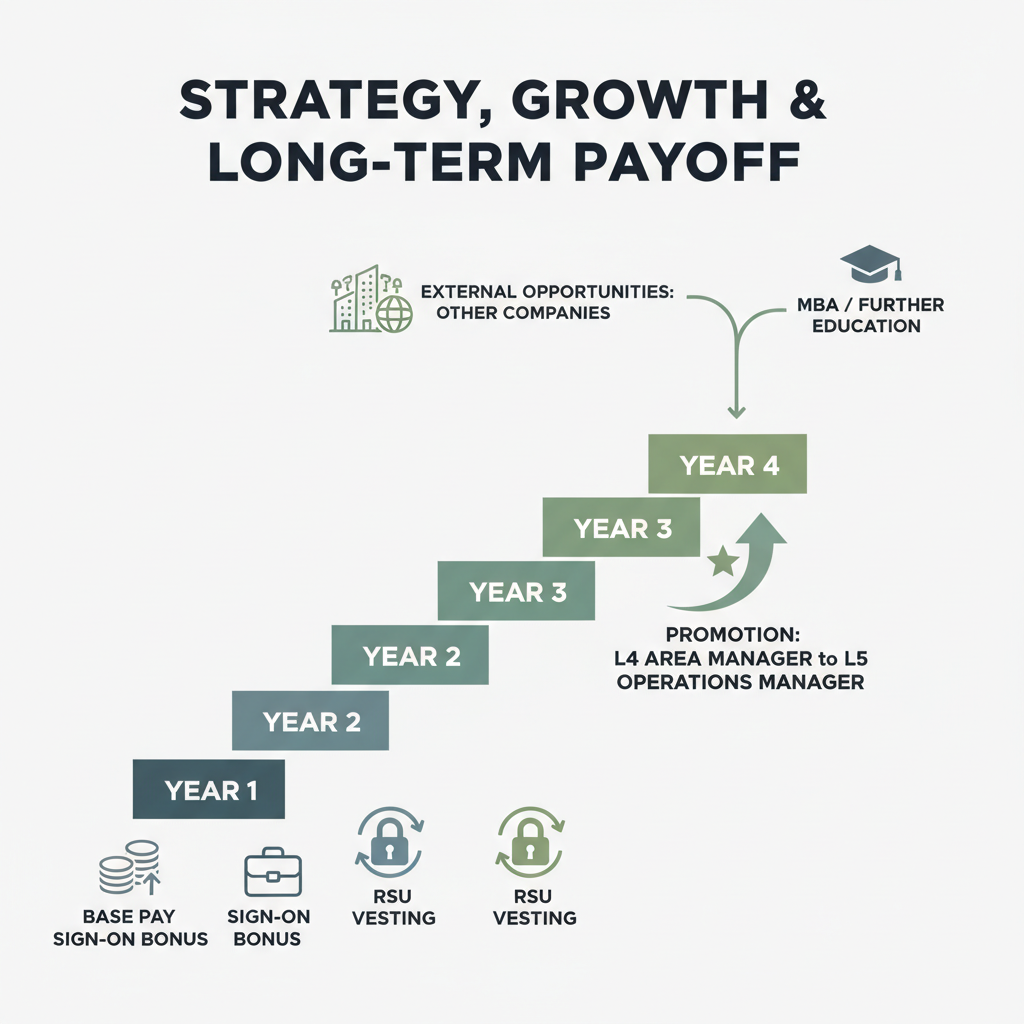
It’s often pitched as a first-step leadership role with a path toward Operations Manager (L5) and beyond.
Takeaway: Think: front-line leadership + high-pressure logistics + a lot of walking.
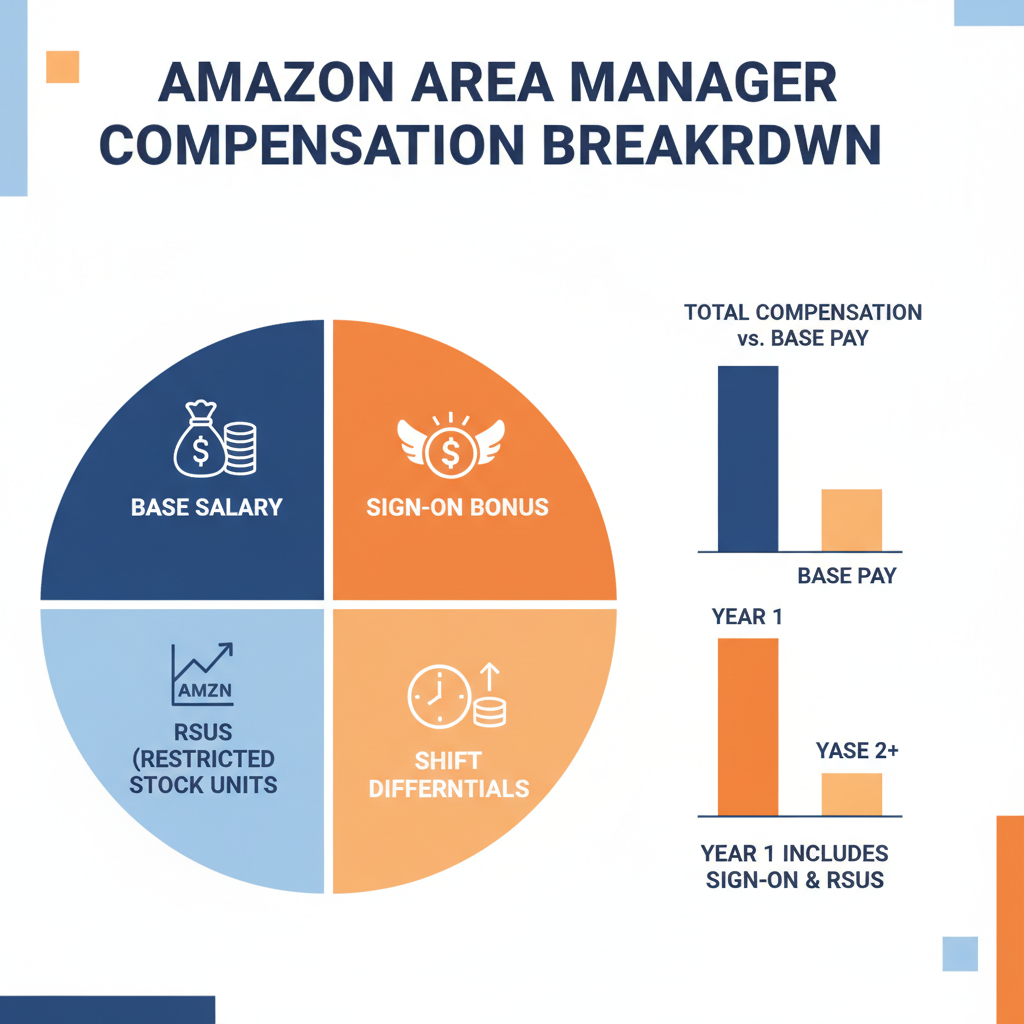
Amazon Area Manager Salary Overview (U.S.)
Because Amazon comp is location- and level-based, there isn’t one magic number. But we can talk realistic ranges for L4 Area Managers in the United States.
Typical annual total compensation for an Area Manager includes:
- Base salary – guaranteed yearly pay
- Sign-on bonus (often for the first 1–2 years)
- Restricted Stock Units (RSUs) – Amazon stock that vests over time
- Shift differentials – extra pay for night or weekend shifts in some buildings
Putting that together, many new Area Managers in the U.S. see roughly this range:
- Base salary: often around $55,000–$75,000+
- Total compensation (base + sign-on + RSU + differentials): can land roughly in the $65,000–$90,000+ ballpark depending on location, shift, and market conditions
These aren’t official posted numbers (Amazon doesn’t publish a neat band on one page) — they’re pulled from aggregated compensation reports (like Glassdoor, Levels.fyi, Blind, and Indeed) plus public candidate discussions. Actual offers can land below or above this depending on:
- City/region (New York ≠ Oklahoma)
- Experience (new grad vs. experienced supervisor)
- Business type (fulfillment center vs. sort center vs. specialty sites)
Takeaway: The “headline” pay most people talk about usually includes sign-on and stock, not just base.

Base Pay vs. Total Compensation (Don’t Mix Them Up)
When people say, “Amazon pays Area Managers $80k+,” they often mean total compensation, not the paycheck part that hits your bank every two weeks.
Base Salary
Base is the fixed number on your offer letter.
- Paid out evenly across the year
- Does not include overtime (you’re salaried-exempt)
- Adjusted by cost of labor in your area
You might see two Area Managers doing similar jobs, but:
- One in a tier-1 low cost market (smaller city, lower costs) at $58k base
- One in a high-cost metro (Seattle, NYC nearby, Bay Area suburbs) at $70k+ base
Sign-On Bonuses
Amazon loves front-loaded sign-on bonuses, especially for L4 Ops roles.
Common patterns:
- Year 1: higher sign-on (for example, $10k–$20k range)
- Year 2: smaller sign-on (maybe half of year 1)
This helps boost your first two years while your RSUs are still ramping up. But remember:
Sign-ons are temporary. Don’t build your lifestyle around them.
Restricted Stock Units (RSUs)
As a full-time Area Manager, you’ll usually receive Amazon RSUs that vest over multiple years (often 4).
Key points:
- The grant value is converted into a number of shares
- Those shares vest over time according to a schedule (e.g., 5% / 15% / 40% / 40%)
- The actual value depends on Amazon’s stock price when they vest
Some early-career AMs mentally ignore RSUs because they feel abstract. That’s a mistake — in a strong market, they can be a meaningful part of total comp.
Shift Differentials
Certain buildings and shifts (especially overnights and some weekends) pay extra hourly differentials to hourly associates. For salaried AMs, sometimes your effective pay feels higher because you’re managing “off-peak” shifts where hiring is harder — but you don’t get standard hourly overtime.
Occasionally, roles may advertise a premium for specific shifts or hard-to-staff sites. Always ask your recruiter if there’s any shift or location-based premium baked in.
Takeaway: Don’t compare “my buddy’s $80k” to your base. Always compare total comp to total comp.

How Location Changes Amazon Area Manager Pay
Amazon uses market-based pay bands. That means an Area Manager in rural Kentucky will not be paid the same base as one overseeing a building outside of Seattle.
Common patterns:
- High cost-of-living (COL) regions – Think major metros, coastal cities, tech hubs. Higher base salary and often more competition.
- Moderate COL regions – Large regional cities, many suburbs. Mid-range base pay.
- Low COL regions – Smaller cities or more rural areas. Lower base pay, but your money can stretch further.
If you’re comparing offers:
- A $65k base in a low-cost city can feel better day to day than $75k base near NYC once you factor in rent, transportation, and taxes.
Quick tip: Before accepting, plug your base salary into a cost-of-living calculator for the city you’ll work in and compare it to where you live now.
Takeaway: Ask your recruiter bluntly which pay zone/market tier the role is in — and run the numbers against housing.

New Grad vs. Experienced Hire: Does It Change Pay?
Yes — but maybe not as much as you think.
Amazon frequently hires:
- New grads from supply chain, business, industrial engineering, and related majors
- Experienced supervisors from warehouses, military, retail, or manufacturing
In both cases, you’re usually entering at L4, so the band is somewhat defined. What can change:
- Where you land within the band (bottom/middle/top)
- Size of sign-on bonus
- Which site/shift you’re placed into
Examples:
- A new grad with internships and strong leadership experience might land close to the middle of the band with a competitive sign-on.
- A candidate with 5+ years of logistics or military leadership could push for higher base or stronger sign-on within the same level.
Takeaway: You may not jump levels out of the gate, but you can negotiate where you land inside the L4 pay band.
How Hard Is the Job… and Is the Salary Worth It?
Pure numbers don’t tell you if the Amazon Area Manager salary is actually “good.” You have to compare it to the tradeoffs.
Pros (Why People Say Yes)
- Strong brand name – “Amazon Operations” on your résumé opens doors in logistics, supply chain, and tech-adjacent roles.
- Clear promotion path – Many AMs move to L5 Operations Manager in ~2–3 years if they perform well.
- Leadership reps fast – You’ll manage more people, more quickly, than in many corporate roles.
- Decent total comp early in your career – Especially if you’re just out of school.
Cons (The Stuff You Hear on Reddit)
- Long hours – 50–60 hour weeks aren’t unusual during peak seasons.
- Non-traditional schedules – Nights, weekends, early mornings.
- Physically and mentally demanding – You’re on your feet, putting out fires, and context-switching all day.
- Burnout risk – Some people tap out after 1–2 years and use it as a launch pad to something else.
Is the Salary “Good” Compared to Similar Roles?
Compared to other front-line leadership roles:
- Retail management – Often lower base and weaker bonus/stock packages.
- Small/medium warehouse supervisor – May offer more predictable hours but usually less total comp and fewer benefits.
- Manufacturing team lead – Can be comparable in base in some markets, but often without big-tech RSU upside.
Takeaway: The salary is competitive, especially when you factor in brand + growth, but you pay for it in schedule and intensity.
How to Read (and Negotiate) Your Amazon Area Manager Offer
When you get an offer, you’ll usually see these components broken out explicitly. Don’t just glance at the top-line number — dissect it.
1. Clarify Each Piece of Compensation
Ask your recruiter to spell out in writing:
- Base salary (yearly)
- Sign-on bonuses – how much in Year 1 and Year 2
- RSU grant – total value and vesting schedule
- Any relocation assistance (lump-sum, direct billed, payback clauses)
Then create a simple table for yourself:
| Year | Base | Sign-On | Estimated RSU Value | Total (Est.) |
|---|---|---|---|---|
| 1 | ||||
| 2 | ||||
| 3 | ||||
| 4 |
Even rough numbers will help you see if the package really matches what you want.
2. Know What’s Often Negotiable
Amazon can be stricter than some companies, but there is sometimes room, especially in tight labor markets.
You can politely ask about:
- A higher sign-on bonus
- A slight bump to base within the band
- Alternate locations or shifts if comp differs
Be ready with:
- Competing offers (if you have them)
- Specific ask: “Given my experience doing X, I was targeting a base closer to $Y. Is there any flexibility within the L4 band?”
3. Don’t Forget the Lifestyle Math
Before you say yes, sanity-check:
- Will your rent + transportation + student loans be manageable on base alone?
- Can you live comfortably without sign-on bonuses once they disappear?
- Are you okay with nights/weekends for a couple of years in exchange for the pay + experience?
Takeaway: Treat the offer like a 2–4 year project: What will your skills, savings, and options look like at the end of it?
How to Maximize Your Earnings as an Amazon Area Manager
If you decide to go for it, there are ways to make the compensation (and experience) work harder for you.
1. Target Strong-Opportunity Locations
Some buildings are higher volume, more visible, and more complex. That can mean:
- More chances to lead big initiatives
- Access to influential leaders
- Better shot at fast promotion (L5)
Fast promotion = bigger salary jumps.
Ask your recruiter or future manager:
- “Is this building considered growth, stable, or sunset?”
- “How many L4s here typically move to L5 each year?”
2. Crush the First 12–18 Months
Your first 1–2 performance cycles matter a lot.
Focus on:
- Safety and quality metrics – These are non-negotiable in ops.
- Relationships with associates – Turnover and morale can make or break your shift.
- Documented wins – Cost saves, process improvements, or metric turnarounds you can quantify.
These wins help you:
- Make a strong case for promotion
- Build a résumé that recruiters outside Amazon love
3. Use the Brand and Experience
Even if you don’t stay long-term, Area Manager experience translates well to:
- Operations Manager / Sr. Ops roles at other companies
- Logistics, supply chain, and 3PL leadership roles
- MBA applications (admissions committees like real leadership)
Takeaway: The real payoff can be your next job as much as this one.
Is an Amazon Area Manager Salary Right for You?
Here’s a quick self-check:
It might be a good fit if:
- You’re early in your career and want leadership responsibility fast
- You like measurable results, structure, and fast-paced environments
- You’re okay trading some nights/weekends/holidays for strong early-career comp
You might want to think twice if:
- Work–life balance and predictable hours are your top priority
- You hate being on your feet or dealing with daily people issues
- You’re counting on sign-on bonuses as permanent income
Bottom line:
An Amazon Area Manager salary can be a strong early-career package — especially when you factor in sign-ons, RSUs, and the Amazon name on your résumé. But the real question isn’t just “How much does it pay?” It’s:
“Given the schedule, stress, and growth potential, is this the right way for me to earn that money?”
If the answer feels like “yes, at least for a few years,” then it might be a smart move.
If you’d like, I can help you draft a compensation comparison between an Amazon AM offer and another job you’re considering — just share the rough numbers (you can anonymize everything).
Leave a Reply