Amazon Assessment Answers: What Actually Matters
If you searched “amazon assessment answers” hoping for a secret answer key… I have good news and bad news.
Bad news: There is no legit master sheet of Amazon online assessment answers that will magically get you hired.
Good news: You can absolutely prepare in a smart, targeted way so that the questions feel familiar, your answers are stronger, and your chances shoot way up.
This post breaks down how the Amazon assessments really work, what Amazon is actually testing for, and how to respond in a way that matches what they want—without cheating or memorizing random screenshots from Reddit.

What Is the Amazon Online Assessment, Really?
Amazon uses a set of online assessments (often called OA1, OA2, etc. for tech roles, and different names for non-tech) to screen huge numbers of candidates quickly.
Depending on your role, you might see:
- Work style assessment (personality / behavioral)
- Work sample assessment (job-simulation tasks)
- Coding & data structures problems (for software / technical roles)
- Logical reasoning / numerical reasoning
- Language or writing tasks (for content, operations, etc.)
All of these are trying to answer one question:
“Would this person do well working at Amazon, with Amazon’s problems and Amazon’s culture?”
Once you understand that, “amazon assessment answers” stops meaning “what exact options do I click?” and starts meaning “how do I think like Amazon when I answer?”
You’re not being tested on whether you can guess HR’s favorite multiple choice. You’re being tested on judgment, problem-solving, and culture fit.
Why You’ll Never Find a Real Answer Key (And Why That’s Okay)
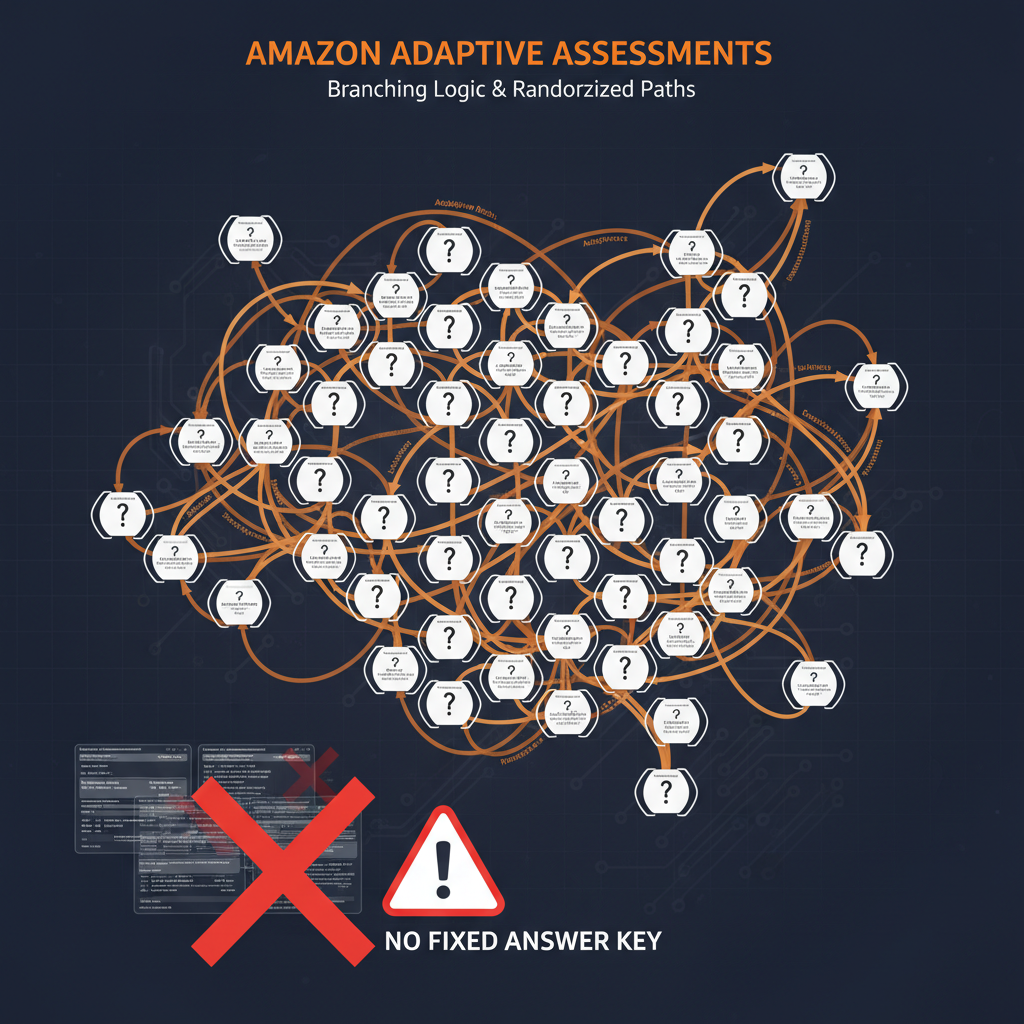
Let’s be blunt: if Amazon used the same fixed questions and answers, those questions would be fully leaked within days.
So what do they do instead?
- Huge question banks. You and a friend may get totally different scenarios.
- Adaptive questions. Some assessments adjust what comes next based on earlier answers.
- Scenario variations. Same core idea, different numbers, details, or characters.
On top of that, Amazon cares a lot about integrity. Trying to cheat via leaked answers can get you flagged or banned from reapplying if they detect it.
But you don’t need a key if you know the rules of the game.
Stop hunting for leaked answer screenshots. Start learning the patterns and principles Amazon rewards.
The Real “Amazon Assessment Answers”: Think Like the Leadership Principles
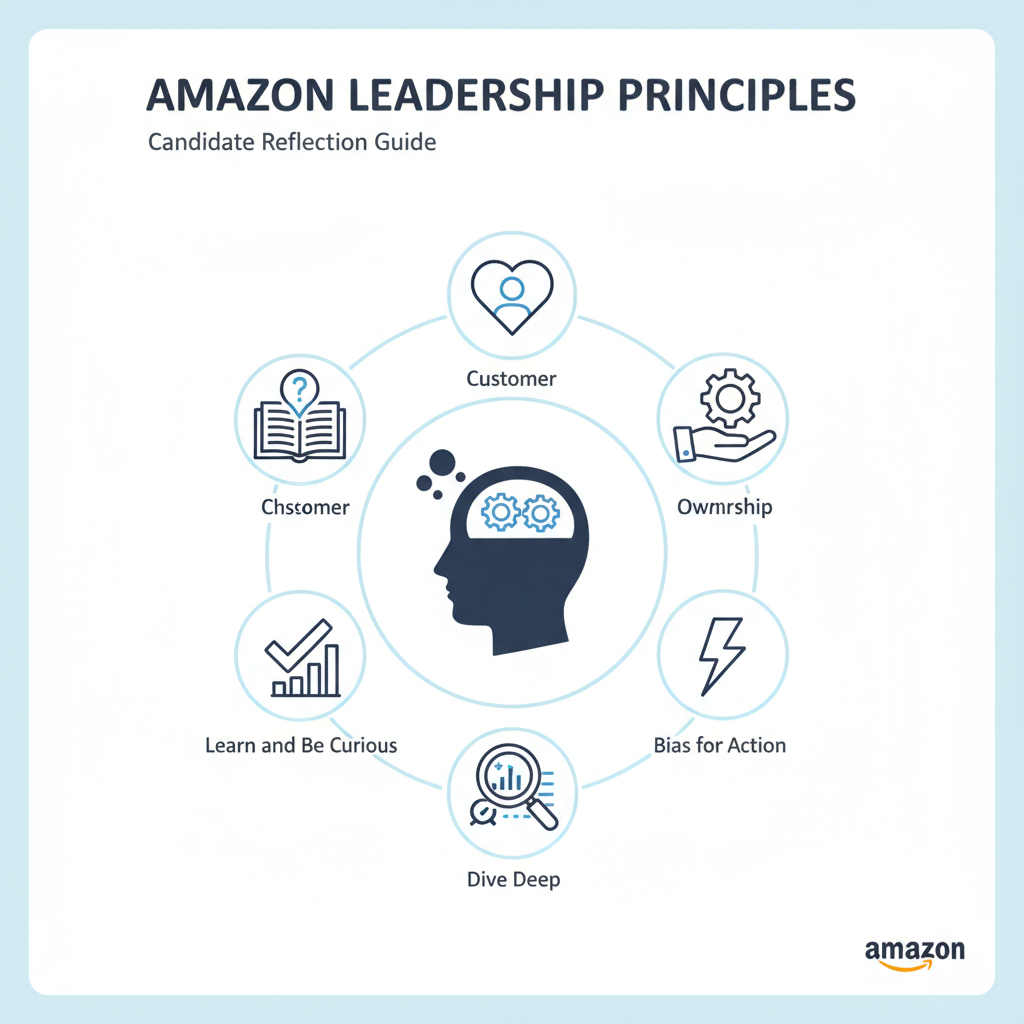
If there is a “secret sauce,” it’s this: almost every behavioral and work-style question is secretly testing your alignment with Amazon’s Leadership Principles.
Some of the big ones that frequently show up:
- Customer Obsession – You prioritize the customer impact.
- Ownership – You take responsibility, not just for your task, but for the outcome.
- Bias for Action – You move with urgency and make decisions with incomplete info.
- Dive Deep – You pay attention to details and data.
- Learn and Be Curious – You seek to understand and improve.
- Deliver Results – You actually get things done, not just talk about them.
When you see a scenario like:
“Your manager is out and a customer is angry. You have limited information and a deadline approaching. What do you do?”
They’re not grading whether you pick Option A versus B based on vibes. They’re checking:
- Do you obsess over fixing the customer problem?
- Do you show ownership instead of saying “I’ll wait for my manager”?
- Do you move, not stall—Bias for Action?
- Do you try to get data or context—Dive Deep?
The best “amazon assessment answers” are the ones that scream: I think and act according to your Leadership Principles.

How to Approach the Work Style Assessment (Personality Part)
The work style assessments are those “What would you do?” or “Which statement sounds more like you?” questions. They often look like simple personality tests, but they’re more targeted.
1. Be Consistent, Not Perfect
Don’t answer as if you’re a flawless superhero. Instead, answer in a way that shows:
- You’re customer-focused
- You take ownership
- You’re data-informed
- You move quickly but aren’t reckless
If in one question you say you always double-check data carefully, but in another you say you rarely review work before sending—those contradictions can hurt you.
2. Don’t Over-Optimize for Niceness
Amazon values being respectful, but many top-scoring answers:
- Push for results
- Challenge ideas when needed
- Escalate issues if customer impact or safety is at risk
Picking the most “polite” or “people-pleasing” option every time won’t necessarily score well.
3. Extreme Answers Are Usually Wrong
Questions like:
“I always follow the process exactly as written, even if it slows things down.”
Amazon culture is big on improvement, innovation, and Bias for Action. Blindly following process with no flexibility rarely matches their ideal. Look for answers that:
- Respect process and
- Focus on customer impact, data, and speed
Aim to be a data-driven, customer-obsessed owner who moves fast, learns, and improves—not a perfect robot or a people-pleasing chameleon.
How to Answer Scenario / Simulation Questions
Many Amazon roles include job simulations:
- You’re a manager dealing with conflicting priorities.
- You’re in operations resolving shipment or inventory issues.
- You’re in support, handling escalations and tricky customers.
These often look like long emails, chats, or dashboards followed by multiple-choice decisions.
Here’s a simple decision framework that tends to line up with strong Amazon-style answers:
Step 1: Clarify the Customer Impact
Ask yourself:
- Who is the “customer” in this scenario?
- What is the worst thing that happens to them if I do nothing?
The higher the impact on the customer, the more urgent and serious your response should be.
Step 2: Show Ownership, Not Deflection
Good answers:
- Take responsibility for moving the problem forward
- Propose a path instead of waiting passively
- Communicate clearly with stakeholders about what you’ll do next
Weak answers:
- Push the problem to someone else without adding value
- Wait indefinitely for more info
- Ignore or downplay clear issues
Step 3: Use Data and Prioritization
Amazon loves people who Dive Deep. So in scenario answers that mention metrics, SLAs, or dashboards:
- Use numbers to justify your choice when possible
- Prioritize tasks based on impact, deadlines, and customer effect
Step 4: Balance Speed and Rigor
In time-sensitive scenarios, strong answers:
- Act quickly on the biggest known risks
- But still check the most critical assumptions
For example, you might:
- Immediately stop a faulty process that harms customers
- While you investigate root cause and prevent recurrence
In simulation questions, the “right” Amazon assessment answers usually protect the customer, show ownership, use data, move fast, and fix the root cause—not just the symptom.

What About Coding Assessments for Amazon (OA1/OA2)?
If you’re applying for a software engineer or SDE internship role, you’ll likely see coding questions similar to what you’d find on LeetCode or HackerRank.
Here’s how to “answer” these the right way:
1. Expect Classic Data Structures & Algorithms
You’ll often see problems involving:
- Arrays, strings, hash maps
- Trees, graphs, queues, stacks
- Greedy algorithms, dynamic programming
- Sorting, searching, and complexity tradeoffs
You don’t need secret Amazon-specific tricks. You need:
- Clean problem understanding
- A correct and efficient approach
- Working code that handles edge cases
2. Practice With a Timer
Most Amazon coding assessments are timed. To prep:
- Solve 2–3 problems a day with a strict time limit
- Practice writing from scratch in the language you’ll use (Java, Python, C++, etc.)
- Focus on clarity: good variable names, helper functions, comments if needed
3. Don’t Panic on Edge Cases
Before you hit “submit,” quickly ask:
- What if the input is empty?
- What if it’s very large?
- What if values repeat or are negative?
Often, fixing one or two simple edge cases can move you from partial credit to a pass.
The best “answers” here are just good algorithm prep, solid coding habits, and calm testing under time pressure.

Example: Turning a Weak Answer into a Strong Amazon Answer
Let’s say the scenario is:
A key shipment to a major customer is delayed due to an internal error. They’re upset and threatening to cancel future business. What do you do?
Weak answer (what many people pick):
- Apologize
- Explain it wasn’t your fault
- Offer a small discount
- Promise to do better next time
This sounds reasonable—but it’s light on Ownership, Dive Deep, and Deliver Results.
Stronger Amazon-style answer:
- Immediately acknowledge and apologize for the impact on the customer (Customer Obsession)
- Take responsibility on behalf of the team, not blaming colleagues (Ownership)
- Offer specific, meaningful options: expedited shipping, alternative inventory, or other compensation based on policy (Deliver Results)
- Quickly investigate the root cause of the delay using system data/logs (Dive Deep)
- Implement or propose a process fix to prevent recurrence and communicate back to the customer what changed (Learn and Be Curious)
See the difference? The second answer doesn’t just soothe feelings; it fixes the problem and the system.
When in doubt, layer in multiple Leadership Principles into your decision.
Red Flags That Can Hurt Your Amazon Assessment Score
Even strong candidates sometimes tank the assessment by doing these:
-
Trying to “game” the test too hard
Overthinking every option as “What do they want?” instead of “What would a strong, data-driven owner do?” can make your answers inconsistent. -
Being conflict-avoidant in every scenario
If you never escalate, never challenge a bad decision, and always just go along—that doesn’t align well with Amazon’s culture of insisting on high standards. -
Ignoring data that’s clearly given
If a question gives you metrics, trends, or SLAs, and you choose an answer that acts like those numbers don’t exist, that’s a bad sign. -
Blaming others or hiding mistakes
Amazon heavily values Ownership and earning trust. Answers that dodge responsibility or shift blame usually score poorly.
Answer like a high-ownership, numbers-aware teammate who cares more about the customer and outcome than about avoiding hard conversations.
How to Prepare for the Amazon Assessment (Without Cheating)
Here’s a simple prep plan you can follow over a few days:
Day 1–2: Learn the Culture
- Read through Amazon’s Leadership Principles and rewrite each in your own words.
- For each principle, think of one real story from your past that shows it (job, school, projects, volunteering).
Day 3–4: Practice Scenarios
- Look up example Amazon-style behavioral questions (search for Amazon behavioral questions leadership principles).
- For each, ask: “Which principle is this testing?”
- Practice choosing options that:
- Protect customer impact
- Show ownership
- Use data
- Deliver results
Day 5–7: If It’s a Tech Role, Grind Problems
- Use sites like LeetCode / HackerRank for 1–2 problems a day.
- Focus on arrays, strings, hash maps, and sorting/searching.
- Set a timer equal to typical OA time per problem.
Right Before the Assessment
- Check your environment: stable internet, quiet space
- Read every question carefully (you can’t “undo” some answers)
- Don’t rush, but don’t obsess over perfection either
You don’t need months of preparation. A focused week aligned to how Amazon actually evaluates can make a big difference.
Final Word: The Best “Answer” Is Your Fit
You can’t (and shouldn’t) brute-force your way into Amazon with a collection of leaked “amazon assessment answers.”
What you can do is:
- Understand what Amazon values
- Practice thinking and deciding with those values in mind
- Prep the skills (coding, analysis, communication) that the role requires
Then, when you sit down for the assessment, the questions won’t feel like trick puzzles. They’ll feel like a preview of the job—and a chance to show you already think like someone who belongs there.
If you’d like, tell me what role you’re applying for (SDE, operations, marketing, warehouse, etc.), and I can walk you through the most likely assessment format and how to tailor your preparation.
Leave a Reply