Amazon CDL Training: How It Really Works
Thinking about driving big rigs instead of a desk… and wondering if Amazon will help you get your CDL?
You’re not the only one.
Amazon touches almost every package on the road, so it’s natural to assume they run a big, shiny “Amazon CDL training school” where you roll in with a permit and roll out in a blue Prime truck.
Reality check: it’s a bit more complicated—but still full of opportunity if you know where to look.
Let’s break down how Amazon and CDL training actually fit together, what options you really have, and how to avoid the expensive mistakes a lot of new drivers make.
Quick answer: Does Amazon offer CDL training?
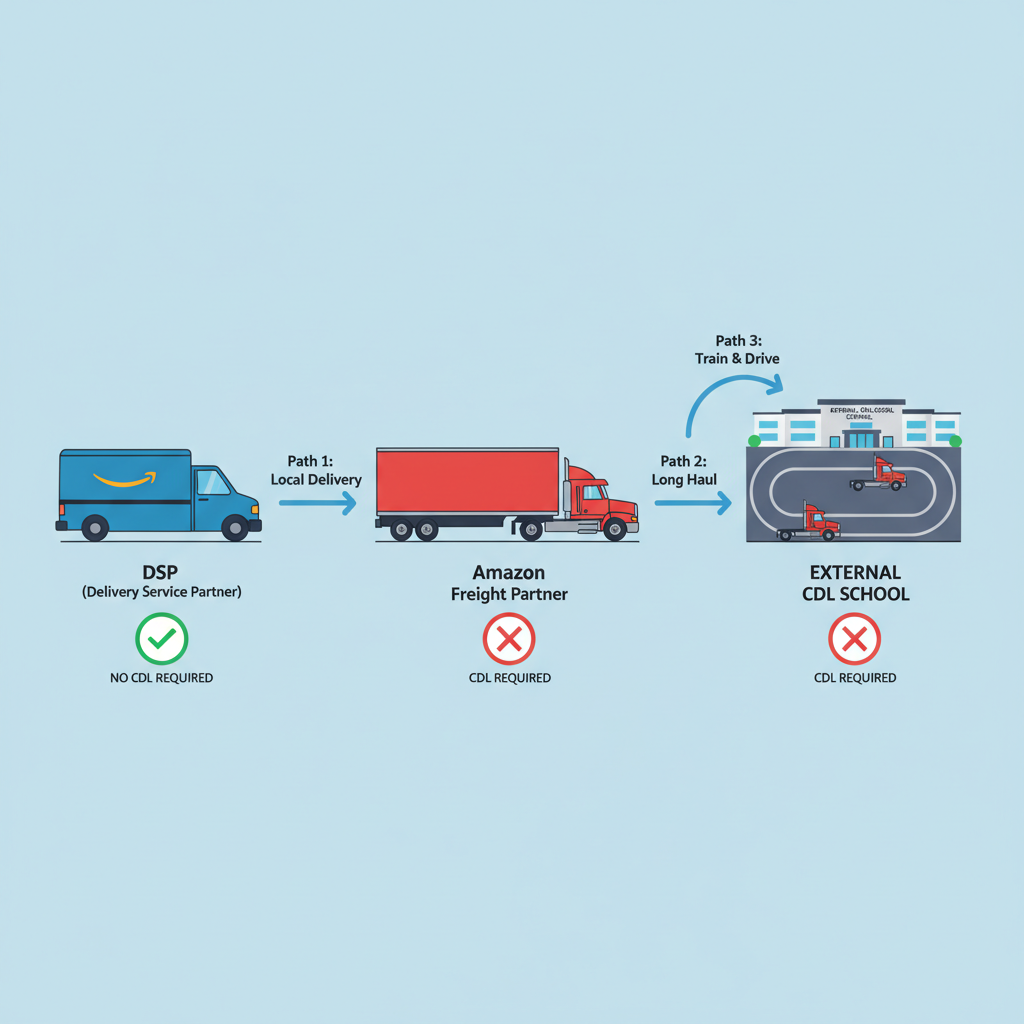
Short version: Amazon (the company itself) does not run a nationwide, in-house CDL school the way some big trucking carriers do.
Instead, you’ll see three main paths connected to Amazon:
- Amazon Delivery Service Partners (DSPs) – these are the blue van routes (small package delivery). They usually don’t require a CDL (just a standard driver’s license), so no CDL training is provided.
- Amazon Freight Partners / Relay Partners – independent trucking companies that haul Amazon freight using Class A tractors. Some of these may:
- Hire entry-level drivers who just got a CDL, or
- Partner with outside schools, or
- Rarely, offer some financial help or a “train-to-hire” setup.
- External CDL schools + then apply to Amazon-related carriers – the most common and realistic path.
Step 1: Decide what kind of driving job you actually want
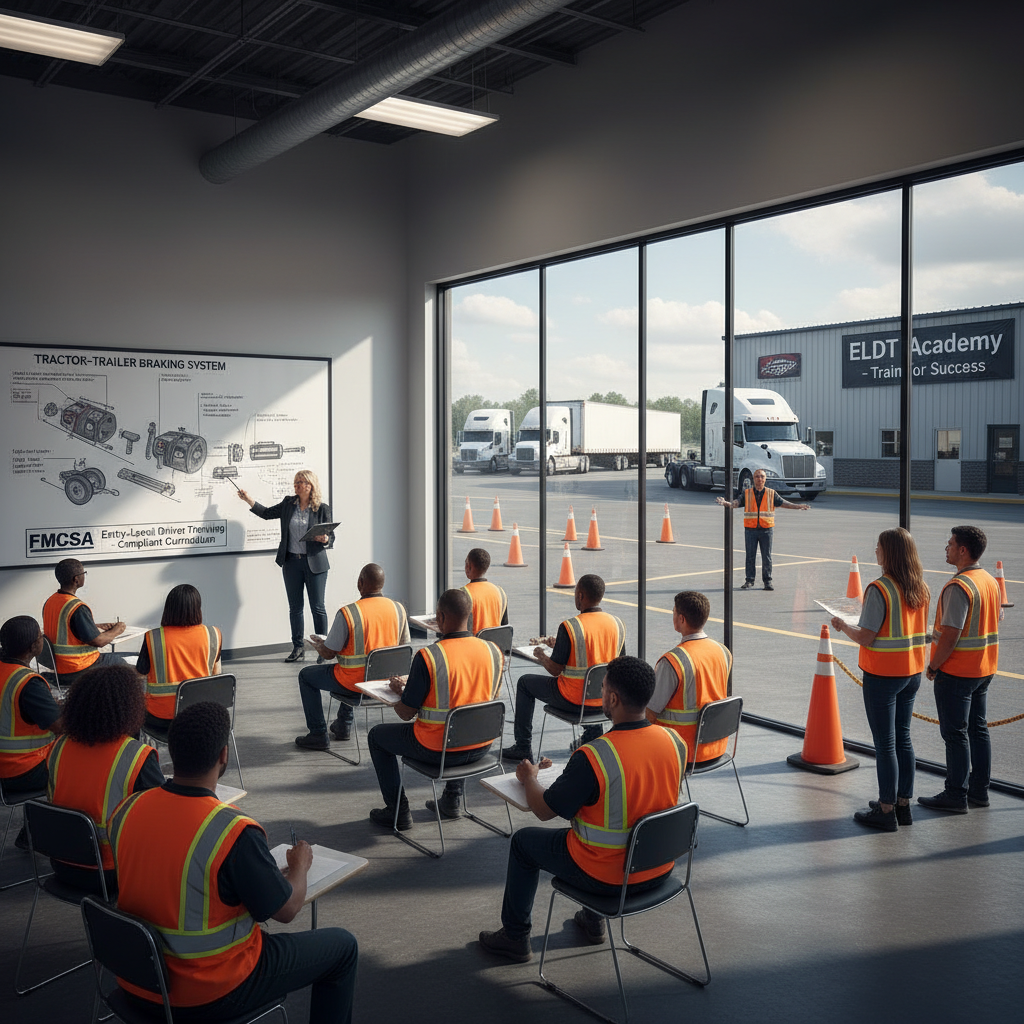
“Driving for Amazon” can mean different things—and not all of them require a CDL.
1. Amazon DSP driver (blue vans)
- Vehicle: Cargo vans/step vans
- License: Regular driver’s license (no CDL)
- Training: Company-specific, focused on safety, delivery methods, and route apps
- Schedule: Local, home every night, fast-paced, delivery-heavy
This is not CDL work. It can be a good stepping stone if you want delivery experience but doesn’t move you toward a Class A license.
2. Class A CDL driver hauling Amazon freight
Typically you’re hired by an Amazon Freight Partner or other carrier that has Amazon contracts, not by “Amazon” directly.
- Vehicle: Tractor–trailer (53’ dry van in most cases)
- License: Class A CDL
- Training: CDL school + possible on-the-job training (OTR or regional)
- Schedule: Regional or over-the-road, sometimes relay-style drop-and-hook
Many of these companies want at least some experience, but some are open to new grads.
Step 2: Understand how CDL training works (post-2022 rules)
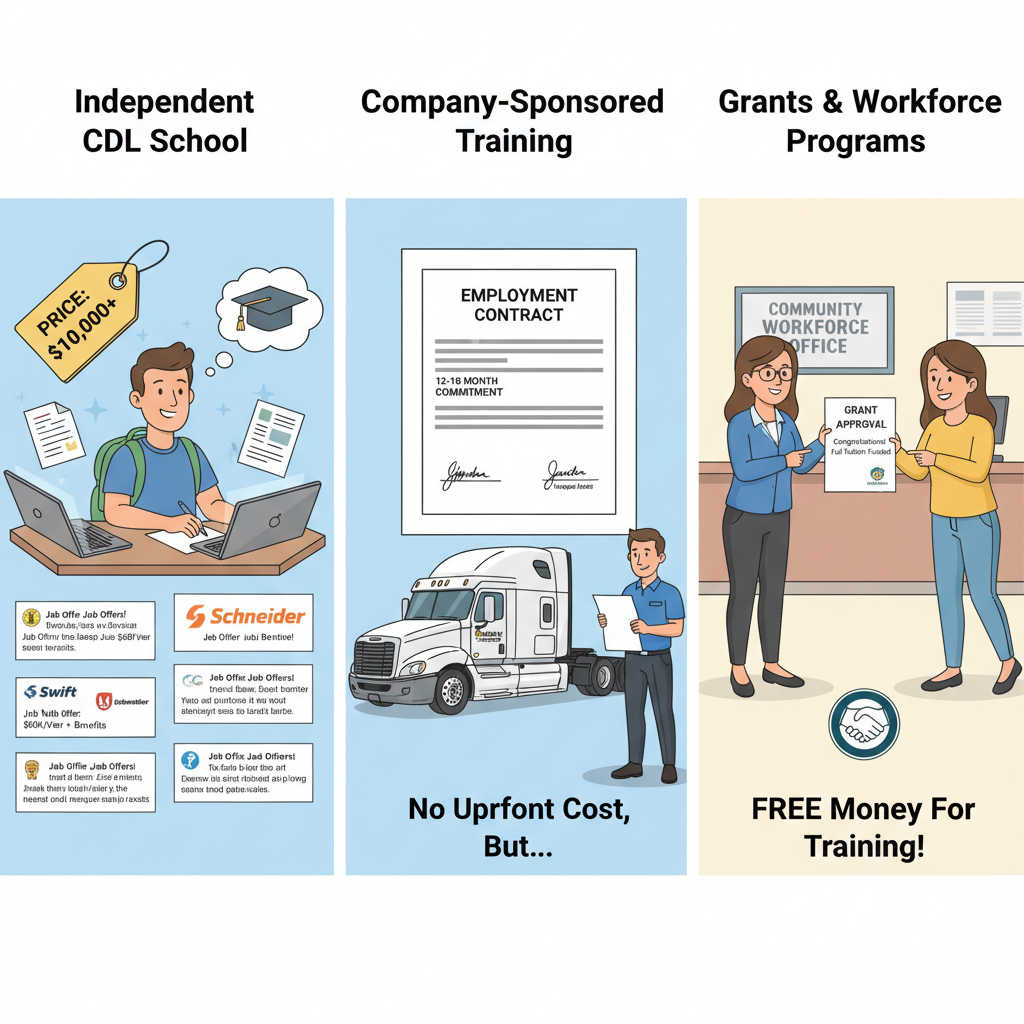
As of early 2022, you can’t just show up at a random truck and learn on the fly. The FMCSA’s Entry-Level Driver Training (ELDT) rules require new CDL applicants to train with an approved provider listed in the federal Training Provider Registry.
For you, that means:
- You must attend an ELDT-compliant school or trainer before you can take the CDL skills test.
- Most legit truck driving schools and community colleges already meet this standard.
- Many big carriers who “train you from scratch” are also registered providers.
So when you look for “Amazon CDL training,” what you really need is:
- An ELDT-approved CDL school (so the DMV will let you test), and
- A post-graduation job that ideally includes Amazon freight.
Step 3: Your main options to pay for CDL training
CDL school can run $3,000–$8,000+ depending on your location and program. That’s enough to scare people into some… bad decisions.
Here are your realistic paths:
Option A: Independent CDL school (you pay out-of-pocket or with aid)
- What it is: A private truck driving school or community college program.
- Pros:
- You’re not locked into a single employer.
- You can shop around for the best post-grad job (including Amazon freight partners).
- Some schools offer job placement with multiple carriers.
- Cons:
- Upfront cost can be high.
- You need to manage your own job search.
This path gives you the most freedom if your end goal is to compare several employers hauling Amazon freight.
Option B: Company-sponsored CDL training (with another big carrier)
Many large trucking companies (not necessarily Amazon-related) will:
- Pay for (or front the cost of) your CDL school
- Sometimes give you a small weekly training pay
- Require you to work for them for 9–24 months to repay the investment
After finishing your commitment, you can:
- Move to a regional carrier that does a lot of Amazon freight
- Or apply to Amazon Freight Partners that want drivers with 1–2 years of experience
Pros: Lower upfront cost; you earn while you learn.
Cons: You’re committed to one company early on, with less control over routes and home time.
Option C: Local programs, grants & workforce funding
In many states, you can reduce or eliminate CDL school costs through:
- Workforce development grants
- State or federal programs (e.g., WIOA funding)
- Veterans benefits (GI Bill®) for approved schools
If money is tight but you want to avoid long company contracts, it’s worth checking local workforce offices or community colleges.
Step 4: How to connect your CDL to Amazon-related jobs
Once you’ve got a CDL (and ideally some experience), here’s how you actually get into Amazon freight.
1. Target Amazon Freight Partners and carriers with Amazon contracts
Look for job posts with language like:
- “Amazon freight only”
- “Drop and hook with Amazon”
- “Amazon relay lanes”
These companies often offer:
- Predictable lanes (repeated routes)
- Lots of drop-and-hook (less live loading, more efficiency)
- Mix of day and night schedules
You’ll find them by searching:
- “Amazon Freight Partner hiring CDL Class A near me”
- “Dedicated Amazon account Class A driver”
2. Use your school’s job placement help
Most quality CDL schools maintain relationships with recruiters and local carriers.
Ask specifically:
“Which companies you work with have consistent Amazon freight or dedicated Amazon accounts?”
You’re more likely to hear about:
- Regional carriers with strong Amazon lanes
- Dedicated accounts where you run the same warehouses over and over
3. Build experience if needed
Some Amazon-freight-heavy carriers want:
- 3–12 months of verifiable CDL experience
- Clean MVR (motor vehicle record)
- Decent DAC report (your trucking work history)
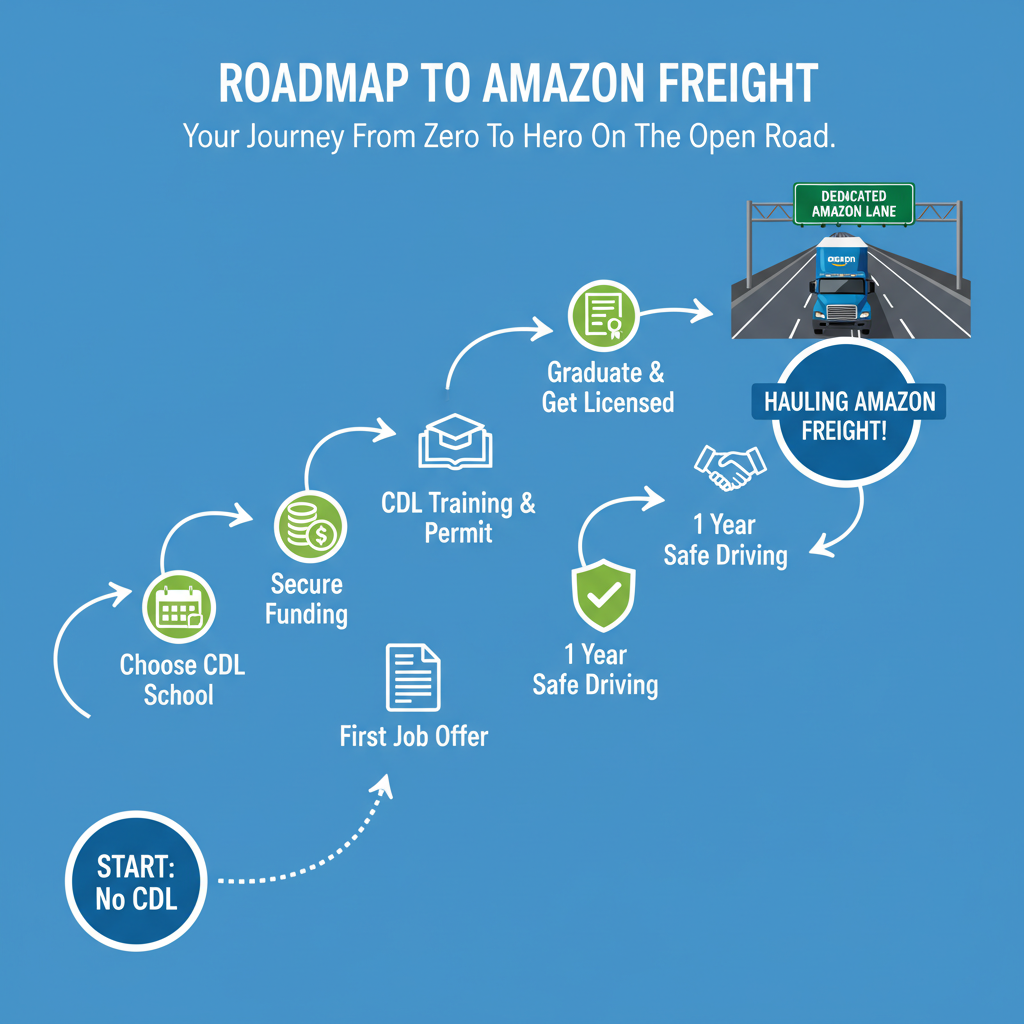
If you’re totally new, your path may look like:
- Get your CDL via school.
- Work your first year with any solid starter carrier that will hire new grads.
- Keep your record clean: no serious accidents, no alcohol/drug issues, minimal tickets.
- After 12 months, start applying to Amazon-focused jobs.
Example paths: From zero to Amazon freight
Scenario 1: You’re totally new, no money for school
- You talk to several big carriers that offer paid CDL training.
- You choose one with decent reviews, sign a 12–15 month contract.
- You finish training, run OTR or regional for a year.
- With a year under your belt and a clean record, you apply to:
- Amazon Freight Partners, or
- Regional carriers advertising “Amazon-only freight.”
You didn’t pay for school upfront, but you traded a year of your life at one company.
Scenario 2: You’ve got some savings, want maximum flexibility
- You enroll in an independent ELDT-compliant CDL school (4–8 weeks).
- While training, you ask the school which employers they place grads with who run Amazon freight.
- After graduating, you target companies advertising:
- “Dedicated Amazon lanes”
- “Amazon drop-and-hook freight”
- You compare offers: pay per mile, home time, equipment, benefits.
You paid for school, but now you choose who you sell your miles to.
Scenario 3: You’re already a local driver without a CDL
Maybe you:
- Deliver packages for an Amazon DSP in a blue van
- Drive box trucks with a non-CDL job
You can:
- Keep working while attending evening/weekend CDL classes.
- Use any available tuition reimbursement, grants, or benefits.
- Once you get your CDL, move into a Class A role with a carrier that hauls Amazon freight.
You’re essentially leveling up from last-mile to linehaul.
Key skills to focus on during CDL training (if you want Amazon-style work)
If your end goal is Amazon-type freight, certain skills matter a lot:
- Backing and maneuvering:
- You’ll be in and out of busy warehouses, often at night.
- The smoother your backing, the less stressful your job.
- Time management & on-time delivery:
- Amazon runs on tight schedules and scan times.
- Learn to manage your Hours of Service, pre-trips, and fuel stops efficiently.
- Drop-and-hook efficiency:
- Many Amazon lanes are drop-and-hook.
- Practice quick but thorough inspections (pre-trip & post-trip), so you’re safe and productive.
- Comfort with technology:
- You’ll use ELDs (electronic logs), apps for dispatch, and possibly Amazon-specific tools.
- Get comfortable with tablets, scans, and digital workflows.
Red flags to avoid when choosing a CDL training path
When you’re excited to start, it’s easy to fall for big promises. Watch out for:
- “Guaranteed job with Amazon” from a random school – most can’t promise that. They may have relationships with some Amazon Freight Partners, but nothing is truly guaranteed.
- Contracts that sound like a trap – if a carrier-sponsored school wants 2–3 years of commitment, read the fine print.
- No mention of ELDT or the Training Provider Registry – if they’re not compliant, you may not even be allowed to test.
- High-pressure sales tactics – legit schools will answer questions and give you time to decide.
Always ask:
- “Are you listed on the FMCSA Training Provider Registry?”
- “What percentage of your students get hired within 60–90 days of graduating?”
- “Which companies usually hire your grads, and do any of them haul Amazon freight?”
Is Amazon-related CDL work worth it?
That depends on what you want out of trucking.
Potential upsides
- Predictable freight: Amazon moves huge volumes year-round.
- Drop-and-hook focus: Less time waiting at docks, more time moving.
- Structured lanes: Some routes are very repeatable, which many drivers like.
Potential downsides
- Tight schedules: Time pressure can be real.
- Night/odd hours: Warehouse-to-warehouse runs can be heavy on nights.
- Third-party employers: You’re usually working for a carrier, not Amazon directly, so pay/benefits vary a lot.
Action plan: How to start your Amazon CDL path this month
If you’re serious about this, here’s a simple roadmap:
- Get clear on your goal
- Want to be home often? Look for regional/dedicated Amazon lanes.
- Willing to do OTR first? Company-sponsored training may work.
- Research ELDT-compliant CDL schools near you
- Check reviews, placement rates, and graduation rates.
- Ask which carriers they work with that run Amazon freight.
- Explore funding options
- Compare independent school vs. company-sponsored training vs. local grants.
- If you’re a veteran, look for GI Bill–eligible programs.
- Finish training and protect your record
- Treat your first year like a paid internship.
- Avoid risky behavior on and off the job.
- After 6–12 months, start targeting Amazon freight jobs
- Search “Amazon Freight Partner CDL jobs near me.”
- Compare offers carefully: pay, home time, equipment, benefits.
Stick to that plan, and in 12–18 months you can go from “scrolling CDL TikToks” to running consistent Amazon freight lanes with a real career under your belt.
If you tell me what state you’re in and whether you have any driving experience, I can help you sketch a very specific, step-by-step plan (including what kind of schools and jobs to look for first).
Leave a Reply