Amazon Layoffs 2025: What Really Changed
What the 2025 cuts actually mean for workers, careers, and the future of work inside and beyond Amazon.
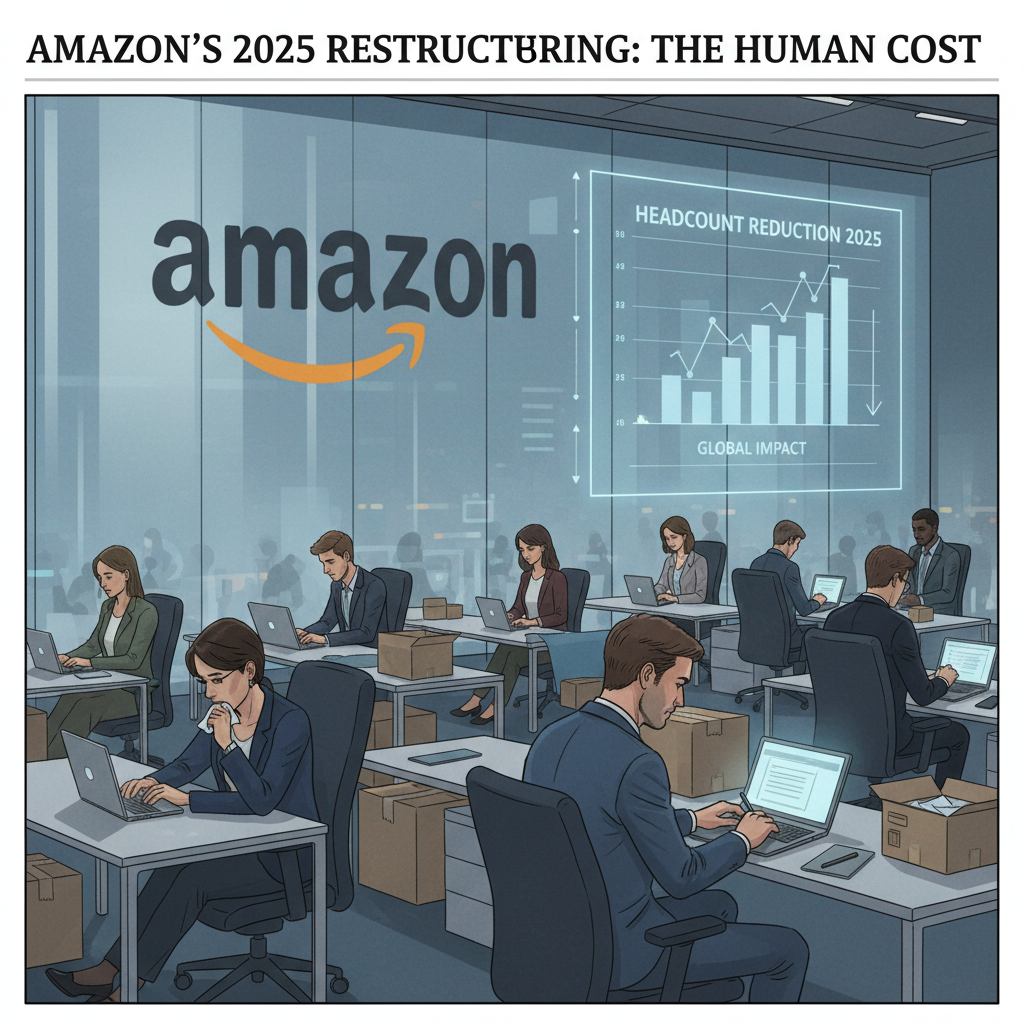
If it feels like every time you refresh the news another tech giant is cutting jobs, you’re not imagining it.
Amazon is once again at the center of that story in 2025 — with tens of thousands of roles on the line, AI in the spotlight, and a lot of people quietly wondering: “Is my job next?”
Let’s unpack what’s actually happening with Amazon layoffs in 2025, why it’s not just “cost cutting,” and how this wave fits into a much bigger shift in how work is changing.

Quick snapshot: What’s happening with Amazon layoffs in 2025?
Here’s the 2025 picture in plain English.
According to multiple reports and company memos:
-
Amazon is planning to cut up to 30,000 corporate jobs, its largest corporate reduction to date, affecting around 10% of its roughly 350,000 corporate employees.
(reuters.com) -
A confirmed 14,000 corporate roles are being eliminated as part of this restructuring, with reports suggesting further reductions toward that 30,000 target.
(techcrunch.com) -
Layoffs are concentrated in corporate functions like HR/People Experience & Technology (PXT), Devices & Services, Operations, and some AWS-related groups — even while other teams are still hiring.
(techcrunch.com) -
This comes on top of earlier, smaller rounds in 2025, including cuts in the Devices & Services division (Alexa, Echo, Kuiper, Zoox) and engineering roles in several key states.
(geekwire.com) -
Industry-wide, more than 120,000 tech employees have been laid off in 2025 alone, with AI and automation cited as major drivers at Amazon, Microsoft, Salesforce, and others.
(indiatoday.in)
Takeaway: This isn’t a one-off “oops we overhired” moment. It’s a multi‑year restructuring in how Amazon allocates people, capital, and technology.

Why is Amazon cutting jobs in 2025 when business is… actually good?
Here’s the weird part: Amazon isn’t shrinking because it’s failing.
Amazon’s revenue and cloud business (AWS) are still growing, and the company is investing tens of billions of dollars in tech infrastructure to support AI and cloud services.
(techcrunch.com) So why the layoffs?
1. The AI pivot: Fewer humans doing the same work
Amazon’s leadership has been unusually blunt: as it rolls out generative AI and AI “agents” across the company, it expects to need fewer people for many existing corporate roles.
In internal and public memos, Amazon has framed this as:
- AI is “the most transformative technology since the Internet” and they want to be leaner, with fewer layers, to move faster.
-
As AI tools spread internally, some jobs will shrink or disappear, while new types of roles emerge in AI, data, and infrastructure.
(techcrunch.com)
Fortune and others have connected the 2025 layoffs directly to Amazon’s automation and robotics strategy, especially in warehouses and logistics, raising questions about “robot‑driven unemployment.”
(fortune.com)
Takeaway: AI isn’t just a buzzword here. It’s literally being used as a justification for reducing headcount and reorganizing work.
2. From “growth at all costs” to “efficiency at all costs”
From 2020–2022, Amazon hired aggressively to handle pandemic‑era demand. When that demand normalized, the company started unwinding those bets:
- 2022–2023: ~27,000 jobs cut in earlier rounds.
-
2024–2025: additional layoffs in Twitch, Prime Video, MGM Studios, some HR teams, Devices & Services, and now this large 2025 corporate restructuring.
(techcrunch.com)
Layer that on top of pressure from investors to protect margins, and you get a very familiar tech‑sector formula:
Grow like crazy → Overbuild → Market shifts → Wall Street gets nervous → “Efficiency” phase → Layoffs + automation.
Takeaway: Even when profits and revenue look good, public tech companies are now rewarded for shrinking their cost base, not just expanding their top line.
3. Reallocating to long‑term bets
Amazon has been clear about where it is spending more:
-
Massive capex on cloud infrastructure to support AI and AWS.
(techcrunch.com) - Strategic projects like Project Kuiper (satellite internet), advanced robotics, and fulfillment automation.
The layoffs are part of a portfolio shift: fewer people in “traditional” corporate roles, more capital and specialized talent going into AI, infrastructure, and automation.
Takeaway: This isn’t just cutting — it’s swapping one kind of investment (people in certain roles) for another (AI, infra, and a different talent mix).

Who is most affected by the 2025 Amazon layoffs?
Let’s break it down beyond the scary big numbers.
Impacted groups and functions
Based on reporting and internal communications referenced in coverage:
-
Corporate HR / PXT (People Experience & Technology)
Reportedly one of the hardest‑hit areas, with some estimates suggesting double‑digit percentage cuts in certain HR functions as Amazon standardizes and automates people processes.
(linkedin.com) -
Devices & Services
Includes Alexa, Echo, Zoox, and Kuiper. Roughly 100 roles were cut earlier in the year in this group alone, even as the division continues hiring in other areas.
(geekwire.com) -
Operations & supporting corporate roles
Some operations‑adjacent corporate teams are being downsized as automation and robotics increase in fulfillment centers. -
Selected AWS teams
Amazon confirmed layoffs in certain AWS groups in 2025, describing them as necessary to “optimize resources” while still investing heavily in cloud innovation.
(crn.com)
Locations most in the spotlight
Reports and local coverage have highlighted layoffs particularly affecting:
- Major U.S. tech hubs (Seattle, the Bay Area, Northern Virginia)
-
Key engineering centers and certain states where Amazon has been consolidating teams and data‑center‑adjacent talent
(thehrdigest.com)
What it feels like internally
From public statements and leaked memos, some consistent patterns:
-
Impacted corporate employees are typically given about 90 days to find a new role internally before severance kicks in.
(techcrunch.com) - Amazon emphasizes that it is still hiring in priority areas, even as it cuts deeply elsewhere — creating a strange mix of anxiety and opportunity on the inside.
Takeaway: It’s not a blanket collapse of jobs, it’s a very targeted reshuffle. Some roles are vanishing; others are growing at the same time.

How do Amazon’s layoffs fit into the bigger 2025 tech layoff wave?
Amazon is big, but it’s not alone.
According to layoff trackers and news analyses:
-
Over 120,000 tech workers have lost jobs in 2025 so far across more than 250 companies.
(indiatoday.in) -
Amazon’s reductions (14,000 confirmed corporate cuts, up to 30,000 planned) put it in the top tier of 2025 job cutters, alongside firms like Verizon, IBM, Nestlé, Nissan, UPS, and multiple large tech players.
(businessinsider.com)
At the same time, there’s a parallel trend:
- Companies cutting in customer service, operations, and mid‑level management…
-
While aggressively hiring for:
- AI and machine learning engineers
- Data infrastructure and cloud roles
- Robotics, automation, and cybersecurity
Takeaway: The job market isn’t dying; it’s tilting. If your skills map to the “old stack,” your risk is higher. If they map to the AI/cloud/automation stack, your opportunities are expanding — often at better pay.
If you work at (or want to work at) Amazon, what should you do now?
Let’s talk practical moves — whether you’re inside Amazon or eyeing it from the outside.
1. Audit your role against the automation curve
Ask yourself bluntly:
- Is my work rules‑based, repetitive, or process‑driven?
- Could a combination of AI tools and better internal systems reasonably do 60–80% of what I do?
- Am I mostly approving, routing, or reporting, rather than designing, deciding, or inventing?
If you’re answering “yes” to those, your role — at Amazon or anywhere — is at higher risk over the next few years.
Move to make: Start shifting your responsibilities toward:
- Owning metrics and outcomes, not just tasks
- Designing systems and processes instead of just operating them
- Working with AI tools (prompting, evaluation, integration) rather than ignoring them
2. Pivot toward Amazon’s “big bets” skills
Regardless of whether you stay at Amazon, pay attention to where it’s investing:
- Cloud & AWS: architecture, security, data platforms
- Generative AI & agents: applied ML, prompt engineering, evaluation, product roles that integrate LLMs into workflows
- Automation & robotics: controls, simulation, industrial engineering, logistics optimization
You don’t need to become a PhD researcher. Even for non‑technical professionals, you can:
- Learn to design AI‑augmented workflows (e.g., using AI to triage tickets, draft responses, or surface insights)
- Build basic analytics skills (SQL, dashboards, experimentation)
- Become the person who can bridge ops + product + AI in your niche
3. Treat internal mobility like a 90‑day startup
If you’re an Amazon employee in a at‑risk org and given a 90‑day internal search window, treat it as a mini startup sprint:
- Clarify your story in 2–3 sentences: what problems you solve and what you want next.
- Target teams aligned with AI, cloud, infra, or clear strategic initiatives.
- Reach out directly to hiring managers and skip relying solely on internal postings.
- Show you can help with automation — don’t fight the trend; stand in front of it.
4. Build a portable narrative beyond “I worked at Amazon”
The 2022–2025 Amazon layoff cycles have already created a large alumni wave, many of whom land quickly at other tech firms, startups, or in consulting.
What separates fast landers from the long job search?
- They don’t lead with: “I was a Level X at Amazon.”
-
They lead with:
“I owned X metric, improved it by Y%, and did it under Z constraints. Here’s how I’d do something similar for you.”
In a market where your previous company might also be cutting, you win by translating your experience into concrete, future‑relevant impact.
Takeaway: Your employer brand (Amazon, FAANG, etc.) might get you a first look. Your story of impact + adaptability gets you the offer.
What does this mean for the future of work at Amazon?
Zooming out, what do Amazon layoffs in 2025 tell us about where things are headed?
1. Corporate headcount isn’t sacred anymore
The old assumption was: automate warehouses and blue‑collar work, keep corporate headcount pretty stable.
2025 blows that up.
Automation is now eating into white‑collar, managerial, and support functions, and Amazon is explicitly saying that AI will allow it to run leaner at the corporate level.
(techcrunch.com)
2. “AI fluency” becomes a baseline, not a bonus
If Amazon believes AI is as transformative as the internet, then not being AI‑literate in a few years will likely feel like not being internet‑literate today.
For most knowledge workers that means:
- Comfort using AI tools in day‑to‑day workflows
- Understanding what AI is good at (patterns, text, code) versus what still requires human judgment
- Being able to design processes that intentionally blend humans and AI
3. Stability looks different now
Long‑term job security inside a single big tech company is no longer the “safe” path it once appeared to be.
Stability increasingly looks like:
- A portable skill stack (AI‑aware, data‑literate, systems‑thinking)
- A strong network across companies and sectors
- The ability to relearn and reposition every few years as tech shifts
Takeaway: The safest thing you can do in a period of mass restructuring is not to cling to one employer — it’s to relentlessly upgrade the skills and relationships that travel with you.
So… should you be worried?
Some truth, with minimal sugar‑coating:
- If your current job (at Amazon or anywhere) is mostly repetitive digital work that AI is getting good at, you should be concerned — and proactive.
- If you lean into AI, automation, metrics, and cross‑functional problem‑solving, you can often turn this same wave into leverage.
Amazon layoffs in 2025 are not just a corporate drama headline; they’re a preview of how large companies will:
- Use AI to justify shrinking some roles, and
- Rapidly expand others that build, run, and orchestrate those AI systems.
You don’t control the first part.
You do control how quickly you move toward the second.
If you take one step this week, make it this: pick one task you do regularly, and ask, “How could I use AI or automation to handle 50–80% of this?” Then experiment.
That small mindset shift is exactly the kind of thing that will matter — at Amazon, or anywhere else tech decides to reinvent work next.
Leave a Reply