Amazon Moments: Rewarding Customer Loyalty
If you’ve ever added something to your Amazon cart just to hit free shipping, you already understand the power of incentives. Amazon Moments lets you harness that same psychology inside your own app or website—without building a logistics empire.
If you’ve ever added something to your Amazon cart just to hit free shipping, you already understand the power of incentives.
Now imagine using that same psychology inside your own app or website.
That’s basically the promise behind Amazon Moments: turn user actions into trackable, reward-powered growth.
Let’s break down what Amazon Moments is, why it matters, and how to use it without lighting your marketing budget on fire.
What Is Amazon Moments?
Amazon Moments is a cross‑platform marketing and loyalty solution that lets you reward specific user actions with real-world rewards—paid for on a cost-per-action (CPA) basis.
Instead of paying for clicks or impressions, you only pay when users actually do the thing you care about: sign up, hit a milestone, subscribe, make a purchase, complete a level, renew, etc.
Those users can then redeem a reward (like a product, digital content, or coupon) fulfilled by Amazon. You define:
- The action: e.g., “Finish Level 5,” “Subscribe for 3 months,” “Refer a friend,” “Spend $50+ in one order.”
- The audience: specific segments, geos, or platforms.
- The reward: actual products, credits, or perks delivered via Amazon.
- The budget: you bid a maximum CPA and Amazon only charges when the action is completed.
Why Marketers Care About ‘Moments’ (Not Just Impressions)
Most performance campaigns still revolve around:
- Cost per click
- Cost per install
- Cost per thousand impressions
All of those are… fine. But clicks don’t equal habit, and impressions don’t equal loyalty.
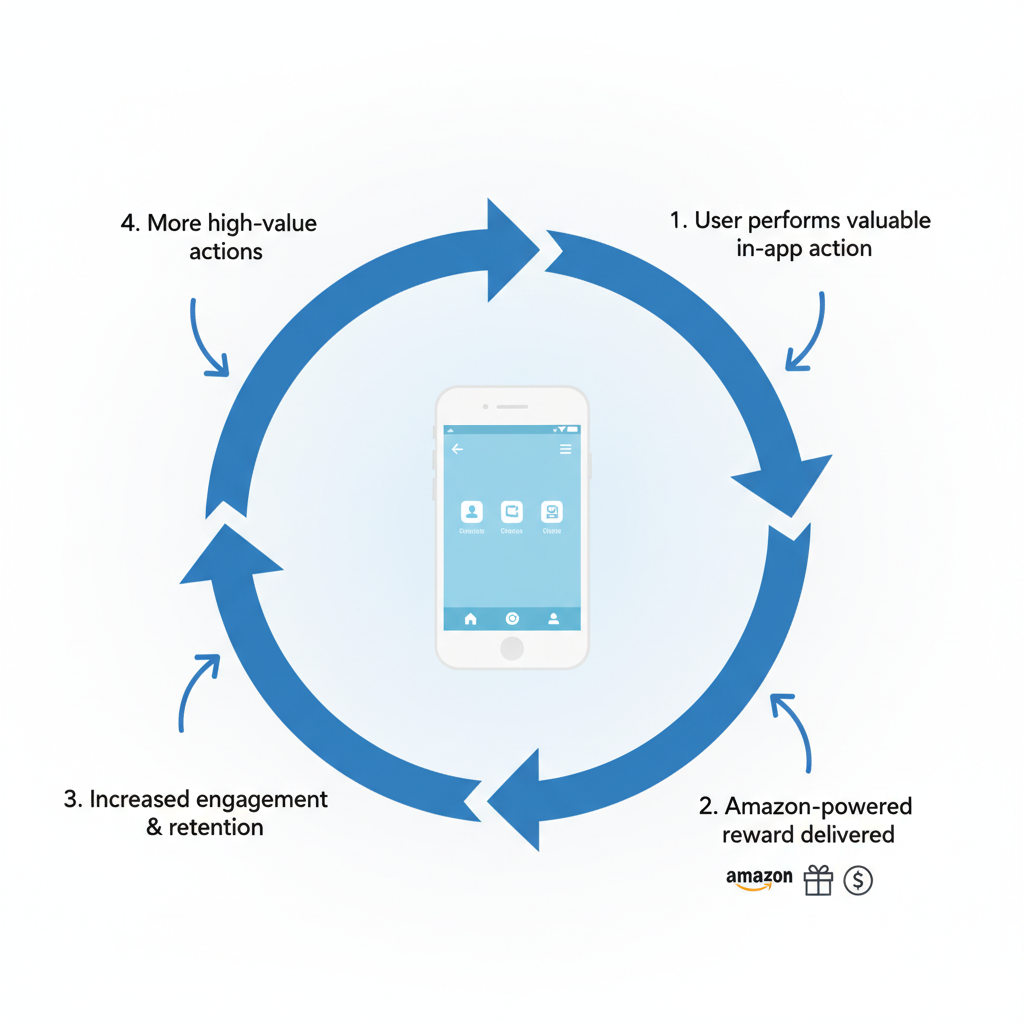
Amazon Moments shifts the unit that matters from traffic to behavior. You design a moment—a meaningful action in your lifecycle—and tie a reward to it.
Examples of high-value Amazon moments:
- A casual player becomes a daily active user for 7 days.
- A free user converts to paid for the first time.
- A first-time buyer returns for a second purchase within 30 days.
- A podcast listener subscribes and listens to 5 episodes.
You’re not just “getting users”; you’re training users to do the right things.
How Does Amazon Moments Work in Practice?
Let’s walk through a simple flow.
1. You define your goal
You start by deciding what behavior you want to pay for. For example:
- “Complete onboarding in 24 hours.”
- “Watch 10 videos in the app.”
- “Spend at least $25 in one order.”
This becomes your moment.
2. You set your CPA and choose rewards
You decide how much a completed action is worth to you.
- If a new subscriber is worth $50 in LTV, maybe you’re willing to pay $10–$15 in rewards.
- If a 2nd purchase predicts long-term retention, maybe you’ll pay $5 to nudge it along.
Then you set up a catalog of eligible rewards for that moment—these can be physical items, Amazon credit, or other digital rewards.
3. Users earn rewards when they hit the moment
Once integrated, your app or site notifies Amazon (via API/SDK) when a user completes the desired action.
That user receives:
- A notification, banner, or message that they’ve earned a reward
- A unique link or mechanism to redeem via Amazon
Amazon handles:
- Showing them their reward
- Checkout / purchase flow
- Fulfillment and shipping
You handle:
- Driving the right actions
- Controlling the economics
4. You measure and iterate
Because Moments is CPA-driven and event-based, it naturally fits into your analytics stack.
You can track:
- How many users completed the target action
- Effective cost per completed action
- Downstream impact (retention, ARPU, LTV)
Real-World Amazon Moments Examples
Let’s make it concrete with a few scenarios.
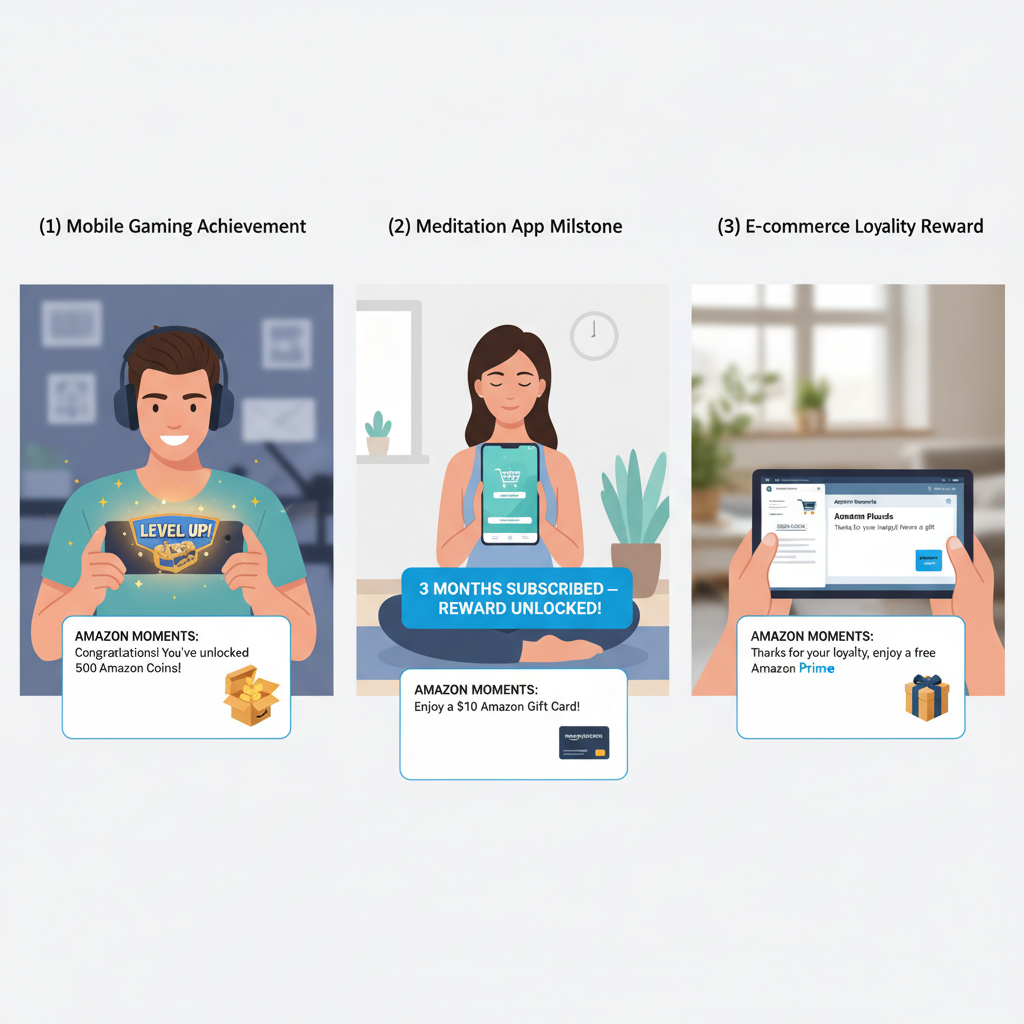
Example 1: Mobile Game Boosting Retention
A midcore game struggles with early churn. They use Amazon Moments to reward:
- Completing the tutorial
- Reaching Level 10
- Making a first in-app purchase over $4.99
For each milestone, users earn a small physical reward (e.g., a collectible or toy) or Amazon credit.
Result? Players push through early friction because they’re chasing both in-game progress and real-world rewards. Churn drops, and ARPU goes up because more users reach monetization points.
Lesson: When progression feels more valuable, people stick around.
Example 2: Subscription App Driving Upgrades
A meditation app has tons of free users, but paid conversion is low.
They create a Moment:
“Subscribe for 3 months and get an Amazon reward worth $10.”
Because they know a 3‑month subscriber is likely to keep paying, they’re willing to give away a portion of that future value up front.
Users who hit the 3‑month mark get a reward link, making the habit of using the app feel extra rewarding (literally).
Lesson: Tie rewards to commitment, not just sign-ups.
Example 3: E‑commerce Brand Encouraging Repeat Orders
A DTC brand selling consumables struggles to get customers to place a second order—classic retention problem.
They integrate Amazon Moments so that:
- First-time buyers who place a second order within 45 days earn an Amazon product reward.
Customers now have a tangible reason to restock sooner rather than later.
Lesson: Use Moments to close key lifecycle gaps: trial → repeat → loyal.
Key Benefits of Amazon Moments
Let’s zoom out and look at why teams consider Amazon Moments in the first place.
1. Pay For Outcomes, Not Hopes
Because you’re paying per completed action, you avoid the classic sinkhole of buying impressions or installs that never convert.
- Better budget efficiency
- Cleaner attribution to business value
2. Built-In Trust & Fulfillment
Rewarding people with something shipped by Amazon carries inherent trust:
- Users know they’ll actually get the reward
- You don’t have to build logistics, manage inventory, or handle customer support for rewards
3. Flexible Across Platforms and Channels
Amazon Moments can be used across:
- Mobile apps (iOS/Android)
- Web apps and sites
- Email and lifecycle campaigns
- Referral and ambassador programs
Anywhere you can track a user action, you can, in theory, attach a Moment.
4. Easy to Communicate to Users
“Do X, get a reward from Amazon” is much easier to explain than complex point systems.
When Amazon Moments Doesn’t Make Sense
It’s not magic. There are cases where Moments isn’t the right tool.
1. Your Core Product Experience Is Weak
If your app or site doesn’t deliver real value, no amount of rewards will fix that.
You might temporarily goose metrics, but retention will crater as soon as rewards stop. Moments should amplify a good experience, not cover up a bad one.
2. Your Unit Economics Are Fuzzy (or Negative)
If you don’t know your:
- LTV per user
- Payback period
- Margins
…then you’re guessing at what you can afford to pay per action.
Without solid numbers, you may over‑reward and quietly destroy profitability.
3. Your Audience Doesn’t Value Physical Rewards
Some products or communities thrive on status, access, or exclusive content, not stuff.
In those cases, consider whether Moments can still work (via digital or credit rewards) or if your own native rewards system might be more on‑brand.
How to Design a High-Impact Amazon Moment
If you decide to try Amazon Moments, don’t just pick a random milestone and hope.
Here’s a simple playbook.
1. Map Your Customer Journey
List the major steps:
- Discover product
- Sign up / install
- Complete onboarding / first key action
- Return in the first 7 days
- Make first purchase or upgrade
- Make second purchase / renew subscription
- Become a promoter (referrals, reviews)
Identify two or three steps that:
- Strongly predict long-term retention or revenue
- Have significant drop-off today
Those are your best candidate Moments.
2. Attach Meaningful, Not Massive, Rewards
Your reward should be:
- Large enough to feel real (not a $1 coupon most people won’t use)
- Small enough to be sustainable at scale
Think:
- $5–$15 equivalent value for high-intent or high-LTV actions
- Smaller perks for mid-funnel milestones
3. Communicate Clearly and Early
Make sure users know:
- What they need to do
- By when (if there’s a window)
- What they’ll get
Use:
- Onboarding tooltips
- In-app banners
- Email sequences
Example: “Create your first project in the next 3 days and earn a reward, fulfilled by Amazon.”
4. Protect Against Abuse
Any time there’s a reward, there will be people who try to game it.
You can mitigate this with:
- Limits per account or per device
- Verification steps for high-value rewards
- Cooldowns or minimum time windows between actions and redemptions
5. Test, Measure, Iterate
Start small:
- Choose 1–2 Moments
- Run for 4–8 weeks
- Compare cohorts with and without rewards
Look at:
- Incremental lifts in completion of the target action
- Changes in retention, ARPU, and LTV
- Actual cost per incremental action (not just any action)
Amazon Moments vs. Traditional Loyalty Programs
You might be thinking: “Is this just a points program with extra steps?”
Not quite.
Traditional loyalty:
- Points for almost every action
- Big, complex catalogs of rewards
- Often slow gratification (save up for weeks or months)
Amazon Moments:
- Focuses on specific, strategic actions
- Immediate or near-immediate gratification
- Rewards handled, shipped, and fulfilled via Amazon
For many products, you might even run both:
- A lightweight in‑app points/badges system for everyday engagement
- Amazon Moments for major milestones that change user behavior
Is Amazon Moments Worth It?
It’s worth exploring if:
- You know your unit economics reasonably well.
- You can clearly define one or more high-value user actions.
- Your audience is likely to respond to Amazon-powered rewards.
- You have at least basic analytics and event tracking in place.
It’s probably not worth it (yet) if:
- You’re pre-product-market fit.
- You don’t know what behaviors correlate with long-term success.
- Your main problem is awareness, not activation or retention.
Final Thoughts: Design the Moment, Then Add Amazon
The real power of Amazon Moments isn’t just the rewards catalog or shipping muscle.
It’s the discipline of asking:
“What specific actions in our product create long-term value—and how do we nudge more users to take them?”
Once you’ve answered that, plugging Amazon in as the reward engine becomes the easy part.
Start with one moment.
Track it ruthlessly.
Learn from it.
Then—when you see the lift—you can add a few more moments that genuinely matter, instead of bribing users randomly.
That’s how you turn a simple Amazon moment into a repeatable growth system.
Leave a Reply