Amazon Private Label Playbook
If you’ve ever thought, “I wish I could sell my own brand on Amazon” and then immediately panicked because you have no idea where to start… this post is for you.
Amazon private label isn’t just for big brands with huge budgets anymore. Regular people are turning simple products into real businesses — sometimes with surprisingly boring items like garlic presses and yoga blocks.
Let’s unpack how that works (without the hype or the fake Lamborghini screenshots).
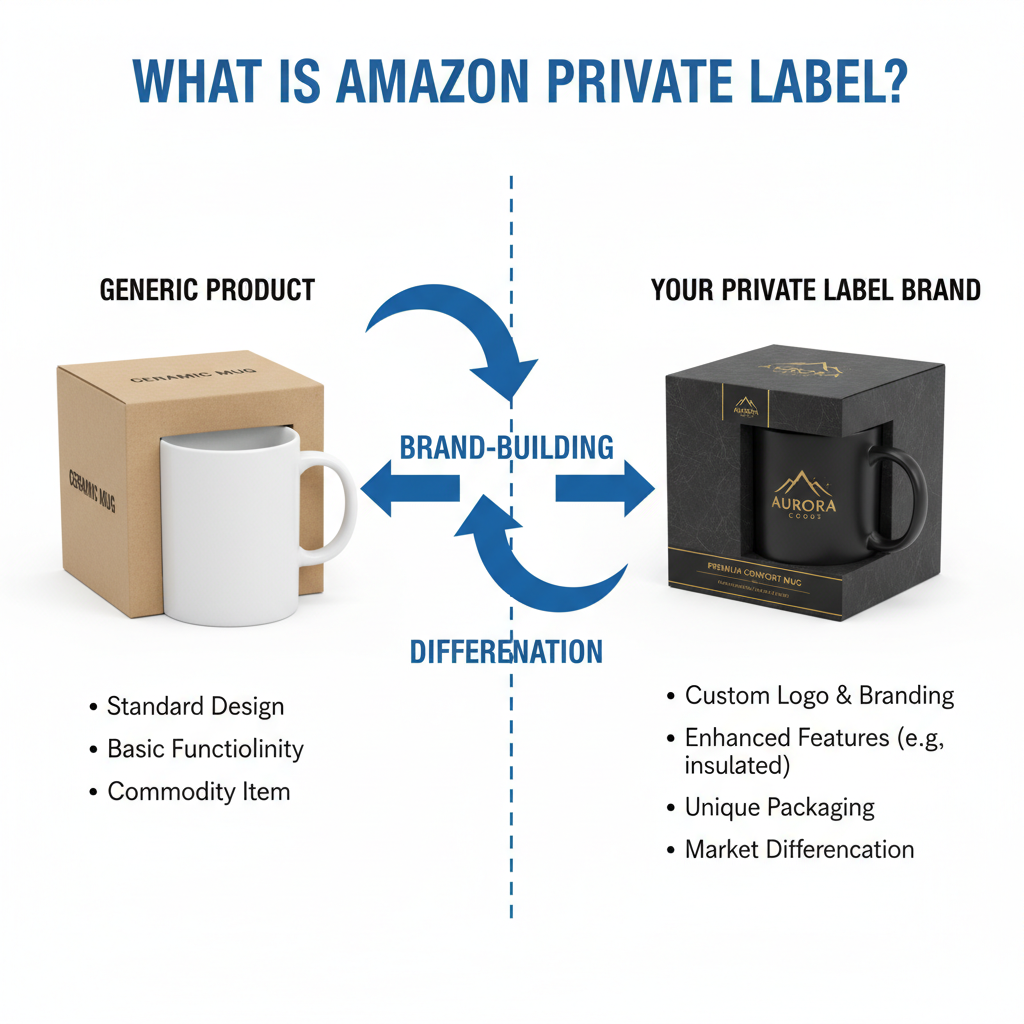
What Is Amazon Private Label, Really?
In plain English: Amazon private label means you take a generic product that already exists, work with a manufacturer to put your brand on it (ideally with some improvements), and sell it on Amazon as your own branded product.
You’re not inventing the next iPhone. You’re:
- Finding a product that’s already proven to sell.
- Sourcing it (often from a manufacturer that makes it for many brands).
- Adding your logo, packaging, and sometimes design tweaks.
- Listing and marketing it on Amazon under your own brand name.
Key difference vs. reselling/wholesale:
- Wholesale/online arbitrage: You sell other brands’ products (e.g., Nike sneakers).
- Private label: You create and own the brand (e.g., “PeakStride Running Gear”).

Is Amazon Private Label Still Worth It In 2026?
Yes — but not in the “get rich in 30 days” way.
It can still be very profitable, if you treat it like a real business:
- Competition is higher than it was 5–10 years ago.
- Quality, branding, and reviews matter a lot more.
- Slapping a logo on a generic product with no differentiation is a fast way to lose money.
Amazon is still massive, though, with hundreds of billions in annual sales and millions of active customers searching for products every single day. That demand doesn’t disappear just because more sellers joined.
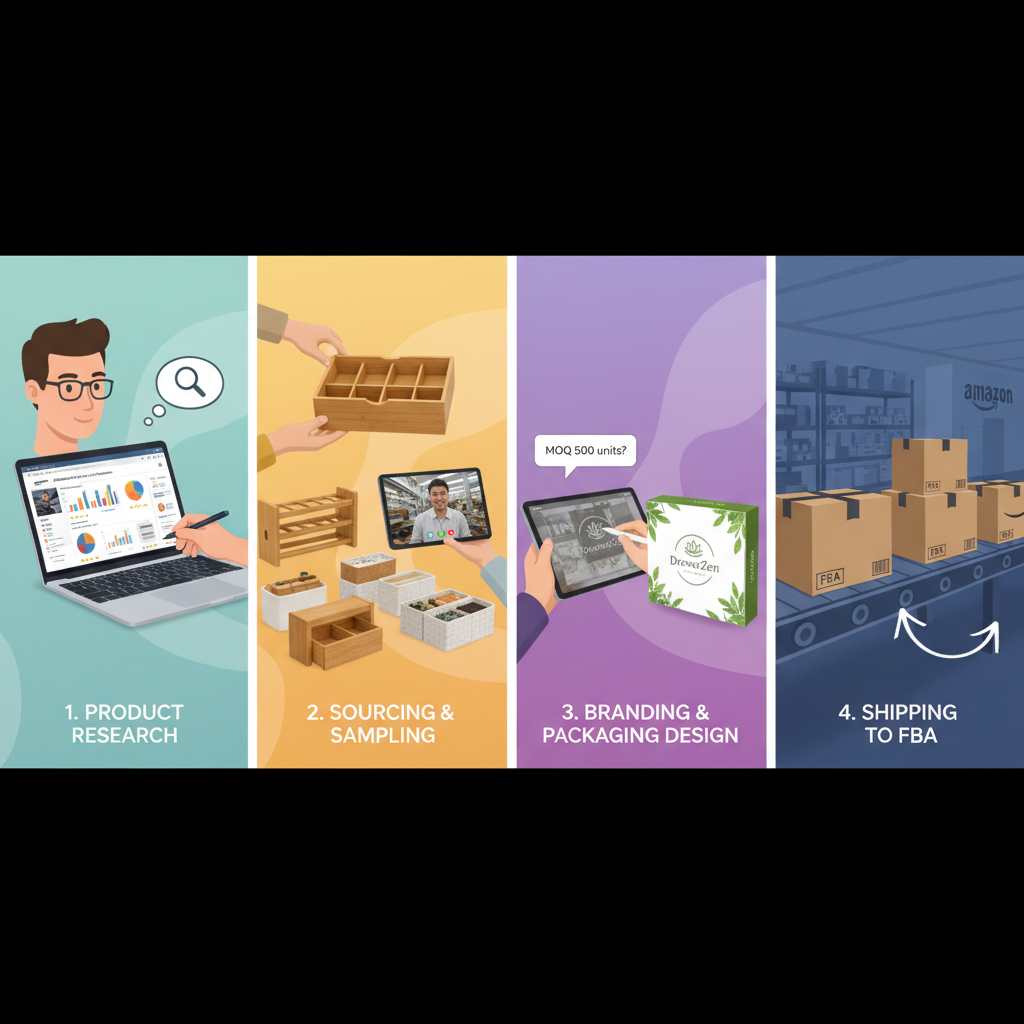
How Amazon Private Label Works (Step-by-Step)
Let’s walk through the process from zero to first sale.
1. Product Research: What Should You Sell?
This is where most private label success or failure is decided.
You want products that hit a sweet spot:
- Steady demand: People are already searching for and buying the item.
- Manageable competition: Not dominated by huge brands with 20k+ reviews.
- Decent margins: After Amazon fees, shipping, and product cost, you still have profit.
- Simple and small: Especially for your first product (think: low breakage, light weight, not super regulated).
Practical ways to research:
- Browse Amazon Best Sellers, New Releases, and Movers & Shakers in specific categories.
- Use product research tools (e.g., Helium 10, Jungle Scout, SellerAmp, etc.) to estimate monthly sales volume, pricing, and competition.
- Read existing product reviews to spot complaints and feature requests.
Look for signs like:
- Many listings with 500–2,000 reviews (good demand) but not all with 10k+ (not totally locked up).
- At least a few poorly optimized listings: bad photos, weak titles, or missing benefits — that’s your opportunity.
You see that “bamboo drawer organizers” sell well. Top listings have 2,000–4,000 reviews, but a few page-one results have ugly photos and generic descriptions. Reviews complain about “splintering wood” and “no adjustable compartments.” That might be a niche you can improve on.
2. Validate Profit: Will You Actually Make Money?
Falling in love with a product before you do the math is how wallets get hurt.
You need to account for:
- Product cost (from manufacturer).
- Shipping cost (to Amazon, and possibly from Amazon to customer if not included in FBA fees).
- Amazon FBA fees (fulfillment + storage).
- Referral fee (usually around 8–15% depending on category).
- Advertising (PPC on Amazon, maybe external traffic).
A simple way to sanity-check:
- Look at the average selling price on page one.
- Aim for a landed cost (product + shipping) of around 25–35% of that selling price.
- After Amazon fees (roughly another 30–40%), you still want 20–35% profit margin before ads.
If you’re selling a $20 item that costs you $9 landed and another $6 in fees, you have $5 left before ads — not great. But if the landed cost is $4 and fees are $6, you have $10 left, which is workable.
3. Find a Supplier and Create Your Brand
Once a product looks promising on paper, it’s time to find someone to make it.
Common places to source:
- Alibaba (and similar platforms) to find manufacturers mainly in China.
- Domestic manufacturers (U.S. or regional) for faster lead times and sometimes easier communication.
What to do:
- Contact multiple suppliers. Ask for quotes, minimum order quantities (MOQs), lead times, and customization options.
- Order samples from at least 2–3 different factories.
- Evaluate quality, packaging, and responsiveness of the supplier.
Then layer on the “private label” part:
- Create a brand name and check that the .com and social handles are relatively available.
- Get a simple, clean logo (freelancer, agency, or design tools).
- Ask the supplier about custom packaging, logo printing, and small product improvements.
You decide to launch “DrawerZen” bamboo organizers. You:
- Ask suppliers to use thicker bamboo.
- Add non-slip pads underneath.
- Print your brand on the packaging with clear visuals and a simple tagline like “Find Everything in One Glide.”
4. Set Up Your Amazon Seller Account
To sell private label on Amazon, you’ll typically:
- Create a Professional seller account.
- Choose between FBA (Fulfilled by Amazon) and FBM (Fulfilled by Merchant).
- Most private label sellers use FBA, so products are Prime-eligible and Amazon handles shipping and customer service.
You’ll also want to:
- Register your brand with Amazon Brand Registry (requires a trademark or at least a pending application in most regions).
- This unlocks brand protection tools, A+ Content (enhanced product descriptions), and better control over your listings.
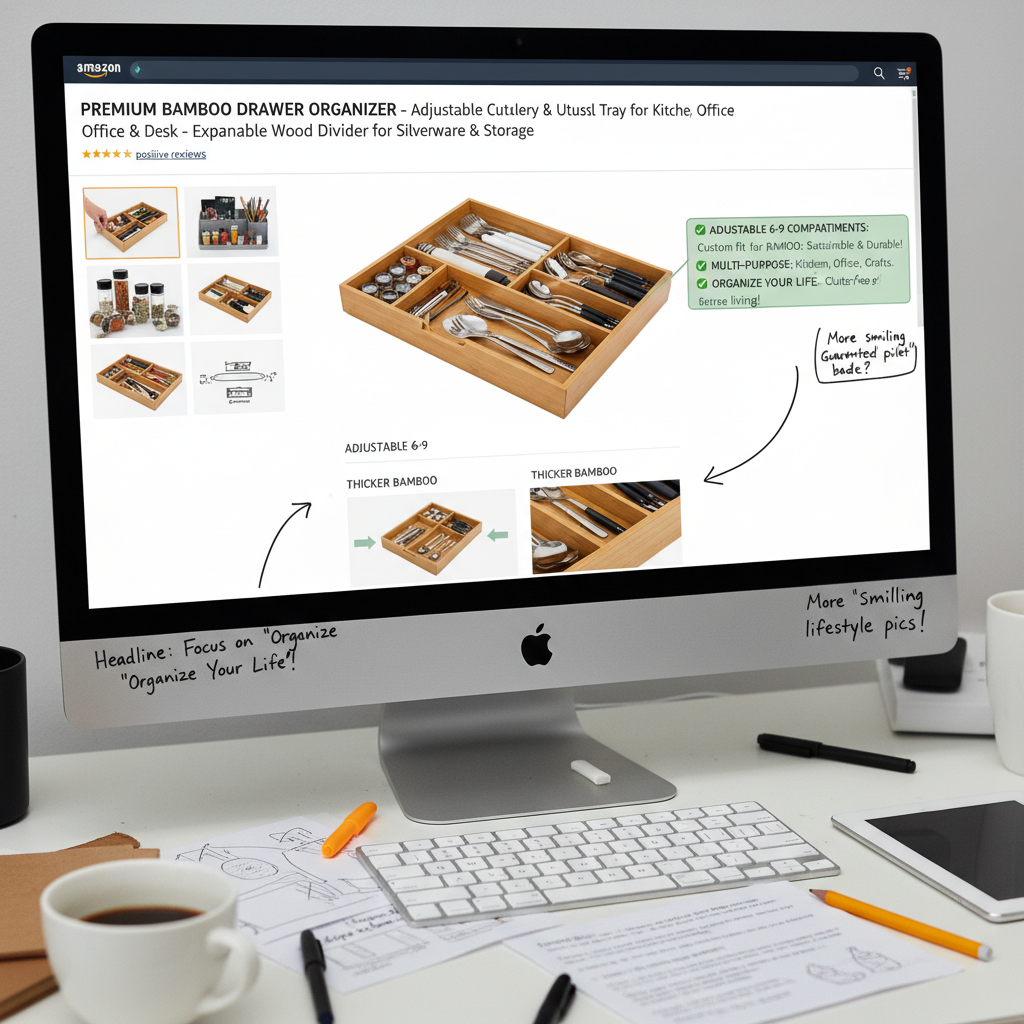
5. Build a High-Converting Listing
A lot of private label products fail not because the product is bad, but because the listing is.
Title
- Include main keywords naturally (e.g., “bamboo drawer organizer,” “adjustable kitchen drawer divider”).
- Make it readable, not a keyword word salad.
Images
- Use all available image slots.
- Include:
- Clean main image on white background.
- Lifestyle shots showing the product in use.
- Infographics calling out key benefits (e.g., “Adjustable 6–9 compartments,” “Thicker 100% bamboo”).
Bullet points & description
- Focus on benefits, not just features.
- Example: Instead of “Made of bamboo,” say “Smooth bamboo finish that won’t snag utensils or splinter over time.”
- Answer objections raised in competitor reviews (e.g., “No more sliding around in drawers thanks to built-in non-slip pads.”).
Keywords
- Use keyword tools or Amazon’s search suggestions to find related terms.
- Include important ones in the title, bullets, and back-end search terms — naturally, not spammy.
6. Launch Strategy: Getting Your First Sales and Reviews
Even the best product with the best listing will sit there lonely without visibility.
A typical Amazon private label launch includes:
-
Competitive pricing at launch
Start slightly lower than competitors to encourage trial and build momentum. -
Amazon PPC (pay-per-click ads)
- Run ads on your main keywords (e.g., “bamboo drawer organizer”).
- Start with automatic campaigns to discover converting search terms, then add manual campaigns for control.
-
Review strategy
- Use Amazon’s built-in programs where available (like “Request a Review” button and Vine if eligible).
- Provide excellent packaging and product quality so people want to leave 4–5 star reviews.
- Never buy fake reviews — it’s against Amazon’s terms and can destroy your account.
-
External traffic (optional but powerful)
- Simple social media posts, email lists, or influencer shoutouts can help early.
Pros and Cons of Amazon Private Label
Let’s be honest about both sides.
Pros
- You own the brand. You’re building an asset that can be expanded or even sold.
- Higher profit potential per unit compared to reselling other brands.
- Control over product quality and differentiation. You’re not stuck with whatever a brand gives you.
- Scalability. Once one product works, you can add variants and related items.
Cons
- Upfront capital needed. Inventory, samples, branding, and launch ads aren’t free.
- Risk of slow sales or failure. If the product misses, you’re stuck with stock.
- Complex logistics. Managing suppliers, shipping, and Amazon’s ever-changing rules is real work.
- Competition and copycats. If you succeed, others may try to imitate you.

Common Mistakes New Private Label Sellers Make
Want to avoid expensive lessons? Learn from other people’s bruises:
-
Choosing products based on personal preference, not data.
“I love this gadget” is not a business case. Demand, competition, and margins matter more. -
Ignoring quality to shave a few cents.
Cheap quality = bad reviews = tanked listing. -
Ordering way too much inventory up front.
Start with the minimum viable order that still makes financial sense. You can reorder if it takes off. -
Weak branding.
A random name, generic packaging, and no clear value proposition make you forgettable. -
Not tracking numbers.
You should know your profit per unit, ad spend, and reorder timelines — not just “sales look okay.”
How to Start Amazon Private Label in 30–60 Days (Simple Roadmap)
Here’s a high-level timeline:
Week 1–2: Research & Plan
- Deep dive into 1–2 product categories.
- Shortlist 3–5 promising product ideas.
- Validate demand, competition, and approximate margins.
Week 3–4: Suppliers & Samples
- Contact multiple manufacturers.
- Order samples from the best 2–3.
- Finalize branding, logo, and packaging concept.
Week 5–6: Listing & Launch Prep
- Place your first inventory order.
- Create and optimize your Amazon listing (photos, copy, keywords).
- Set up Amazon PPC campaigns ready to go live.
Lead times and shipping can extend this, but this rough roadmap shows it’s doable in a couple of months if you stay focused.

Who Is Amazon Private Label Best For?
You’ll probably enjoy (and stick with) private label if you:
- Like analyzing markets and solving problems.
- Have patience to iterate instead of chasing shiny objects.
- Can invest some money upfront (even a lean start often requires a few thousand dollars).
- Want to build a brand with long-term value, not just short-term flips.
If you need money next week, or hate dealing with suppliers, logistics, and data, this might not be your lane — and that’s okay.
Final Thoughts: Treat It Like a Real Business
Amazon private label can absolutely change your income and your options — but only if you respect it.
If you:
- Do real product research.
- Focus on quality and differentiation.
- Build a brand, not just a listing.
- Keep learning and adjusting based on data…
…you give yourself a genuine shot at building something meaningful.
If you want, I can help you in a follow-up by:
- Brainstorming potential product niches.
- Reviewing a product idea for risk and opportunity.
- Drafting an optimized Amazon listing title and bullet points.
Your move.
Leave a Reply