Amazon SDE2 Salary: What To Expect
“So… what’s the Amazon SDE2 salary, really?”
If you’re asking that, you’re either:
- An SDE1 wondering if the promotion is worth the grind,
- An external candidate trying to sanity-check a recruiter’s number,
- Or just salary-window-shopping like it’s Zillow for jobs.
Either way, let’s break down how Amazon SDE2 compensation really works in 2025–2026 terms—base, bonus, stock, location differences, and how to tell if your offer is good or trash.
Quick TL;DR: Amazon SDE2 Salary Snapshot
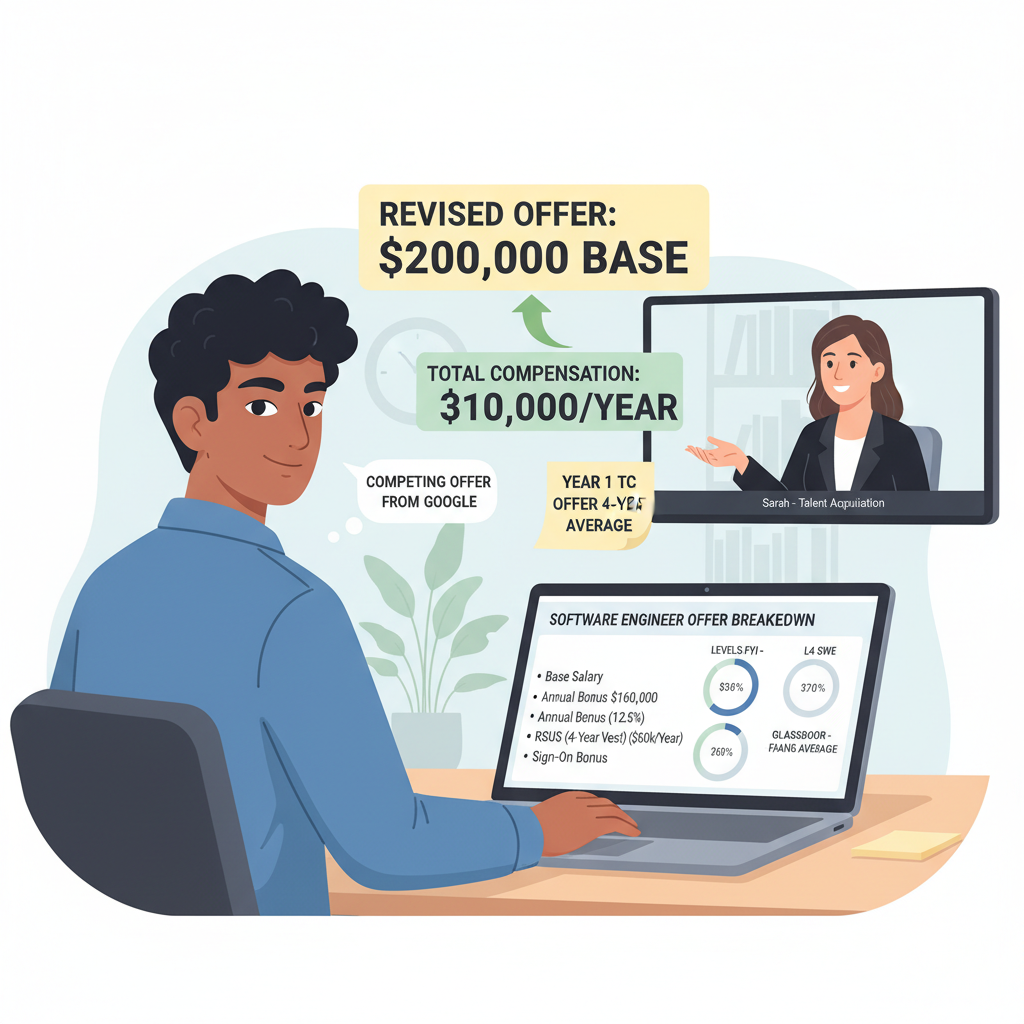
Numbers fluctuate with market conditions, but as of recent data in the U.S., a typical Amazon SDE2 total compensation range is roughly:
- Base salary: about $150K – $185K
- Annual cash bonus: typically 5–15% of base, depending on performance and level band
- RSUs (Amazon stock): often $60K – $200K+ over 4 years (front-loaded or back-loaded depending on offer structure)
- Total compensation (TC): commonly $200K – $280K+ per year in major tech hubs (Seattle, NYC, Bay Area), lower in smaller markets.
These are ranges, not guarantees. Offers can go above or below depending on:
- Location / cost of living
- Your experience (years + depth)
- Team urgency (hard-to-hire orgs sometimes pay more)
- How hard you negotiate
Takeaway: SDE2 is a solid six-figure role where stock and location matter almost as much as base.

What Exactly Is an Amazon SDE2?
Before we nitpick salary bands, it helps to know what Amazon means by SDE2.
SDE2 (Software Development Engineer II) is:
- A mid-level engineer (roughly 2–6 years experience as a guideline)
- Expected to own medium-to-large features or components
- Able to design systems, not just implement tickets
- Still mostly an IC (individual contributor), but often mentoring SDE1s and interns
Rough mapping (not official, but common industry mental model):
- Amazon SDE1 ≈ junior / entry-level
- Amazon SDE2 ≈ mid-level (L5 at some other companies)
- Amazon SDE3 ≈ senior engineer
Takeaway: SDE2 is where your comp jumps because the expectations jump—architectural thinking, ownership, and reliability.
Amazon SDE2 Salary Breakdown: Base, Bonus, Stock
Let’s unpack the three big pieces of SDE2 compensation: base, bonus, and RSUs.
1. Base Salary for Amazon SDE2
In the U.S., recent market data and crowdsourced reports (e.g., Levels.fyi, Blind, Glassdoor) show:
- Typical SDE2 base salary: about $150K – $185K
- In high-cost locations (Seattle, SF Bay Area, NYC), base often leans to the upper half of that range
- In lower-cost markets, base may be closer to $145K – $165K
Note: Amazon historically had a base salary cap that they update periodically; total comp beyond that is typically made up with stock.
What to look for:
- If your base is below $150K in a major tech city as an SDE2, you should ask why and push back.
Mini example:
- Candidate A in Seattle: Base = $175K
- Candidate B in a smaller U.S. city: Base = $155K
Same level, different geo. The rest of the package (stock, bonus) levels it out somewhat, but not entirely.
Takeaway: Base pays the bills, but it’s only part of the SDE2 story.
2. Bonus for Amazon SDE2
Amazon’s cash bonus for SDE2 is usually modest compared to some competitors, but it exists.
- Expect a target bonus of around 5–10% of base for mid-level engineers, with potential to go a bit higher based on performance and org norms.
- Amazon has a performance-driven culture, so your actual payout can vary with your review.
Example:
- Base: $170K
- Target bonus: 10% → $17K (paid annually)
- Actual: Could be, say, $12K–$20K+ depending on performance.
Takeaway: Bonus is nice, but don’t anchor your decision on it; the real swing factor is stock.
3. Amazon SDE2 RSUs (Restricted Stock Units)
This is where Amazon compensation gets… interesting.
Amazon pays a large portion of total compensation in RSUs (AMZN stock), typically over a 4-year vesting schedule.
For SDE2, a realistic range might look like:
- $60K – $200K+ in Amazon stock over 4 years, depending on level band, location, and how hard your recruiter is fighting for you.
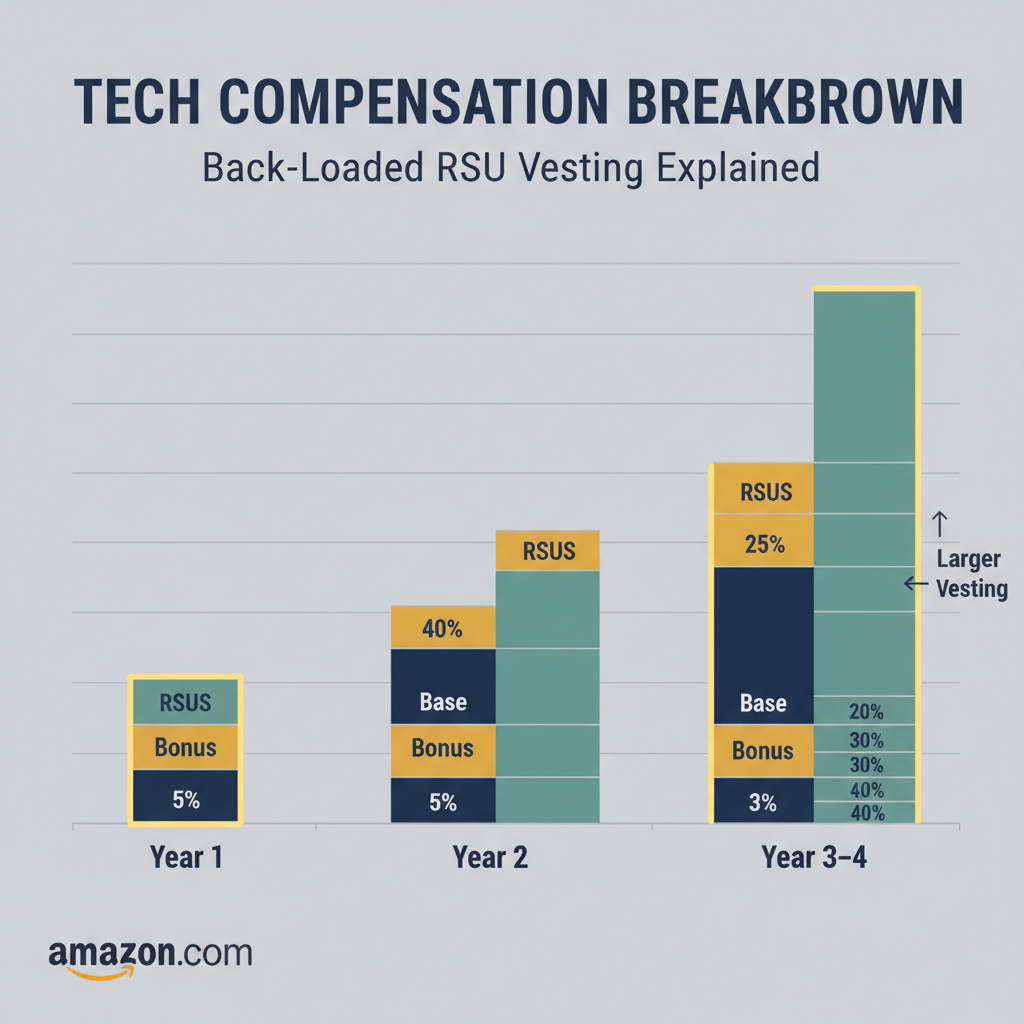
The vesting schedule is usually not the classic 25/25/25/25. Historically, Amazon has used a back‑loaded schedule, commonly:
- Year 1: 5%–10%
- Year 2: 15%–20%
- Year 3: 35%
- Year 4: 40%
(Exact percentages can vary by offer and internal policy at the time; always read your offer letter carefully.)
Example RSU package:
- Total RSUs grant value: $160K
- Vesting (hypothetical 5/15/40/40):
- Year 1: $8K
- Year 2: $24K
- Year 3: $64K
- Year 4: $64K
If Amazon’s stock price goes up, your realized value could be higher; if it drops, lower.
Takeaway: Your Year 3 and 4 compensation can be way higher than Year 1 if you stay.
Amazon SDE2 Total Compensation: Putting It All Together
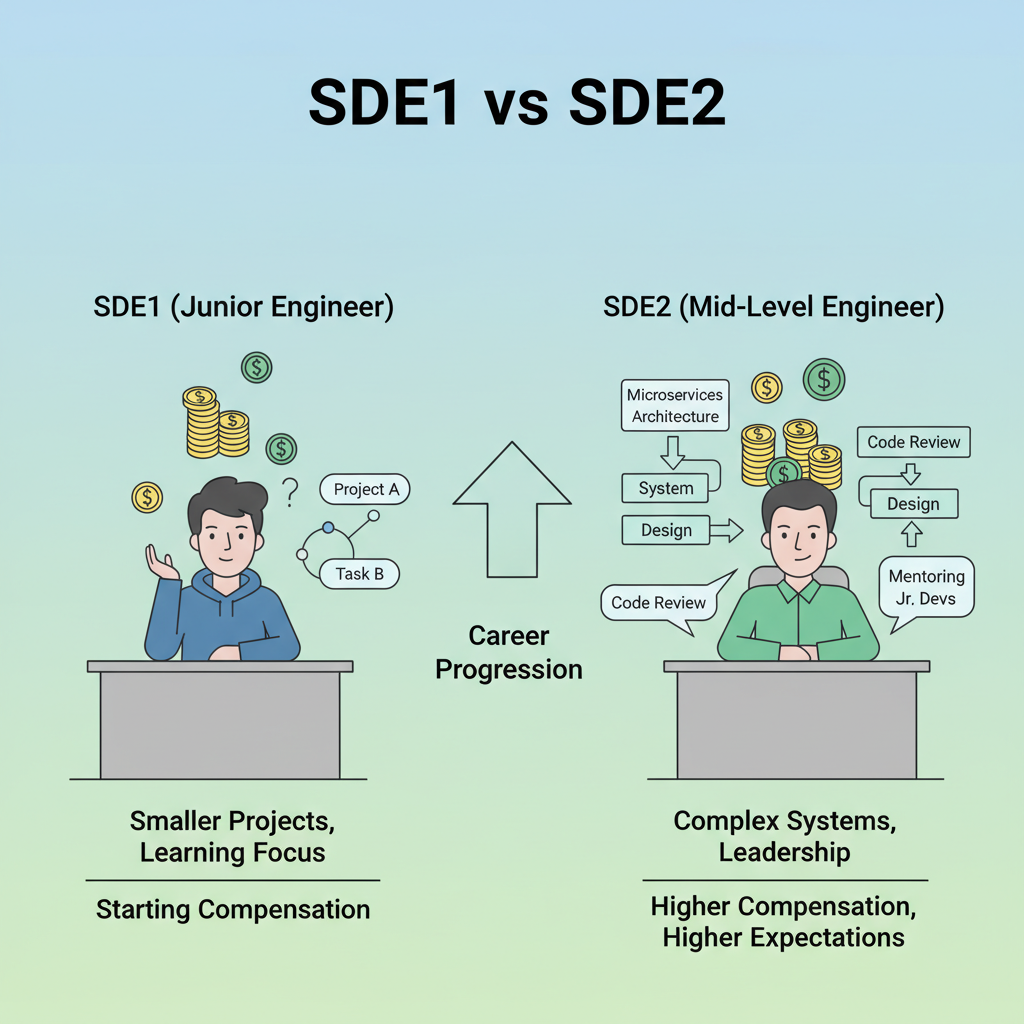
Here’s how all of this typically shakes out in total compensation (TC) per year.
Example 1: SDE2 in Seattle
- Base: $175K
- Target bonus (10%): $17.5K
- RSUs (4-year average): say $60K/year
Average annual TC ≈ $252K
Year-by-year (with back‑loaded vesting) might look like:
- Year 1: $175K + $17.5K + $20K ≈ $212.5K
- Year 2: $175K + $17.5K + $40K ≈ $232.5K
- Year 3: $175K + $17.5K + $80K ≈ $272.5K
- Year 4: $175K + $17.5K + $80K ≈ $272.5K
Notice how Year 1 can feel underwhelming compared to later years.
Example 2: SDE2 in a Lower-Cost Market
- Base: $155K
- Bonus: $10K
- RSUs (average): $35K/year
Average annual TC ≈ $200K
Takeaway: When people say “Amazon SDE2 salary,” they usually mean total package in the $200K–$260K+ band in big markets—but your first year could be on the low end because of vesting.
Amazon SDE1 vs SDE2 Salary: Is the Jump Worth It?
If you’re already at Amazon as an SDE1, you’re probably wondering: How big is the SDE2 bump?
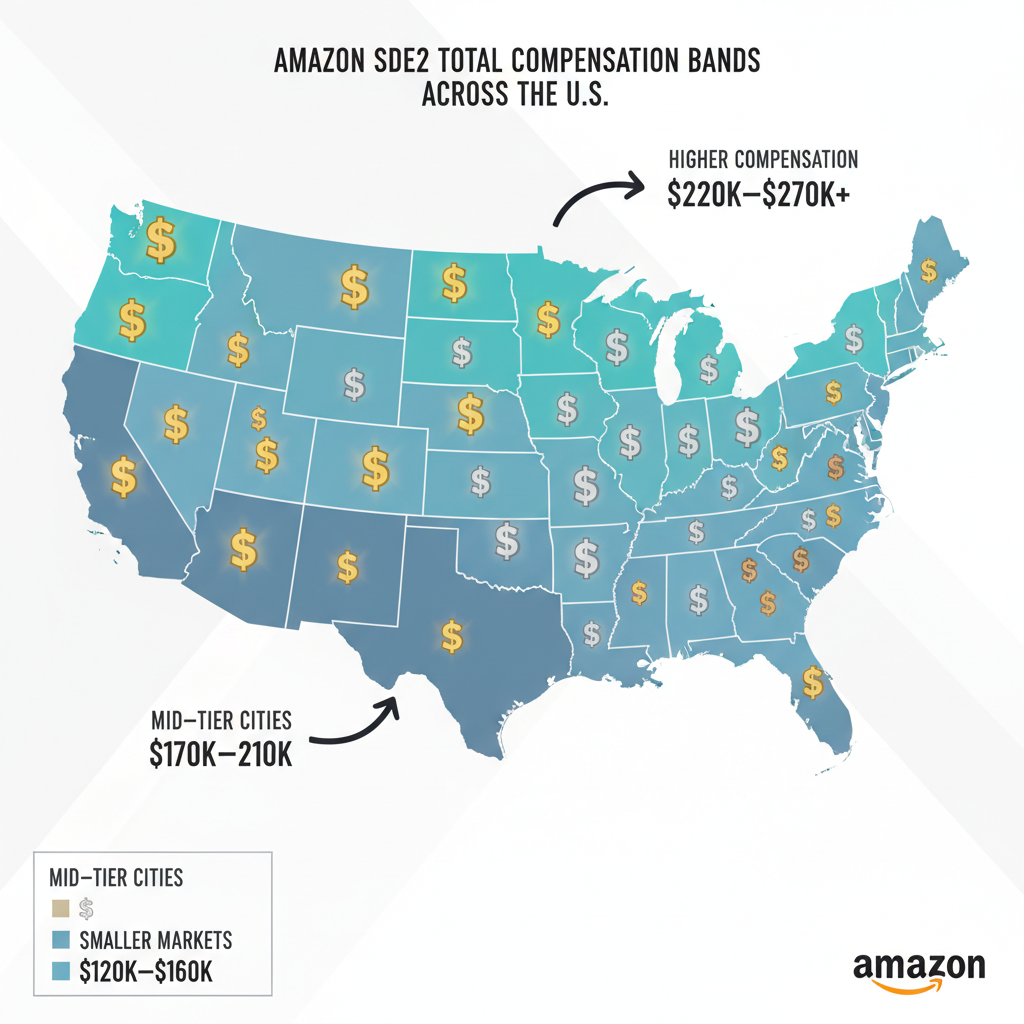
While exact numbers vary, a promotion from SDE1 to SDE2 typically comes with:
- A noticeable base bump (often $20K–$40K+)
- A larger RSU refresh tied to the higher level
- More influence and expectation of ownership
Rough mental model:
- SDE1 total comp: ~$140K – $190K depending on geo & experience
- SDE2 total comp: ~$200K – $260K+ in major markets
But—the bar for SDE2 is higher:
- You need to drive features end‑to‑end
- You’re on the hook for design decisions
- Your impact is expected to be broader and more visible
Takeaway: Yes, the money is meaningfully better, but so are expectations. Don’t underestimate the scope jump.
How Location Affects Amazon SDE2 Salary
Amazon pays differently across locations based on comp bands and cost of labor, not just cost of living.
Broadly speaking:
- Highest bands: Seattle, SF Bay Area, NYC
- Mid bands: Austin, Boston, some U.S. metros
- Lower bands: Smaller or non-tech-hub cities
Same level, same title, different realities:
- SDE2 in Seattle: TC might land in $220K – $270K+
- SDE2 in smaller markets: TC may instead be closer to $180K – $220K
If you’re remote or relocating, always clarify:
- Which comp band your offer is tied to
- Whether your band changes if you move later
Takeaway: That “same role” can be a $40K–$60K difference just by changing zip codes.
How to Tell If Your Amazon SDE2 Offer Is Good
Instead of just asking, “Is this high or low?”, walk through these checks:
1. Compare Against Market Data
Use sites like:
- Levels.fyi
- Glassdoor
- Blind (with caution; lots of flexing and outliers)
Filter for:
- Amazon
- SDE2
- Your city or closest major hub
You’re looking for the median and 75th percentile of total comp, not the one-off unicorn offer.
2. Break Down the Components
Write out:
- Base: $___
- Bonus target: $___ (and realistic range)
- Year-by-year RSU vest: $___ / $___ / $___ / $___
Then calculate Year 1 actual and 4-year average.
3. Consider Stock Volatility
Your RSUs are tied to Amazon’s stock price.
- If you’re risk-averse, you may care more about base.
- If you’re bullish on Amazon long‑term, a stock‑heavy offer might be attractive.
You can ask recruiters to:
- Move a bit more into base / sign‑on if the stock portion feels too heavy
- Or add a sign‑on bonus to compensate for lower Year 1 vesting
4. Check the Internal Level
Confirm your exact level (e.g., SDE2 vs SDE3), because:
- Same job description + different level = very different comp
Takeaway: Don’t just stare at one number. Model your Year 1, 2, 3, 4 and sanity-check against market data.
Can You Negotiate an Amazon SDE2 Offer?
Yes. You absolutely can—and should—negotiate your Amazon SDE2 salary.
A few realistic tips:
- Know your band: Recruiters typically have a low, mid, and high target band for your level/location.
- Use competing offers: Offers from other big tech or well‑funded startups can often pull you towards the upper end of the band.
- Optimize for your priorities:
- Want stability? Push on base + sign‑on.
- Comfortable with stock? You can accept a stock‑heavy package if overall TC is strong.
- Be specific: Instead of “Can you do better?”, say:
- “Given my other offer at $240K TC, is there room to move this closer to $230K–$240K total?”
Amazon may push back with “this is top of band,” but if you’re in-demand, there’s usually some room—especially in stock or sign‑on.
Takeaway: Polite, data‑driven negotiation can add tens of thousands to your package. Don’t leave that on the table.
When an Amazon SDE2 Salary Might Not Be Worth It
Hot take in 3…2…1…
An impressive-looking number on paper doesn’t automatically mean it’s right for you.
A few red flags where even a strong Amazon SDE2 salary might be questionable:
- Team with brutal on‑call / pager duty, but no extra compensation compared to better-balanced teams.
- Tech stack misalignment: If you care about a certain domain (ML, high-scale distributed systems, front-end depth) and the team doesn’t match, your long‑term growth may suffer.
- Low promotion velocity: If the org is bottlenecked at senior levels, you could be stuck as an SDE2 for years without much career movement—even with okay pay.
Takeaway: Compensation matters, but so do skills, happiness, and realistic growth paths. Money can’t fix a miserable day‑to‑day.
Final Thoughts: How to Approach an Amazon SDE2 Offer
If you remember nothing else, keep this checklist:
- Get the full breakdown: Base, bonus, Year‑by‑Year RSU vesting, sign‑on.
- Benchmark: Compare your Amazon SDE2 salary and total comp against recent market data for your city and level.
- Model the real numbers: Calculate Year 1, 2, 3, 4. Don’t just divide by 4.
- Ask for what you want: Higher base, more RSUs, or a stronger sign‑on—backed by competing offers or data.
- Think beyond money: Evaluate team, tech stack, manager, work-life balance, and growth.
If the total compensation looks competitive, the team fit feels right, and the scope aligns with your career goals, an Amazon SDE2 role can be a powerful launchpad toward senior engineering and beyond.
And if your offer feels low? You’re not being “difficult” by negotiating—you’re just acting like a mid‑level engineer who knows their value.
Leave a Reply