Amazon Smile: What Really Happened
If you ever felt oddly proud that your late-night Amazon shopping was “for charity,” you’re not alone.
For years, AmazonSmile let people support their favorite nonprofits just by buying the stuff they were going to buy anyway. Then one day, poof — Amazon announced it was shutting the whole thing down.
So what actually was AmazonSmile, why did Amazon retire it, and what should shoppers and nonprofits do now?
Let’s unpack it in plain English.

A cozy, slightly nostalgic look at the AmazonSmile era — when late-night shopping felt a little more virtuous.
What Was AmazonSmile?
AmazonSmile was a program that let customers shop at a special URL — smile.amazon.com — and have 0.5% of their eligible purchases donated to a charity of their choice. Same products, same prices, same Prime — just with a small charitable kickback.
How it worked (when it existed)
- You’d go to
smile.amazon.cominstead of the main site. - You’d pick a charity — big names like the Red Cross or tiny local rescues, schools, churches, etc.
- Amazon would donate 0.5% of your eligible purchase price to that organization.
To be clear: this was Amazon’s money, not an extra charge to you. You weren’t “paying more” to give — you were just redirecting a slice of Amazon’s revenue.
AmazonSmile made giving feel effortless, but the actual donation amounts per person were small.
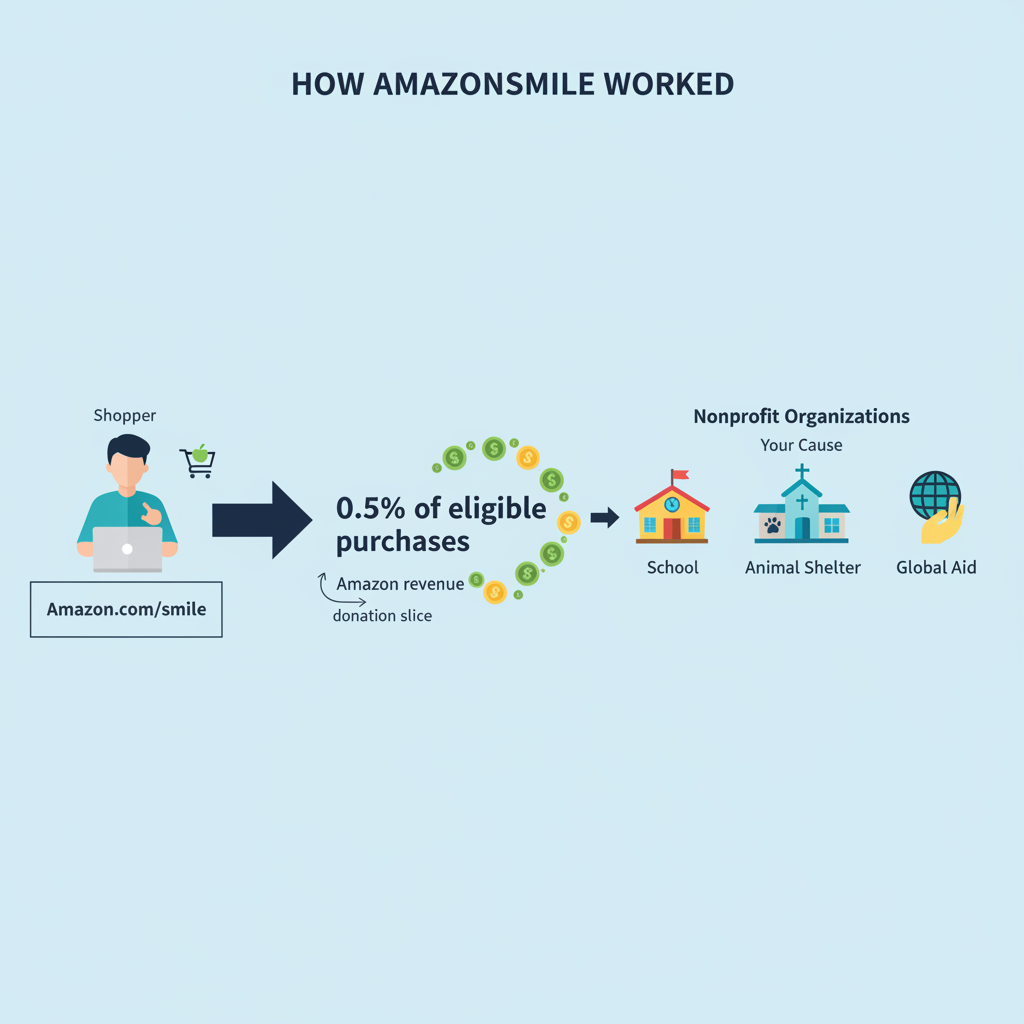
A simple visual of how AmazonSmile once worked: a tiny slice of Amazon’s revenue flowing to your chosen charity.
Is AmazonSmile Still Available?
Here’s the part many people missed:
AmazonSmile officially ended in early 2023.
Amazon shut down the program globally, telling customers and charities that the impact was too spread out across millions of organizations to create meaningful change for most of them.
So if you’re still typing amazon smile or smile amazon into Google hoping to support your favorite rescue, school, or nonprofit at checkout:
- You’ll be redirected back to the main Amazon site.
- You can’t choose a charity and trigger the old 0.5% donations anymore.
As of now, you can’t use AmazonSmile. It’s over, and it’s not just “down for maintenance.”
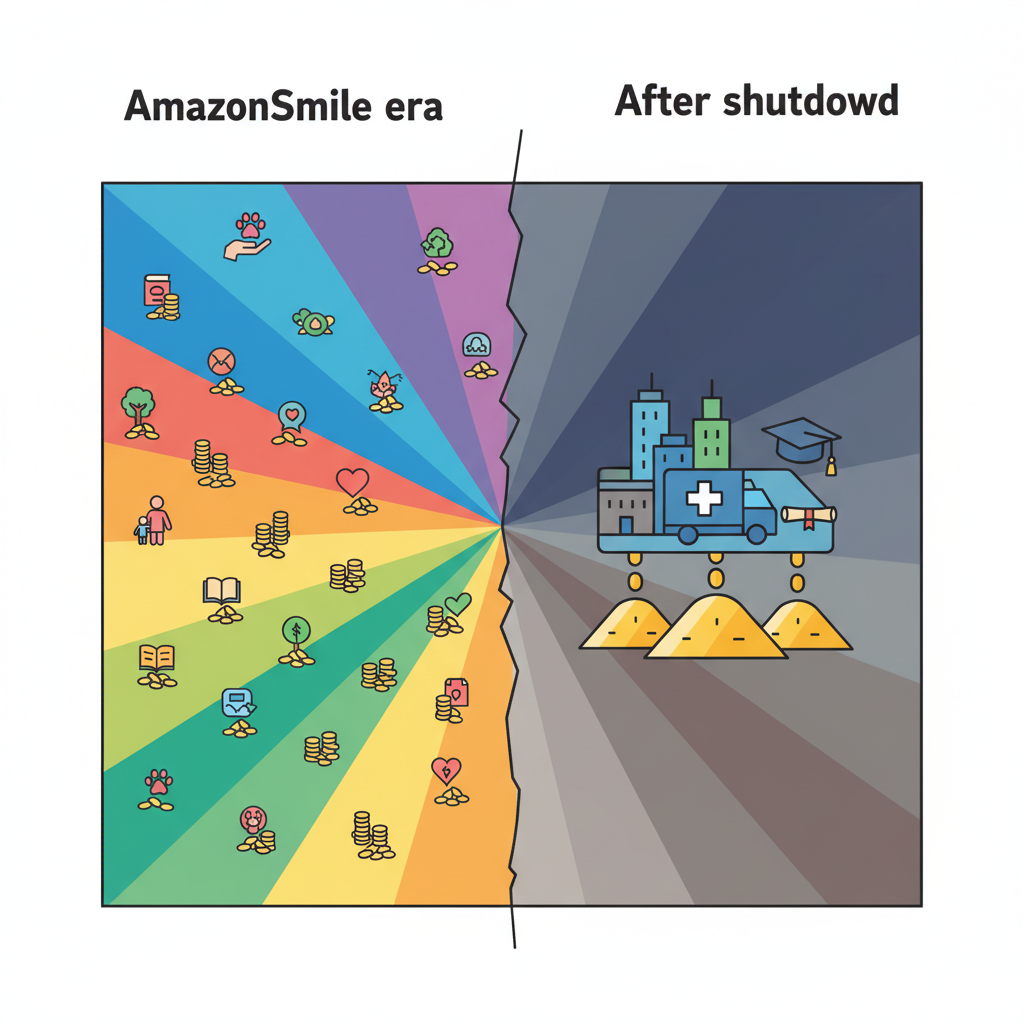
From fragmented micro-donations to fewer, bigger bets: how Amazon framed the shift away from AmazonSmile.
Why Did Amazon Shut Down AmazonSmile?
Amazon gave a few key reasons when they announced the closure:
1. The impact was too fragmented
There were over a million eligible charities. That sounds great in theory — but it meant donations were spread incredibly thin.
For many smaller organizations, annual donations from AmazonSmile were often modest — think tens or hundreds of dollars per year, not tens of thousands.
From Amazon’s perspective, they were running a big, complex global program with a relatively small and scattered impact.
2. Amazon wanted “more focused” giving
Alongside shutting down AmazonSmile, Amazon said it planned to focus more on direct, larger-scale philanthropy — things like:
- Disaster relief
- Affordable housing in regions where it has major offices
- Education and workforce development initiatives
Whether you see that as smart strategy or convenient PR spin is up to you. But that was the official line.
3. Administrative and brand reasons (the unspoken stuff)
Let’s be real:
- Running a global charity program across millions of nonprofits is administratively heavy.
- The marketing benefit may have been shrinking as more people took it for granted.
- The 0.5% rate, while nice psychologically, probably didn’t move the needle much for how people chose where to shop.
Publicly, Amazon said AmazonSmile’s impact was too small and spread too thin. Behind the curtain, cost, complexity, and strategy likely played big roles.
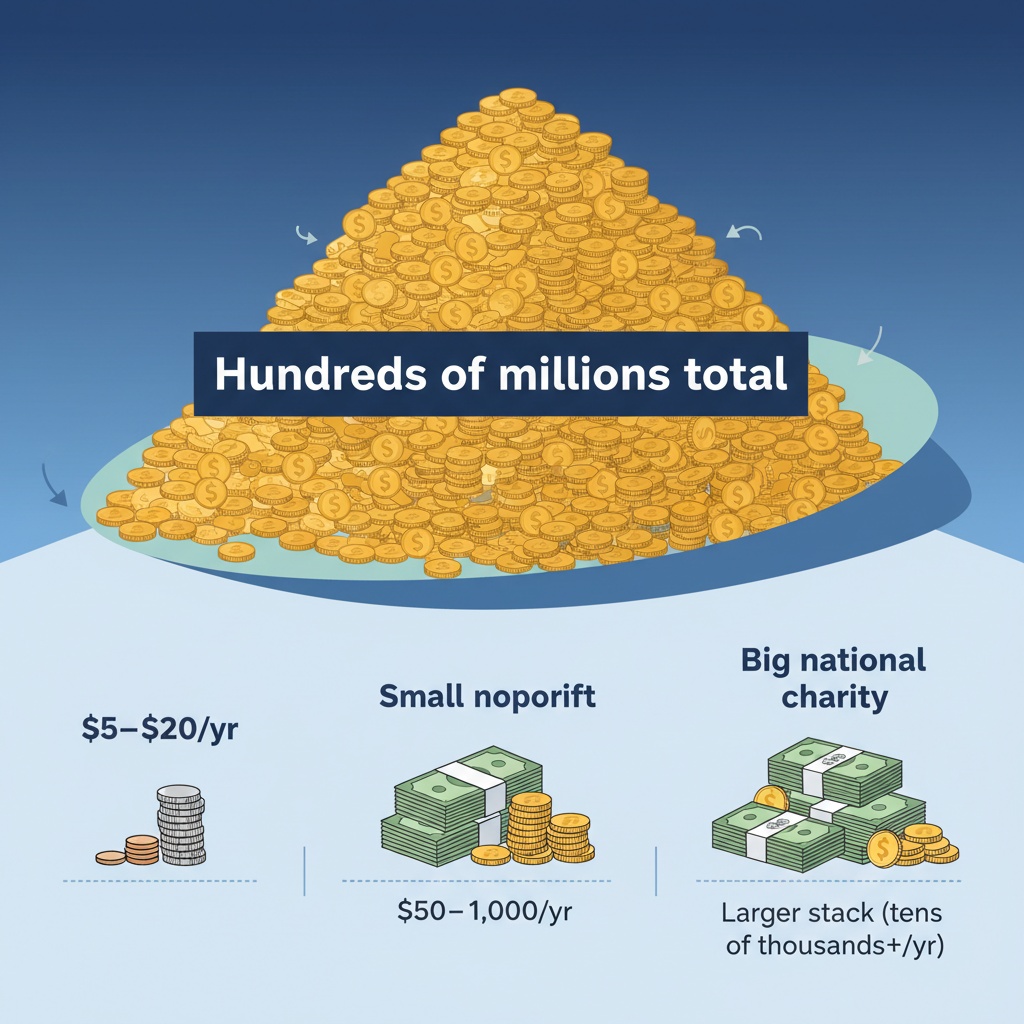
Big global totals, modest everyday impact: how AmazonSmile’s dollars looked from different angles.
How Much Did AmazonSmile Actually Give?
Over its lifetime, AmazonSmile did add up to serious money in total.
Across millions of customers and organizations, the program distributed hundreds of millions of dollars globally.
But here’s the important nuance:
- Per individual shopper, the yearly impact was usually small — often just a few dollars.
- Per small nonprofit, it might be anywhere from $50–$1,000 per year, depending on how heavily they promoted it and how Amazon-focused their donor base was.
Many nonprofits appreciated the extra, but very few relied on it as a core revenue stream. For some, it was more of a “nice surprise check” than a budget pillar.
In aggregate, AmazonSmile gave a lot. For most individual orgs and shoppers, it felt more symbolic than transformational.

The secret sauce: everyday orders quietly whispering, “You just did something good.”
Why People Loved (and Overestimated) AmazonSmile
1. It felt effortless
You didn’t have to:
- Pull out a credit card
- Fill out donation forms
- Remember to give each month
You just bought cat litter and phone chargers, and boom — you “helped save the world.”
That psychological ease is powerful.
2. It turned routine shopping into a feel-good habit
Even if you knew the money was small, there was something satisfying about seeing:
“Your purchases have generated $23.17 for [Your Favorite Charity].”
It made your everyday consumption feel a little less selfish.
3. It created a mental shortcut: “I already give through Amazon”
Here’s the trap: because giving was automatic, some people mentally treated it like they were already donating regularly — and then didn’t make more direct, higher-impact gifts.
AmazonSmile was great for making people feel generous, even when the actual dollar amounts were modest.
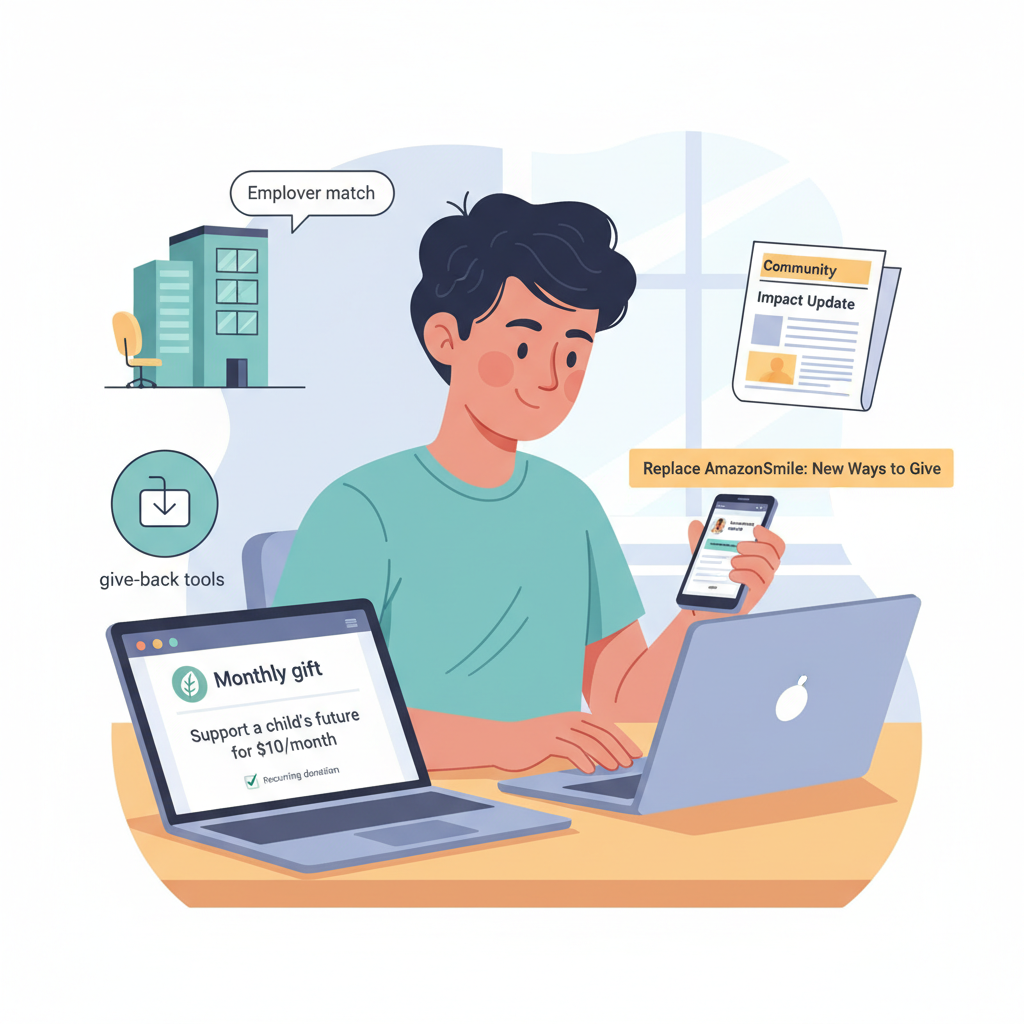
Life after AmazonSmile: turning “set it and forget it” generosity into something even more impactful.
What Can You Do Now That AmazonSmile Is Gone?
If you’re a shopper or a nonprofit wondering, “Okay, now what?”, you’ve got options.
For Shoppers: How to Still Support Charities While Shopping
You can’t revive AmazonSmile, but you can:
1. Give directly (this is the highest impact move)
Instead of hoping 0.5% of your purchase trickles to charity:
- Take a look at what your AmazonSmile totals used to be per year (if you remember them).
- Consider setting up a recurring monthly donation to that same charity instead — even $5–$20/month is usually more than what your shopping would’ve generated.
Nonprofits can do a lot more with a predictable direct donation than with a small, variable corporate kickback.
2. Use employer matching if available
Many employers will match your donations, effectively doubling them.
If you used to rely on AmazonSmile as your main “set it and forget it” giving mechanism, redirect that energy into:
- Giving directly
- Turning on employer match if your company offers it
3. Look into other shopping-based charity tools
While nothing is a 1:1 replacement for AmazonSmile on Amazon itself, there are:
- Browser extensions that route affiliate commissions to charity when you shop across multiple retailers
- Retailers with built-in give-back programs (e.g., some brands donate a percent of profits or products to specific causes)
They all come with their own pros/cons, but the principle is similar: a slice of the transaction goes to charity, usually at no extra cost to you.
If you liked AmazonSmile because it was easy, recreate that feeling with a small, automatic monthly donation and, if you want, a couple of give-back tools stacked on top.
For Nonprofits: Life After AmazonSmile
If your organization used to promote AmazonSmile, you’re not powerless now that it’s gone.
Here’s how to pivot:
1. Reframe the loss in your messaging
Be honest, but strategic:
- Acknowledge that AmazonSmile has ended.
- Share what it meant for your org in concrete terms — e.g., “In 2022, AmazonSmile funded roughly two weeks of food for our shelter animals.”
- Invite supporters to replace that impact directly: “A monthly gift of $10 can fully replace and even exceed what AmazonSmile used to provide.”
2. Launch a “Replace AmazonSmile” mini-campaign
Make it a specific, time-bound push:
- “Help us replace AmazonSmile in 30 days.”
- Show the total amount you used to get in a typical year.
- Break it down into a clear goal: “If 75 people give $10/month, we’re covered.”
People respond well to clear, concrete, solvable problems.
3. Double down on recurring giving
AmazonSmile worked because it was automatic.
Your best replacement strategy is to:
- Heavily promote monthly giving (“Join our Sustainers Circle,” “Rescue Champions,” etc.).
- Make sign-up incredibly simple (one-click options, Apple Pay/PayPal, etc.).
- Reinforce the emotional benefit: “You’re providing stable, predictable support our team can rely on.”
4. Diversify your “easy giving” tools
Consider:
- Text-to-give or QR codes at events
- Donation links in email signatures and social media bios
- Partnerships with local businesses that do round-up at checkout or 1% give-back days
Treat AmazonSmile’s end as a nudge to build more direct, reliable funding streams you actually control.
AmazonSmile’s legacy in one glance: impressive in aggregate, modest up close.
Was AmazonSmile Ever a Game-Changer?
Depends on how you look at it.
- For huge national charities: It sometimes added up to meaningful money due to sheer volume.
- For small local orgs: It was usually a nice bonus, not a budget-maker.
- For individual shoppers: It offered emotional satisfaction more than financial firepower.
From a charity effectiveness standpoint, direct giving and recurring donations almost always beat “X% of your shopping” models.
But from a behavioral standpoint, AmazonSmile proved something important:
People love feeling generous without friction.
The future of online giving will probably keep leaning into that — more automation, more integration, more “set it once and forget it” generosity.
AmazonSmile itself may be gone, but the idea it popularized — frictionless giving baked into everyday life — is absolutely here to stay.
From invisible giving to intentional impact: your next chapter after AmazonSmile.
What You Should Do Next
If you came here by typing something like “amazon amazon smile” wondering how to keep helping your favorite cause, here’s your simple 3-step plan:
- Pick your charity. The one you used with AmazonSmile is a great start.
- Set up a small recurring donation. Aim to beat what AmazonSmile likely produced — even $5–$15/month helps.
- Add one more easy win. Turn on employer matching, use a give-back card or extension, or support brands with clear, transparent donation programs.
AmazonSmile made giving feel almost invisible.
Now you get to make it intentional — and, honestly, far more impactful.
Leave a Reply