Is Amazon Really A Monopoly?
Is Amazon a monopoly, or just really, really good at selling you stuff you didn’t know you needed at 11:47 p.m. on a Tuesday?
Let’s unpack what “monopoly” actually means, what regulators are arguing, what Amazon is doing in practice, and what this all means for shoppers, sellers, and the future of online retail.

First, what is a monopoly, really?
We throw the word around a lot (usually when our favorite app changes prices), but in antitrust law “monopoly” has a very specific meaning.
In U.S. law (under Section 2 of the Sherman Act), a company is considered to have monopoly power when:
- It dominates a relevant market (usually something like 70%+ share, depending on the facts), and
- It maintains that dominance through exclusionary or anticompetitive conduct, not just by being better, cheaper, or more innovative.
Economists often define a monopolist as a firm that faces little to no meaningful competition for a product or service that has no close substitutes. Think local water utility, not a popular restaurant.
So the key questions are:
- What market is Amazon supposedly monopolizing?
- How big is its share of that market?
- And is it using that power in ways that harm competition and consumers?
Keep those three in mind as we go.
How big is Amazon, actually?
Huge. But “huge” and “monopoly” are not the same thing.
According to industry estimates, Amazon accounts for roughly one‑third to two‑fifths of U.S. online retail sales, depending on methodology. One analysis cited by the Wall Street Journal pegs Amazon at about 38% of U.S. online retail.
If you zoom out to all retail (online + brick-and-mortar), Amazon’s share drops dramatically to the single digits, around 3–6% of total U.S. retail sales. (independent.org)
Here’s the basic picture:
- Online retail: Amazon is the largest player by far.
- All retail: Amazon is a big fish in a very, very large pond.
And that’s before you even look at Amazon’s other major businesses:
- AWS (Amazon Web Services): The world’s largest cloud infrastructure provider.
- Advertising: One of the largest digital ad platforms in the U.S.
- E‑books: Dominant share of e‑book sales.
Those businesses raise their own competition questions, but most of the current “monopoly” debate is about Amazon’s online marketplace and retail platform.
So why is the FTC suing Amazon as a “monopolist”?
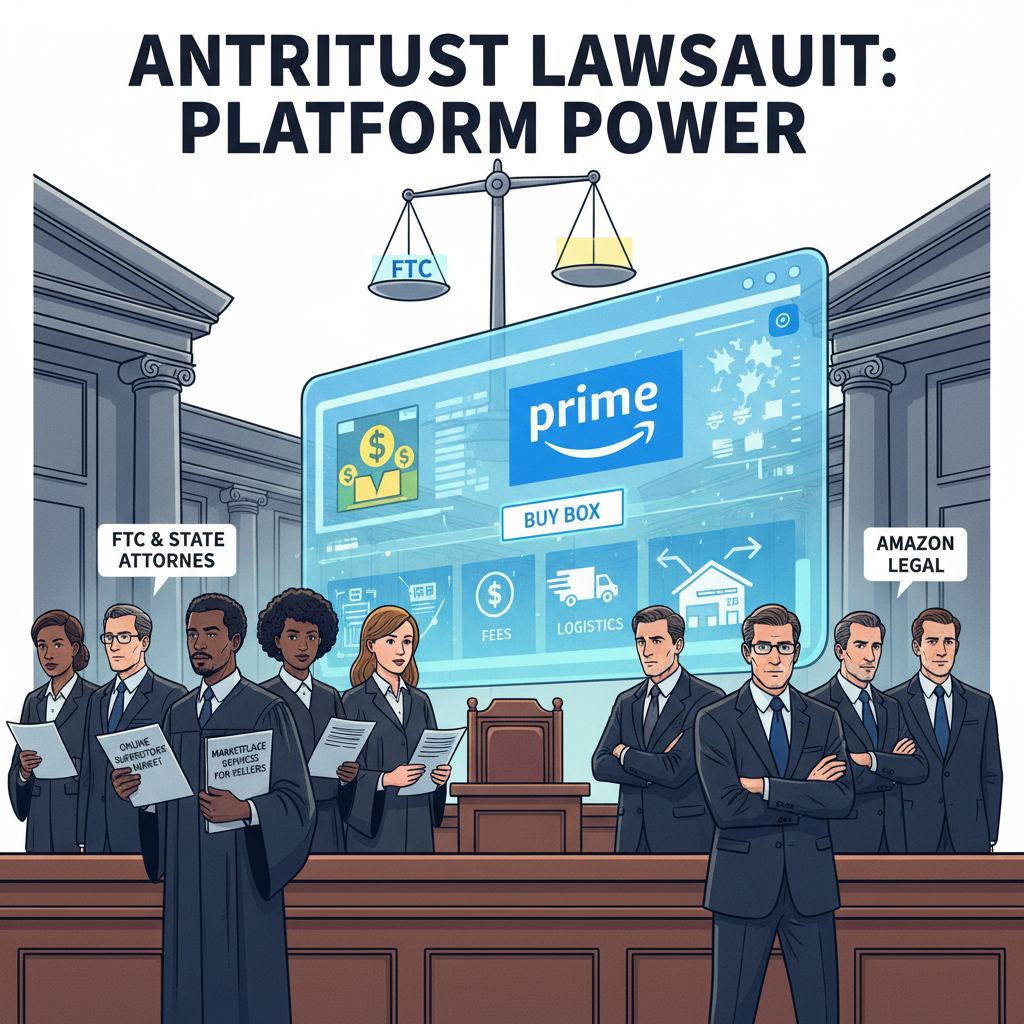
In September 2023, the Federal Trade Commission (FTC) and 17 state attorneys general filed a major antitrust lawsuit against Amazon. They argue that Amazon illegally maintains monopoly power in two specific markets: (americanactionforum.org)
-
The online superstore market for consumers
Basically: large online stores offering a very wide range of products (the FTC’s definition tends to include Amazon and a few generalist rivals like Walmart and Target, but exclude specialty sites, physical retailers, and other alternatives). -
The online marketplace services market for sellers
This is the set of services Amazon provides to third‑party sellers—listing, payment processing, logistics (Fulfillment by Amazon), advertising, and access to Prime customers.
Under the FTC’s narrower online-superstore definition, Amazon’s share is alleged to be over 60–66%. In marketplace services for sellers, its share is likewise alleged to be very high. (americanactionforum.org)
The government’s core claims focus less on size and more on conduct. According to the complaint, Amazon:
- Suppresses price competition by penalizing or burying sellers who offer lower prices elsewhere (or even on Amazon itself) — effectively using its ranking and visibility tools to keep prices from dropping.
- Ties access to Prime customers to use of Amazon’s own logistics/fulfillment services (FBA), making it hard for sellers to mix and match cheaper or more efficient alternatives.
- Raises seller fees significantly, creating what critics call “monopoly rents” — i.e., extracting higher fees from sellers who feel they have no realistic alternative to Amazon’s marketplace. (americanbar.org)
If the FTC wins, it won’t just be a slap on the wrist. Potential remedies could include:
- Bans on certain contract terms or fee structures
- Structural separation between Amazon’s marketplace and some of its logistics/retail operations
- Changes in how Prime and Buy Box rankings work
Amazon’s comeback: “We’re not a monopoly, competition is everywhere.”
Amazon, unsurprisingly, strongly disagrees.
Its counter‑arguments look like this:
-
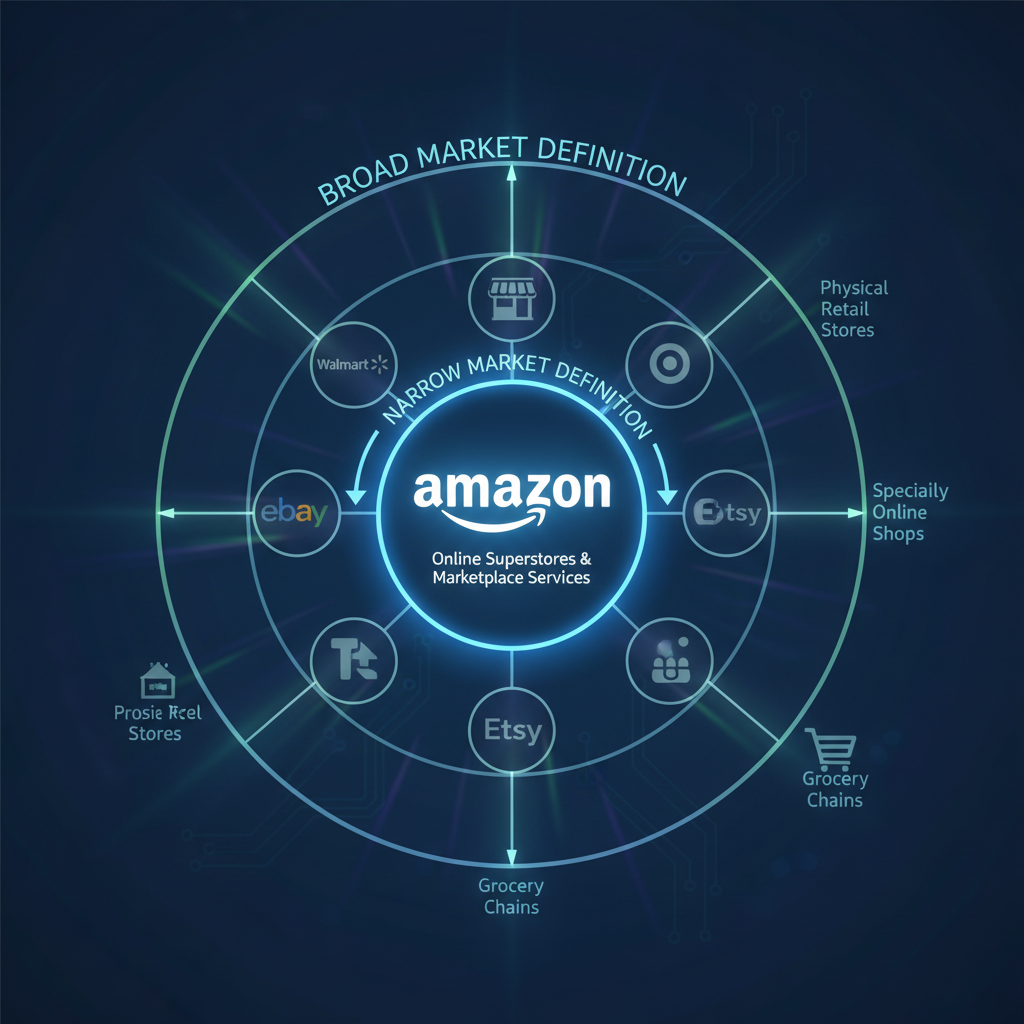
The market is much broader than the FTC claims.
If you define the market as “places consumers can buy stuff,” then Amazon competes with:- Walmart, Target, Costco, and countless brick‑and‑mortar chains
- Specialty online retailers (Wayfair, Chewy, Zara, etc.)
- Marketplaces like eBay, Etsy, and more
In that broader world, Amazon’s share of total U.S. retail is tiny (mid‑single digits). (independent.org)
-
Retail is brutally competitive.
Consumers comparison-shop across Google Shopping, price trackers, and multiple apps. If Amazon raises prices too much, people defect to competitors. Industry analysts critical of the FTC call its narrow “online superstore” definition “distortive” and “unrelated to economic reality” for leaving out obvious substitutes like physical stores and single‑brand sites. (independent.org) -
Many of the challenged practices have pro‑competitive justifications.
- Encouraging price parity can prevent sellers from gaming the system (e.g., using Amazon as a free showroom but charging less elsewhere).
- Tying Prime eligibility to certain logistics standards might improve delivery speed and reliability — which consumers value.
- Fees fund infrastructure: warehouses, two‑day shipping, customer service, and so on.
Critics of the case argue that what looks like “monopoly exploitation” is sometimes just the cost of building and maintaining a massive, high‑quality logistics network that many small businesses rely on.

The real battleground: how you define “the market”
If you want to know whether Amazon is a monopoly, the most important (and strangely nerdy) question is: What is the relevant market?
Two rough options:
1. Narrow market: “online superstores” and “online marketplace services”
This is closer to the FTC’s view. Under this approach, only very large, general-purpose e‑commerce platforms count.
- Result: Amazon’s share looks very high (60%+), and its control over visibility, search ranking, and Prime becomes central to whether sellers can survive. (americanactionforum.org)
- This makes it easier to argue that Amazon has monopoly power in those specific markets.
2. Broad market: “all retail” or “all ways to sell/buy stuff”
This is closer to Amazon’s narrative and many skeptical economists’ views.
- Result: Amazon’s share shrinks to single digits in the U.S. retail market; plenty of competitors online and offline.
- That makes it harder to say Amazon has classic monopoly power, even if it’s the biggest online player.
Courts have wrestled with this market‑definition question in other big tech antitrust cases, including those against Google and Meta. In some instances, regulators won (e.g., Google has been found to hold illegal monopolies in certain search and advertising markets); in others, defining the market narrowly enough to show monopoly power has been a stumbling block (like the FTC’s loss—currently on appeal—in its Meta social networking case). (en.wikipedia.org)

Does Amazon act like a monopoly from a seller’s point of view?
Legal definitions aside, many third‑party sellers would say: “It sure feels like one.”
Consider a typical small brand that sells on Amazon:
- Customer access: Amazon is where the customers are. Not being on Amazon can mean losing a massive chunk of potential buyers.
- Fees: Over the past several years, Amazon’s take from seller fees (listing, fulfillment, advertising) has grown rapidly and, in some markets, outpaced growth in actual sales. Research in Europe and the UK, for example, has documented significant increases in logistics and storage fees from 2017 to 2023, while the FTC alleges similar patterns in the U.S., including nearly 30% increases in certain fulfillment fees between 2020 and 2022. (americanbar.org)
- Dependence: If Amazon tweaks its algorithm, raises fees, or changes Prime rules, a small business’s revenue can tank overnight.
Is that illegal monopoly behavior? That’s exactly what the courts will have to decide:
- If sellers have realistic, scalable alternatives (Shopify stores, Walmart Marketplace, social commerce, etc.), then Amazon’s tough terms might be harsh but still legally competitive.
- If most sellers are effectively locked in and can’t meaningfully leave without destroying their business, the argument for monopoly power gets stronger.
What about consumers — are we being harmed?
This is where things get tricky.
Traditional U.S. antitrust enforcement has focused heavily on consumer welfare, usually interpreted as:
- Are prices higher?
- Is quality worse?
- Is innovation slowing?
On those metrics, Amazon looks… actually pretty good in many respects:
- Prices are often lower or competitive versus brick‑and‑mortar.
- Selection is enormous.
- Shipping has gotten faster and more reliable.
Regulators, however, are making more subtle arguments:
- Prices could be lower if Amazon didn’t use certain tactics to suppress price competition and keep rivals smaller.
- Innovation in alternative channels (like independent seller sites or rival marketplaces) could be stronger without Amazon’s alleged exclusionary conduct.
- Higher fees on sellers may be passed on to consumers in the form of higher prices or degraded product quality.
This shift—from looking only at immediate prices to considering long‑term competition and market structure—is showing up in cases against Amazon, Google, Apple, and others.
So… is Amazon a monopoly or not?
Given all that, here’s a nuanced but honest answer:
- Amazon is not a classic, across-the-board monopoly over retail. You still have Walmart, Target, Costco, local stores, and countless online competitors.
- Amazon likely has something close to monopoly or at least dominant power in narrower markets, especially:
- General‑purpose online superstores
- Marketplace services for third‑party sellers using its platform
Whether that crosses the legal line into “illegal monopoly” depends on:
- How the courts define the market, and
- Whether Amazon’s practices (fees, self‑preferencing, Prime/fulfillment tying, price‑parity rules) are found to be exclusionary and harmful to competition, rather than just aggressive but legitimate competition.
As of early 2026, these cases are still playing out. Just as Google has been found to hold illegal monopolies in certain search and ad markets while Meta dodged a monopoly finding in social networking (for now), Amazon’s fate will come down to the details. (en.wikipedia.org)
Short version:
– In ordinary conversation: “Amazon is kind of a monopoly for online shopping” isn’t a wild take.
– In legal terms: whether Amazon is an illegal monopoly is an open question the courts are actively deciding, not a settled fact.
What this means for you (shopper, seller, or just curious human)
If you’re a shopper:
- You still have meaningful alternatives: brick‑and‑mortar, direct‑to‑consumer websites, other marketplaces.
- If you care about competition, occasionally buying directly from brands or alternative platforms helps reduce over‑dependence on any single giant.
If you’re a seller:
- Treat Amazon as a crucial channel, not your only one.
- Invest in your own website, email list, and at least one additional marketplace where it makes sense.
- Watch regulatory developments: future rulings could change Amazon’s fee structures, Prime requirements, or how Buy Box rankings work — all of which affect your margins and strategy.
If you’re just fascinated by big‑tech power:
- Follow the Amazon, Google, Apple, and Meta cases together. They’re collectively redefining what “monopoly” means in the digital age.
- Pay attention to the tug‑of‑war between short‑term consumer benefits (low prices, fast shipping) and long‑term market structure (who actually gets to compete).
Final thought: asking a better question
Instead of only asking, “Is Amazon a monopoly?” a more useful question might be:
“Does Amazon’s power in online commerce give it too much control over the terms of trade — for sellers and, indirectly, for consumers?”
That’s the issue regulators, courts, and the market itself are wrestling with right now.
And the outcome won’t just determine Amazon’s future — it’ll shape how every big platform in tech is allowed to behave in the next decade.
Leave a Reply