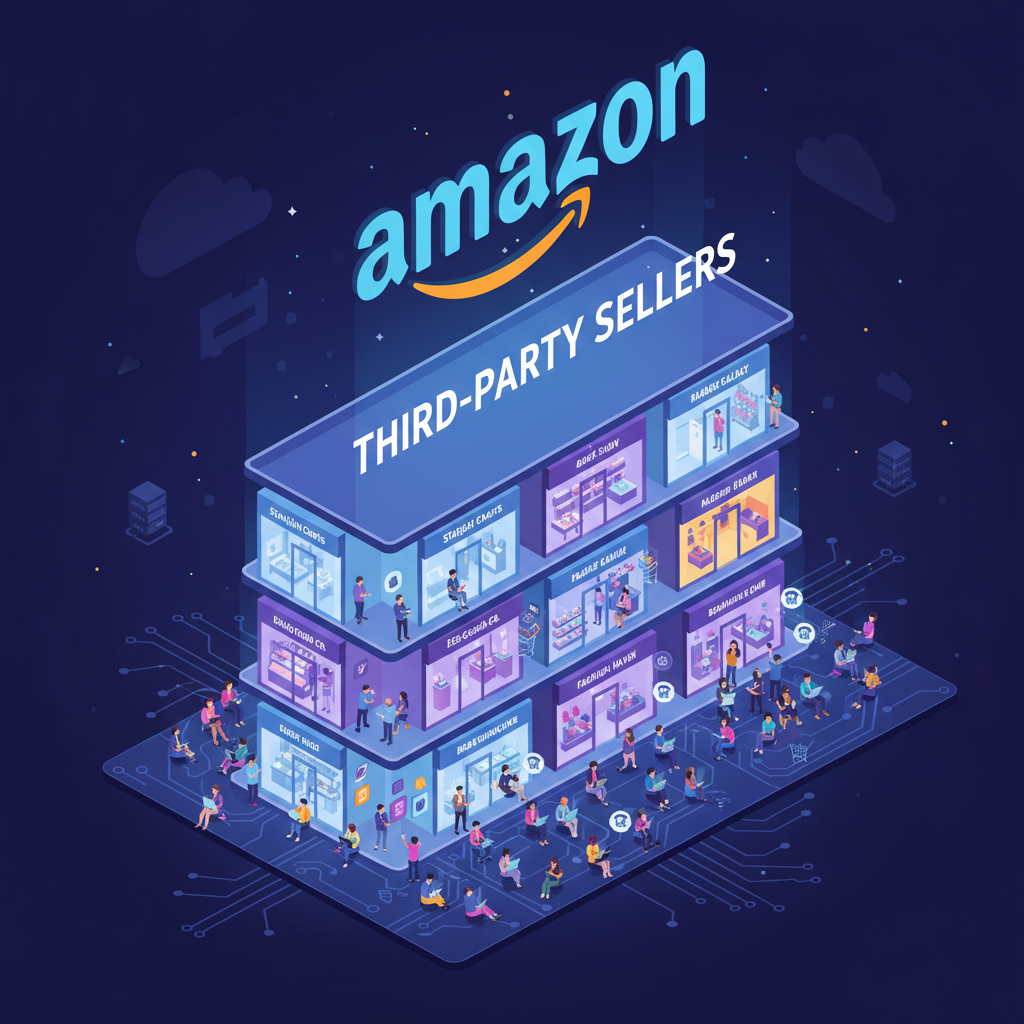
What Is Amazon Marketplace? A Beginner’s Guide for Sellers
Amazon Marketplace is the engine behind most of what you see when you shop on Amazon — the third‑party sellers, brands, and side hustlers quietly running real businesses behind that innocent little “Add to Cart” button.
What Is Amazon Marketplace? A Complete Beginner’s Guide
You know how you go on Amazon to buy “just one thing,” and suddenly it’s 45 minutes later, your cart has 13 items, and you have no memory of how a banana slicer got in there?
Plot twist: a huge chunk of that stuff isn’t even sold by Amazon itself.
If you’ve ever seen “Sold by [Store Name] and Fulfilled by Amazon,” congratulations: you’ve already met Amazon Marketplace — you just didn’t get formally introduced because Amazon is bad at small talk.
This beginner‑friendly guide explains what’s going on behind that Add to Cart button, how Amazon Marketplace sellers actually work, and what it means if you want to sell on Amazon yourself.
Amazon Marketplace in Plain English
Think of Amazon in two modes:
- Mode 1: Classic retailer – Amazon buys products from brands, stocks them, and sells them directly to you.
- Mode 2: Massive online mall – Amazon lets independent third‑party sellers set up shop and sell to you using Amazon’s website, payments, and often shipping.
Mode 2 is Amazon Marketplace.
On the Amazon Marketplace platform, independent sellers can:
- List products on Amazon’s website
- Use Amazon’s checkout and payment system
- Optionally use Amazon’s warehouses and shipping through Fulfillment by Amazon (FBA)
- Reach Amazon’s ridiculously large global customer base
When you buy on Amazon, your order typically falls into one of these buckets:
- Amazon Retail (1P)
– Amazon is the actual seller.
– You’ll see: “Ships from and sold by Amazon.com.”
– Old‑school retail vibes. - Marketplace Sellers (3P)
– Independent Amazon Marketplace sellers sell directly to you, using Amazon as the platform.
– You’ll see things like:- “Sold by [Brand Name] and Fulfilled by Amazon”
- “Ships from and sold by [Seller Store Name]”
These third‑party (3P) sellers are Amazon Marketplace.
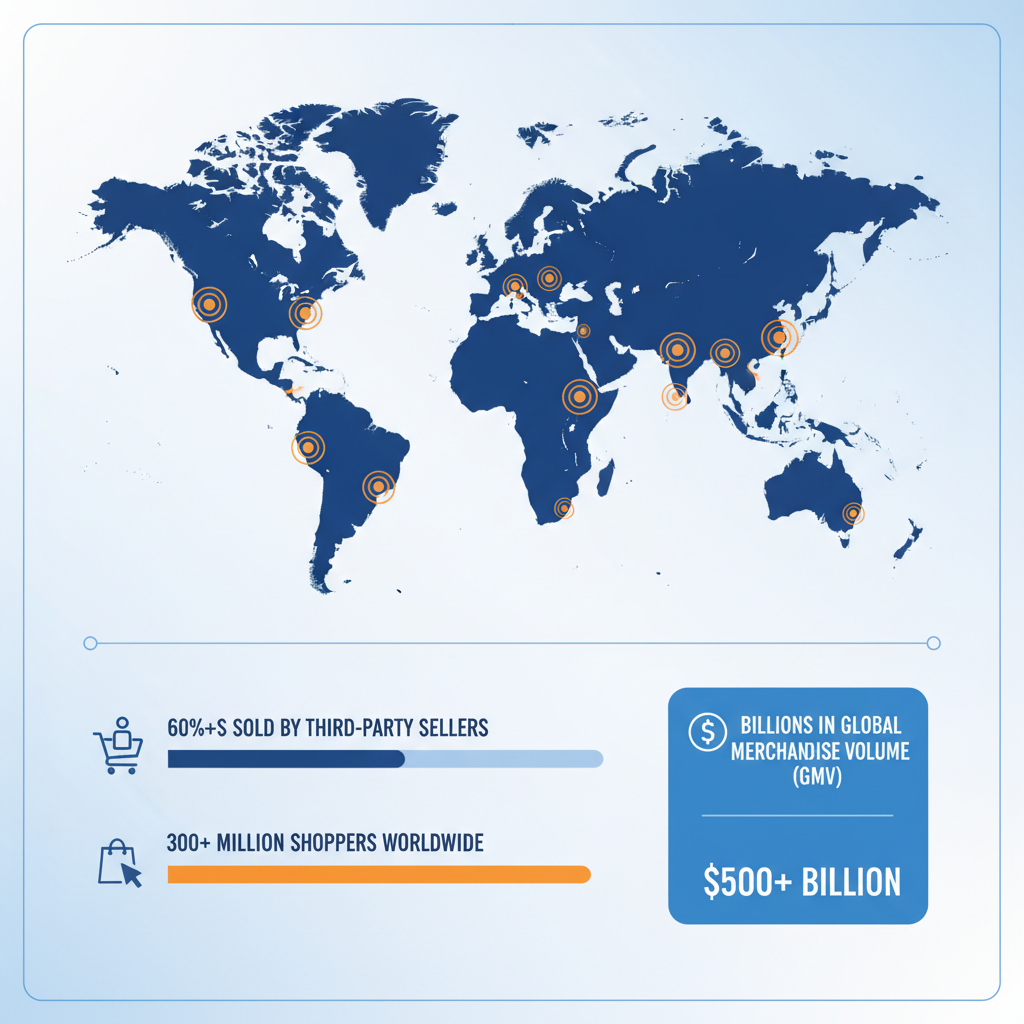
And they’re not some tiny side project. As of 2025, over 60% of all units sold on Amazon come from Marketplace sellers, not Amazon Retail. If you’re exploring how to start selling on Amazon, this is the ecosystem you’re joining.

How Big Is Amazon Marketplace?
To understand why so many people want to sell on Amazon Marketplace, it helps to see the scale:
- Around 9.7 million registered sellers worldwide
- Roughly 1.9–2 million active sellers currently listing and shipping products
- Third‑party sellers account for about 60–62% of Amazon’s unit sales
- Marketplace sellers moved an estimated $480 billion in merchandise in 2023
- Over 300 million shoppers buy at least once a year from Amazon Marketplace sellers
Translation: when you “buy on Amazon,” there’s a very good chance you’re actually buying from:
- A mom‑and‑pop shop
- A side hustler with a garage full of boxes
- A full‑blown brand that’s quietly doing 7 figures behind the scenes
Amazon is basically the shopping mall, landlord, security, and cashier — all rolled into one very large, very data‑obsessed entity.
Who Are the Sellers on Amazon Marketplace?
The cast of characters on Amazon Marketplace is… diverse. If you’re wondering whether you can become an Amazon Marketplace seller, you probably fit one of these types:
- Side hustlers & solo sellers
Importing a handful of products, working nights and weekends, explaining to relatives that no, they do not “work for Amazon.” - Small & medium‑sized businesses (SMBs)
Using Amazon Marketplace to reach national or global customers without opening 43 physical locations and crying over commercial leases. - Direct‑to‑consumer (DTC) brands
Treating Amazon as one major sales channel alongside their own website. - Big brands & manufacturers
Selling directly to consumers instead of (or in addition to) going through distributors.
On average, successful Amazon Marketplace sellers land somewhere around $230,000–$290,000 in annual revenue, with tens of thousands crossing $1 million+.
But — and this is a big but — the distribution is very skewed:
- Many sellers: under $1,000/month
- A smaller group: 6‑, 7‑, even 8‑figure annual revenue
It’s less “everyone gets rich” and more “some people crush it, many people dabble, a bunch flame out.” Understanding this reality is key if you’re serious about how to sell on Amazon as a real business.
How Selling Works on Amazon Marketplace
Here’s the basic flow of how to sell on Amazon Marketplace, minus the panic and 37 browser tabs.
Step 1: Create a Seller Central Account
You start with Amazon Seller Central — the control panel of your future stress.
Two main plan options:
- Individual plan
– No monthly fee
– Higher per‑item fee
– Good if you’re just testing the waters or selling a very small volume. - Professional plan
– Flat monthly subscription
– Lower per‑item fee
– Unlocks key features: ads, bulk tools, reports, APIs, etc.
– This is what most serious Amazon Marketplace sellers use.
If your goal is to actually scale and build an Amazon business, the Professional plan is usually the way to go.
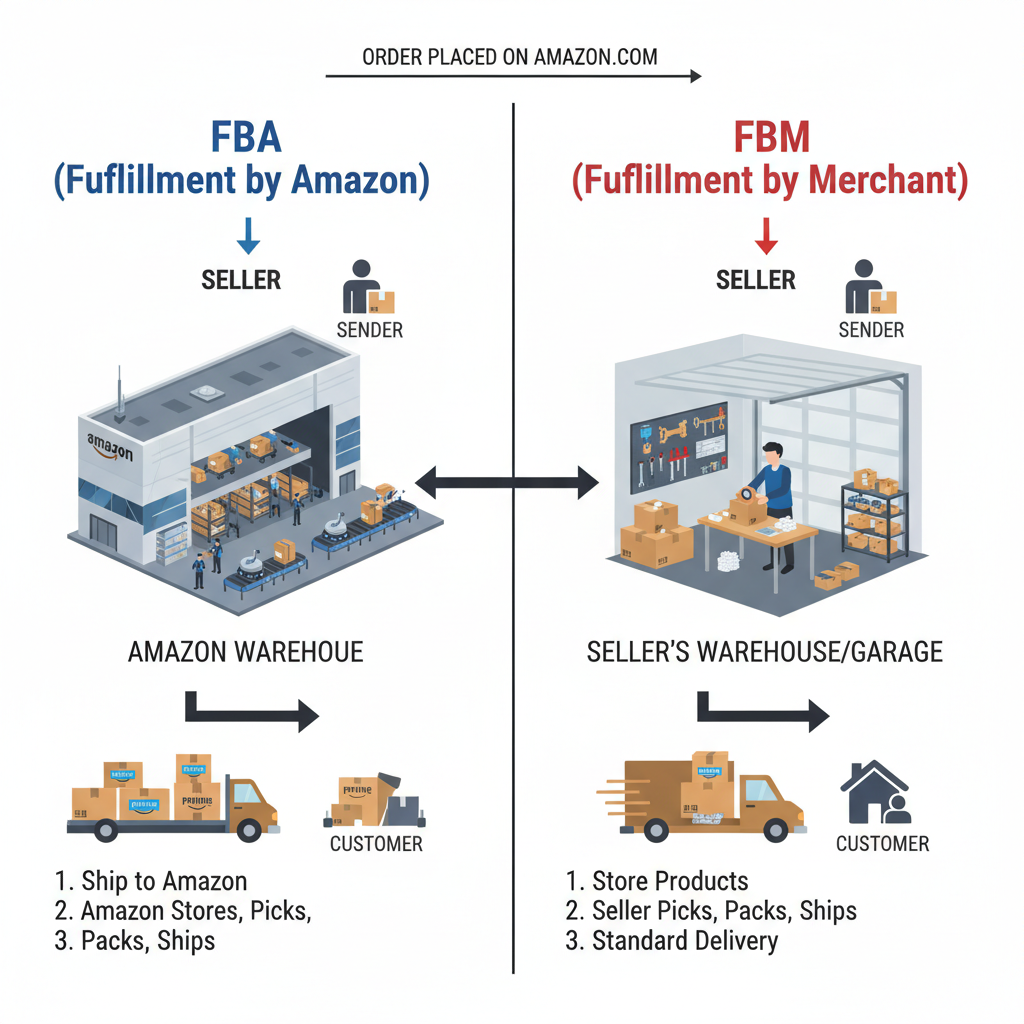
Step 2: Choose a Fulfillment Method (FBA vs. FBM)
“Fulfillment” = who stores, packs, and ships your stuff… and deals with the “my package is late where is it I’m telling my lawyer” emails.
Two big models for Amazon Marketplace fulfillment:
Fulfillment by Amazon (FBA)
You send inventory to Amazon’s warehouses. Amazon:
- Stores your products
- Picks, packs, and ships orders
- Handles customer service and most returns
For shoppers, FBA items often show the Prime badge, which might as well be a “please buy me now” button.
Why sellers love FBA when they sell on Amazon:
- Prime eligibility = higher trust and better conversion
- Less hands‑on shipping chaos
- Amazon handles a lot of customer interaction
Around 80%+ of active sellers use FBA in some way. Because outsourcing your headaches is a beautiful thing.
Fulfilled by Merchant (FBM)
With FBM, you (or your 3PL/warehouse partner):
- Store your inventory
- Ship orders to customers
- Handle customer service and returns
FBM can be smart for:
- Oversized items
- Slow‑moving products
- Very low‑margin items
- Sellers who want more control over their Amazon shipping and handling
Many businesses use a hybrid approach:
FBA for fast movers, FBM for bulky, weird, or niche products.
Step 3: Create Product Listings
No listing = no sales = just vibes.
Every product you sell on Amazon needs:
- Title, bullet points, and description
- Images (and ideally videos)
- Price and variations (size, color, etc.)
- Keywords and backend search terms
Two main scenarios:
- Existing product in Amazon’s catalog
– You “attach” to that listing.
– You’re now competing with other Marketplace sellers on:- Price
- Stock availability
- Performance metrics
- Unique product
– You create a new listing and get your own ASIN (Amazon’s unique product ID).
– You control the content, but you also have to do all the heavy lifting to get traffic with solid Amazon SEO and advertising.
Step 4: Drive Traffic and Sales
Listing live? Great. Now you need eyeballs.
Main traffic sources on Amazon Marketplace:
- Organic Amazon search (SEO for Amazon)
– Good titles and keywords
– Strong click‑through and conversion rates
– Good reviews - Amazon Ads
– Sponsored Products, Sponsored Brands, display ads
– Pay‑per‑click to get visibility, especially early on - External traffic
– Social media and influencers
– Email lists
– Google/Meta ads
– Blog content driving people to your Amazon listings
Since most shoppers never go past page 1 of Amazon search results, ranking well is everything. High‑performing listings with good reviews and competitive prices tend to float to the top — which is why Amazon SEO matters so much when you’re learning how to sell on Amazon Marketplace.
How Amazon Makes Money from Marketplace
Amazon doesn’t just love Marketplace because it’s cute.
Marketplace is a service business more than a retail business.
Amazon earns from:
- Referral fees
– A percentage of each sale (often 8–15% depending on category). - FBA fees
– Storage, fulfillment, and handling fees. - Subscription fees
– Monthly Professional seller plans. - Advertising
– Sponsored ads are a massive and rapidly growing revenue stream.
In 2024, Amazon pulled in $150+ billion from third‑party seller services alone — and this segment is growing faster than some of its traditional retail operations. The mall makes more money renting the stores and selling the billboards than selling shoes itself.
Understanding these Amazon Marketplace fees is crucial if you want profitable products instead of just sales screenshots.
Benefits of Amazon Marketplace (For Sellers)
Why do millions of businesses willingly sign up for this circus and start selling on Amazon?
1. Instant Access to a Huge Customer Base
Amazon has hundreds of millions of active customers. Many people start their product search there instead of Google.
Listing on Amazon Marketplace = plugging directly into existing demand instead of begging the algorithm gods to notice your brand‑new website.
2. Built‑In Trust and Conversion Boosts
Customers already trust:
- Amazon’s payment system
- Shipping (especially Prime)
- Returns and customer service
As a seller, you’re basically borrowing Amazon’s reputation.
Slap a Prime badge on your listing and suddenly you look like a serious, established brand… even if your “office” is half a dining table and a highly judgmental cat.
3. World‑Class Logistics
With FBA, you can:
- Offer 2‑day or even next‑day shipping
- Reach massive geographic areas
- Skip building your own logistics network
A one‑person business can appear as fast and reliable as a huge retailer. The customer doesn’t know you’re shipping in your pajamas. Nor do they care.
4. Scalable Infrastructure
Amazon hands you:
- Listing tools
- Automatic tax collection in many regions
- Payment processing
- Fraud protection
- Data and analytics
So you can obsess over:
- Products
- Pricing
- Branding
- Advertising
instead of reinventing checkout flows, tax rules, and shipping labels from scratch.
Downsides and Challenges of Amazon Marketplace
Now for the part where the dream sequence fades a little.
1. Intense Competition
Because the barrier to entry is relatively low, many categories on Amazon Marketplace are absolute warzones.
You might be up against:
- Dozens or hundreds of lookalike products
- Big brands with big ad budgets
- Overseas manufacturers who can undercut you on price
To survive, you usually need:
- Real differentiation (features, quality, brand, bundle, niche focus)
- Strong content (images, copy, video)
- Smart ad strategy and solid Amazon SEO
Just tossing up another generic item and hoping? That’s the Amazon equivalent of a wish and a prayer.
2. Fees Add Up
Your income statement on Amazon might look like:
- Revenue
- – Referral fees
- – FBA storage & fulfillment
- – Advertising spend
- – Returns & promos
- – “Wait, where did my profit go?”
Many successful sellers aim for 15–30% net margins, but:
- Aggressive ad spend
- Poor product choice
- High returns
can nuke that quickly if you aren’t tracking the math closely.
3. Policy & Algorithm Changes
Amazon frequently updates:
- Search & ranking algorithms
- Content rules and listing standards
- Pricing and fair‑competition policies
- Safety and compliance requirements
A change can mean:
- Your rankings shift
- Your listings get flagged
- You suddenly need new documentation
Amazon has also been actively cleaning up the marketplace. One internal project, “Bend the Curve,” reportedly targeted tens of billions of low‑quality or underperforming listings for removal to improve the shopping experience.
Moral of the story: build a legit, quality‑focused operation, not a quick hack.
4. Risk of Account or Listing Suspensions
Amazon is obsessed with customer trust. As a result, it has strict rules on:
- Product authenticity
- Safety and compliance
- Shipping performance
- Customer service metrics
Mess up enough and you can face:
- Listing removals
- Account suspension
- Funds being temporarily frozen
Getting reinstated often requires a formal Plan of Action: what went wrong, what you fixed, and how you’ll prevent it in the future. It’s like writing apology essays, but for money.
Benefits of Amazon Marketplace (For Shoppers)
From the customer side (aka the people funding all this):
- Huge selection
Hundreds of millions of products — from mainstream brands to “who on earth invented this and why… but also I kind of want it.” - Competitive pricing
Multiple Amazon Marketplace sellers often compete on the same product, which can push prices down. - Fast, reliable shipping
Especially for Prime‑eligible items fulfilled by Amazon. - Protections and recourse
Shoppers can go through Amazon if something goes wrong, rather than tracking down some random email in another time zone.
The flip side: the scale opens the door to:
- Counterfeits
- Questionable quality
- Misleading listings
Regulators have been pressuring Amazon to clamp down, leading to stricter oversight and more aggressive purges of problematic listings.
Is Amazon Marketplace Right for Your Business?
Before you sprint to “Sign Up” and start your Amazon seller journey, it’s worth some brutally honest reflection.
1. Do You Have a Differentiated Product (or Can You Create One)?
If your big idea is “another generic phone charger but, like, cheaper”… it’s going to be rough.
You stand a better chance if you offer:
- A unique brand and packaging
- Better features or quality
- Smart bundles or kits
- Strong content (images, video, story, instructions)
In other words: why would someone pick you on a page full of almost identical products?
2. Can You Compete on Price After Fees?
Run the numbers like a responsible adult:
- Product cost (including shipping to you or Amazon)
- Referral fees
- FBA/storage/handling fees (if applicable)
- Advertising budget
- Expected returns/defects
Calculate your true net margin.
If your margin is already whisper‑thin before ads or discounts, that’s a red flag. Amazon tends to reward:
- Competitive pricing
- Strong performance
So you need enough room to play the Amazon Marketplace game.
3. Are You Willing to Learn Amazon’s Systems?
Winning on Amazon usually requires:
- Keyword research (for Amazon search, not just Google)
- Listing optimization (titles, bullets, images, A+ content)
- Review management and customer communication
- Ads: testing, refining, not panicking after 3 days
If you treat Amazon Marketplace as “set it and forget it,” it’ll probably treat you as “list it and ignore it.”
4. Is It Compatible with Your Brand Strategy?
Some brands worry that Amazon:
- Trains customers to prioritize “cheap”
- Makes it hard to build direct relationships with buyers
- Attracts unauthorized or grey‑market resellers
Others fully embrace Amazon as:
- The main sales channel for volume
- While using their own website for:
- Higher‑margin offers
- Brand storytelling
- Email list building
You don’t have to pick one or the other, but you should decide what role Amazon Marketplace plays in your overall strategy.
How to Get Started on Amazon Marketplace (High‑Level Checklist)
If you’re still here and not crying — impressive. Here’s the simple roadmap to start selling on Amazon.
- Research Your Niche
– Check demand and competition on Amazon.
– Study best‑seller lists and reviews to find gaps and complaints you can solve. - Source or Develop Your Product
– Work with manufacturers, wholesalers, or create your own product.
– Order and test samples before committing big money. - Set Up Your Seller Account
– Register on Amazon Seller Central.
– Choose Individual vs. Professional based on your goals and volume. - Choose Fulfillment Strategy
– FBA, FBM, or hybrid.
– Run the actual cost comparisons; FBA often converts better but isn’t always cheaper. - Create Optimized Listings
– Strong titles, bullet points, and images.
– Clear value proposition.
– Keywords that match how customers actually search on Amazon Marketplace. - Launch and Market
– Start with moderate Amazon Ads to get initial traction.
– Encourage honest reviews (while following Amazon’s rules like your life depends on it). - Measure, Improve, and Scale
– Track sessions, conversion rate, ad performance, and profit (not just revenue).
– Test changes to price, images, copy, and targeting.
– Double down on what works, prune what doesn’t.
Key Takeaways and Next Steps
- Amazon Marketplace = Amazon’s third‑party selling platform, where millions of independent sellers list products and sell directly to customers using Amazon’s infrastructure.
- Marketplace sellers now drive the majority of units sold on Amazon, moving hundreds of billions of dollars in merchandise annually.
- For sellers, Amazon Marketplace offers massive reach, trust, and logistics, but also intense competition, meaningful fees, and strict rules.
- For shoppers, it creates huge choice and competitive pricing, but forces Amazon to constantly fight counterfeits, fraud, and low‑quality listings.
If you want, I can help you with:
- Stress‑testing a specific product idea for Amazon Marketplace
- Breaking down the exact fees and profit margin on one of your products
- Writing a sample optimized listing (title, bullets, description, keywords) tailored to your niche so you’re not shouting into the void of page 7.
Leave a Reply